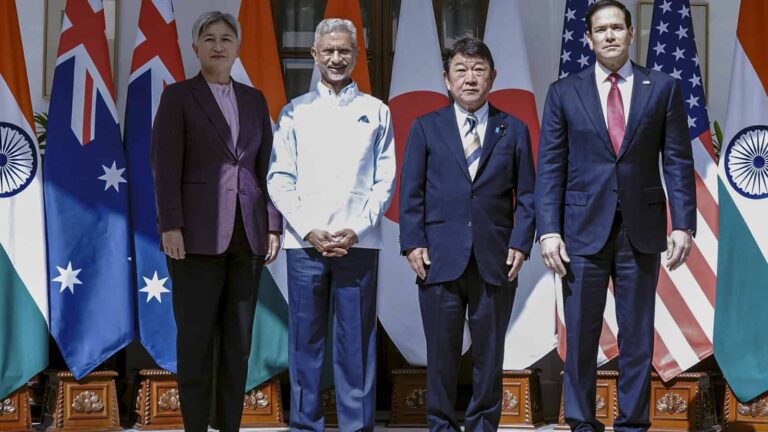
The Quad grouping on Tuesday expanded cooperation in critical minerals and energy while unveiling new measures to boost maritime surveillance and port infrastructure across the Indo-Pacific against the backdrop of China’s growing military posturing in the region.
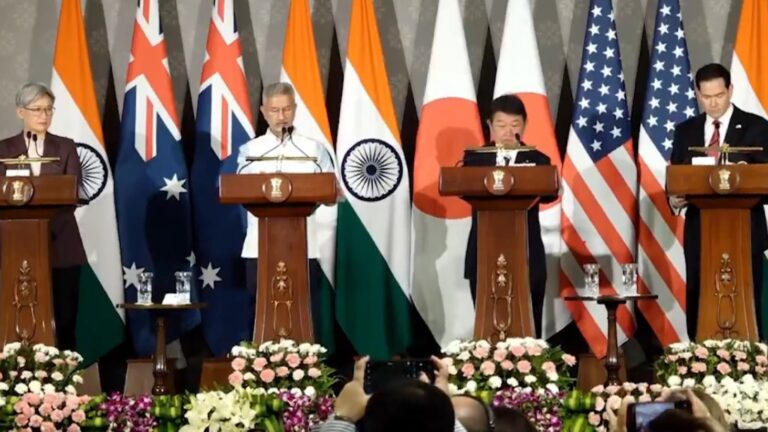
The new measures were announced following a meeting of the grouping’s foreign ministers in New Delhi. The meeting was chaired by External Affairs Minister S Jaishankar and attended by US Secretary of State Marco Rubio, Australian Foreign Minister Penny Wong and Japanese Foreign Minister Toshimitsu Motegi.
In his media statement, Jaishankar announced a critical minerals framework and an Indo-Pacific energy security initiative under the broader Quad agenda to confront major challenges facing the region.
“Much of the discussions and indeed the bilateral exchanges were devoted to the current state of the world,” Jaishankar said at the end of the meeting.
Naturally, the focus of the deliberations was on issues of relevance to the Indo-Pacific, he said.
“Because we are four maritime democracies located at different ends of the Indo-Pacific, the exchange of perspectives was an exercise of considerable value.”
“We spent some time on the question of safe and unimpeded maritime commerce and reaffirmed the significance of scrupulously observing international law,” the minister said.
“Much of the discussions and indeed the bilateral exchanges were devoted to the current state of the world,” Jaishankar said at the end of the meeting.
Naturally, the focus of the deliberations was on issues of relevance to the Indo-Pacific, he said.
“Because we are four maritime democracies located at different ends of the Indo-Pacific, the exchange of perspectives was an exercise of considerable value.”
“We spent some time on the question of safe and unimpeded maritime commerce and reaffirmed the significance of scrupulously observing international law,” the minister said.
Jaishankar said a free and open Indo-Pacific has many dimensions and facets and the Quad meeting took stock of the progress in many of them.
We believe strongly that economic resilience should be promoted and supply chains should be strengthened, he noted, adding that the deliberations also touched upon current energy and fertiliser availability and that of critical minerals.
“In the coming days, whether it is economic activity, energy trade or maritime commerce, the Indo-Pacific will become even more important to the world. The responsibilities of the Quad will grow commensurately, and we must prepare for that,” he said.
We believe strongly that economic resilience should be promoted and supply chains should be strengthened, he noted, adding that the deliberations also touched upon current energy and fertiliser availability and that of critical minerals.
“In the coming days, whether it is economic activity, energy trade or maritime commerce, the Indo-Pacific will become even more important to the world. The responsibilities of the Quad will grow commensurately, and we must prepare for that,” he said.
Countering the common threat of terrorism also figured in the talks, the external affairs minister said.
“There must be zero tolerance for terrorism, and nations subject to terrorist attacks have the right to defend themselves,” he said.
“There must be zero tolerance for terrorism, and nations subject to terrorist attacks have the right to defend themselves,” he said.
In his media statement, US Secretary of State Rubio said the Quad meeting decided to launch an Indo-Pacific Maritime Surveillance Cooperation
Initiative It will leverage each of our country’s maritime surveillance capabilities in the Indo-Pacific, he said.
Rubio also announced expansion of the Indo-Pacific Maritime Domain Awareness Initiative among the Quad nations.
Rubio also announced expansion of the Indo-Pacific Maritime Domain Awareness Initiative among the Quad nations.
“We’re announcing plans to work with Fiji to advance that country’s port infrastructure. It’ll be the first time that the Quad partners work together on a port infrastructure project,” he said.
Australian Foreign Minister Wong said the Quad recognised efforts towards a diplomatic resolution to ensure freedom of navigation in the Strait of Hormuz.
“We recognised the importance of maintaining the principle of freedom of navigation and our opposition to any tolling proposition,” she said, referring to Iran’s plan to demand fees for transiting the Strait.
We are working together to strengthen cooperation against scam centres, particularly in Southeast Asia, Wong said.
The Australian foreign minister said the Quad will be coordinating on maritime surveillance efforts initially in the Indian Ocean. (Agencies)
Australian Foreign Minister Wong said the Quad recognised efforts towards a diplomatic resolution to ensure freedom of navigation in the Strait of Hormuz.
“We recognised the importance of maintaining the principle of freedom of navigation and our opposition to any tolling proposition,” she said, referring to Iran’s plan to demand fees for transiting the Strait.
We are working together to strengthen cooperation against scam centres, particularly in Southeast Asia, Wong said.
The Australian foreign minister said the Quad will be coordinating on maritime surveillance efforts initially in the Indian Ocean. (Agencies)