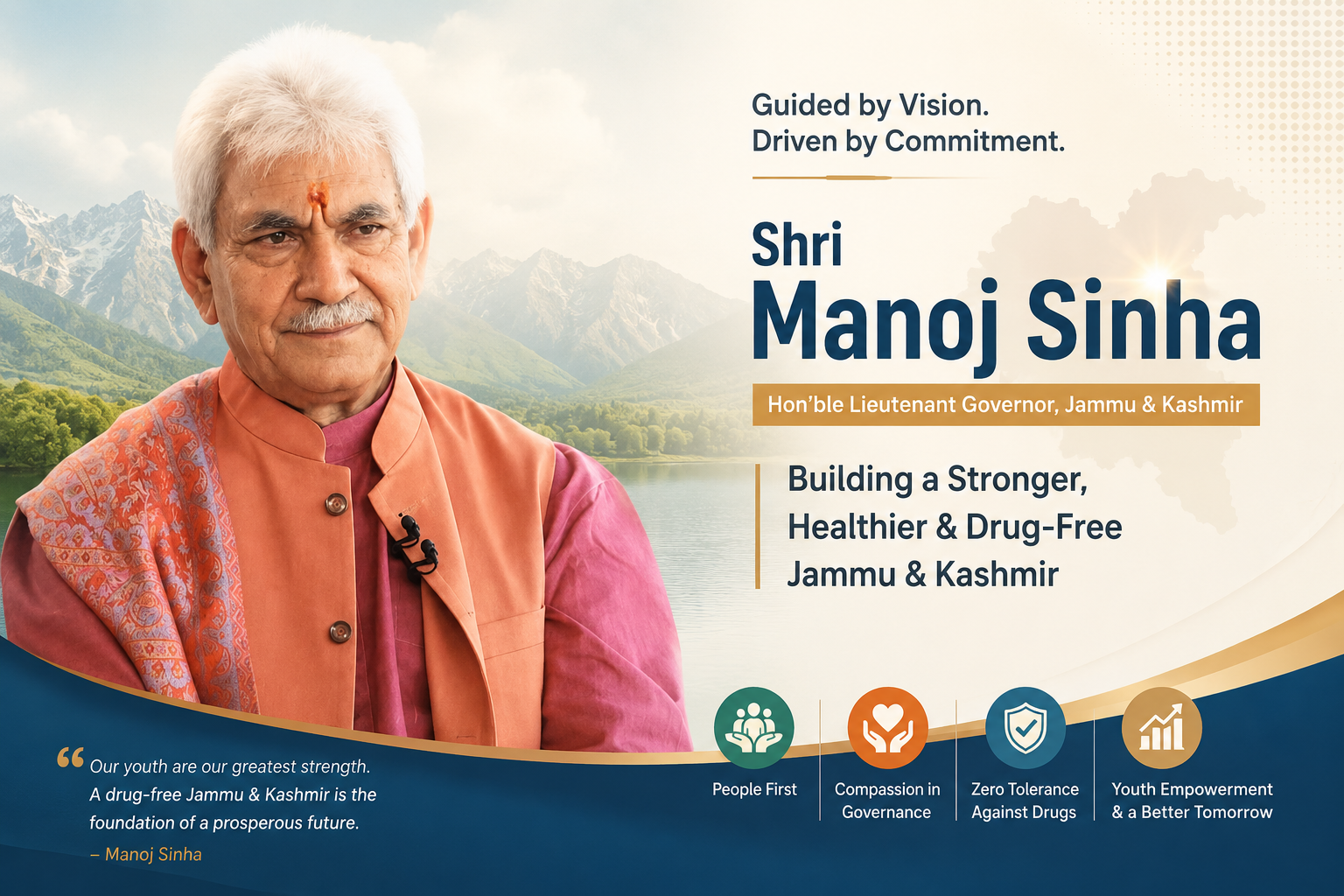
At a time when societies across the country are grappling with the complex and deeply corrosive challenge of substance abuse, Jammu and Kashmir has, in recent months, witnessed an unusually focused and determined response from its administration. At the centre of this effort stands the Hon’ble Lieutenant Governor, Shri Manoj Sinha, whose sustained leadership under the Nasha Mukt Jammu & Kashmir Abhiyaan has brought a sense of seriousness to an issue that for years had quietly hollowed families, neighbourhoods, and communities across the Union Territory.
Drug addiction is not merely a law-and-order challenge; it is a social crisis that gradually erodes the moral and emotional foundations of society. In Jammu and Kashmir, where aspirations of peace, progress, and stability remain deeply cherished, the growing prevalence of narcotics among sections of youth had emerged as a matter of profound concern. What distinguishes the present moment, however, is the unmistakable message that the administration is no longer willing to treat this menace as a peripheral issue.
Under Shri Manoj Sinha’s stewardship, the campaign against narcotics has acquired both administrative urgency and public visibility. His participation in anti-drug marches, outreach programmes, and awareness drives across districts has not merely served symbolic value; it has communicated institutional intent. Equally significant has been the coordinated response involving law enforcement agencies, civil administration, educational institutions, and community stakeholders—an acknowledgment that a challenge of this magnitude cannot be addressed through policing alone.
For many residents of Jammu and Kashmir, this marks a notable shift in governance. Across urban centres and rural belts alike, there is a growing sentiment that, perhaps for the first time in recent memory, the fight against drug abuse is being pursued with sustained seriousness. The administration’s visible resolve, reinforced by intensified police action against peddlers and trafficking networks, has instilled cautious optimism among families who have long feared for the future of their children.
Public policy, particularly on matters as sensitive and socially entrenched as addiction, is often judged not only by outcomes but also by intent and consistency. In this regard, Shri Manoj Sinha’s approach has resonated widely because it reflects both firmness and empathy: firmness against those profiting from the destruction of lives, and empathy towards families seeking rehabilitation and hope.
Jammu and Kashmir’s journey towards becoming drug-free will undoubtedly remain long and demanding. Yet, leadership matters in shaping public confidence. The Hon’ble Lieutenant Governor’s strong commitment to this cause has ensured that the fight against narcotics is no longer an episodic concern, but a collective mission—one that many households today openly acknowledge and appreciate as essential to safeguarding the future of the region’s youth
Jammu
Hon’ble Sinha’s Steadfast Resolve Against Drug Abuse Offers Jammu & Kashmir a Renewed Sense of Hope