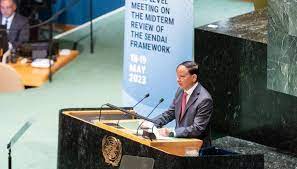
United Nations, May 19: India has emphasized its commitment to disaster risk reduction initiatives during its address to the UN General Assembly. P.K. Mishra, Principal Secretary to Prime Minister Narendra Modi, stated that India considers disaster risk reduction a central public policy issue and is actively developing ambitious mitigation programs to reduce losses from various hazards, including landslides, floods, earthquakes, heat waves, and lightning.
Speaking at the Midterm Review of the Sendai Framework for Disaster Risk Reduction (2015-2030), Mishra highlighted India’s increased funding for disaster risk reduction and significant changes in its financing architecture to support all aspects of disaster risk management. He mentioned that India’s state and local governments have access to approximately USD 6 billion for disaster risk mitigation over five years, in addition to USD 23 billion allocated for preparedness, response, and recovery efforts.
Mishra also highlighted India’s achievements in reducing the loss of lives from cyclones to less than 2% over a decade. He mentioned that India is currently focusing on developing ambitious mitigation programs for a range of hazards, including glacial lake outburst floods, earthquakes, forest fires, heat waves, and lightning.
Referring to the “Coalition for Disaster Resilient Infrastructure,” co-led by India and the United States, Mishra underscored the transformation it brings to infrastructure planning, design, construction, and maintenance in the 21st century. He emphasized that infrastructure investments, guided by robust risk assessments and effective risk governance, can contribute to long-term resilience.
Mishra highlighted India’s efforts to improve early warning systems, including the implementation of the Common Alerting Protocol to disseminate geo-targeted alerts in regional languages to reach every citizen. He commended UN Secretary-General Antonio Guterres’s initiative on “Early Warning for All by 2027” and expressed India’s commitment to achieving this global target.
During his address, Mishra also emphasized India’s commitment to global cooperation and assistance in times of crisis. He mentioned India’s immediate support to Turkey and Syria following the devastating earthquake, demonstrating India’s human-centric approach to global development.
The Midterm Review of the Sendai Framework for Disaster Risk Reduction provides an opportunity for member states, UN system partners, and stakeholders to reflect on the progress made since 2015 and identify new initiatives to effectively address systemic risks and achieve the goals of the Sendai Framework, the 2030 Agenda for Sustainable Development, the Paris Agreement, and other relevant agreements.
President of the 77th session of the General Assembly, Csaba Korosi, acknowledged the need to accelerate global progress in disaster risk reduction, particularly in the face of the challenges posed by the COVID-19 pandemic, conflicts, and climate change. He emphasized the importance of anticipating risks, preparing, responding rapidly, and incorporating lessons learned into future action plans.
The UN General Assembly’s plenary session heard from a survivor of the recent devastating earthquake in Turkey, shedding light on the urgent need for comprehensive disaster risk reduction efforts worldwide.