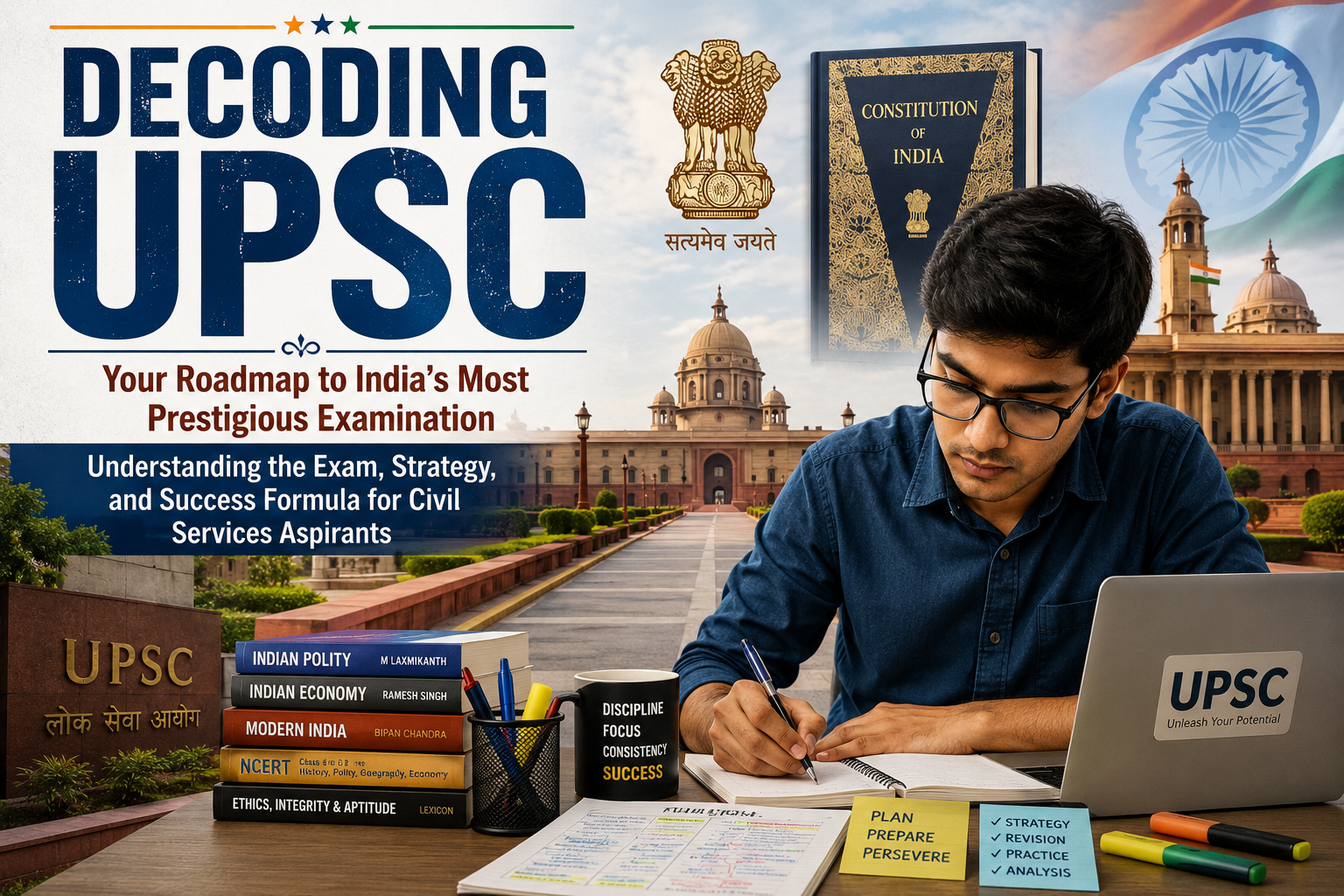
Every year, lakhs of young Indians dream of serving the nation through the prestigious Civil Services Examination (CSE) conducted by the Union Public Service Commission. Yet, only a small percentage succeed. The reason is not merely the vast syllabus but the need for a strategic, disciplined, and analytical approach.
What is UPSC?
The Civil Services Examination is the gateway to some of India’s most respected services, including:
- Indian Administrative Service (IAS)
- Indian Police Service (IPS)
- Indian Foreign Service (IFS)
- Indian Revenue Service (IRS)
- Other Group A and Group B Central Services
Civil servants play a crucial role in governance, policy implementation, law and order, diplomacy, taxation, and public administration.
The Three Stages of UPSC
1. Preliminary Examination
The first hurdle consists of two objective papers:
- General Studies Paper-I
- CSAT (Civil Services Aptitude Test)
The Preliminary Examination serves as a screening test. Marks obtained here are not counted in the final merit list.
2. Main Examination
The Mains Examination is the real test of knowledge, analysis, and writing ability.
It includes:
- Essay Paper
- Four General Studies Papers
- Two Optional Subject Papers
- Language Papers
Success in Mains depends largely on answer-writing skills and conceptual clarity.
3. Personality Test (Interview)
Conducted in New Delhi, the interview evaluates:
- Personality
- Decision-making ability
- Leadership qualities
- Awareness of national and international issues
- Ethical judgment
The board assesses whether a candidate possesses the temperament required for public service.
Why Do Most Aspirants Fail?
Many candidates spend years preparing but struggle because of:
- Lack of a proper study plan
- Excessive dependence on coaching
- Ignoring current affairs
- Poor answer-writing practice
- Inconsistent revision
- Following too many study materials
UPSC rewards depth of understanding, not the number of books completed.
The Golden Strategy
Read Less, Revise More
Successful candidates often revise the same sources multiple times rather than collecting dozens of books.
Focus on Current Affairs
Newspapers, government reports, economic surveys, and international developments form the backbone of preparation.
Practice Answer Writing Daily
Knowledge without presentation seldom fetches high marks.
Build Analytical Thinking
UPSC does not ask what happened; it asks why it happened, its impact, and possible solutions.
Is UPSC Only for Toppers?
Absolutely not.
UPSC has repeatedly proven that success depends more on perseverance, discipline, and smart preparation than on academic brilliance. Candidates from villages, small towns, government schools, and diverse educational backgrounds have secured top ranks.
Final Word
UPSC is not merely an examination; it is a journey of personal transformation. It teaches discipline, patience, awareness, and a deeper understanding of India and its governance systems. For those willing to dedicate themselves wholeheartedly, the examination offers an opportunity to contribute directly to nation-building.
Remember: The goal is not to study everything. The goal is to understand what matters, revise it consistently, and present it effectively when it counts.
“Dreams become reality when preparation meets persistence.”