
JAMMU, Oct 29: The Meteorological (MeT) department on Saturday forecast mainly dry weather and hazy morning in Jammu and Kashmir during the next 24 hours.
“Dry weather with hazy morning is likely to continue in J&K during the next 24 hours”, said an official of the MeT department.
Meanwhile, Srinagar recorded 2.6 degrees Celsius, Pahalgam minus 0.7 degree and Gulmarg 2.2 degrees as the minimum temperature this morning.
Drass town in Ladakh region clocked minus 4.9 degree, Kargil minus 1.8 and Leh minus 3.5 as, while Jammu registered 16 degrees, Katra 13.7, Batote 7.6, Banihal 4.6 and Bhaderwah 5.6. (Agencies)
Mainly dry weather likely in J&K during next 24 hrs: MeT

“Threat of terrorism is growing…” Jaishankar at top UN counter-terror meet
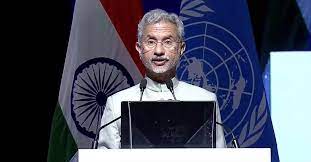
New Delhi, October 29: External Affairs Minister S Jaishankar on Saturday highlighted the global threat of terrorism is growing and expanding, particularly in Asia and Africa, despite the UN Security Council’s (UNSC) best efforts to combat the “gravest threat to humanity”.
Addressing the UNSC’s special meeting of the Counter-Terrorism Committee in the national capital, Jaishankar said, “Terrorism remains the gravest threat to humanity. The UN Security Council in the past two decades has evolved an important architecture built, primarily around the counter-terrorism sanctions regime to combat this menace. This has been very effective in putting the countries on notice that had turned terrorism into a state funded enterprise.”
“Despite this, the threat of terrorism is only growing and expanding, particularly in Asia and Africa, as successive reports of 1267 sanctions committee monitoring reports have highlighted,” he added.
India is hosting the two-day anti-terrorism meeting of the United Nations Security Council (UNSC). The ongoing meeting in Delhi is being held under India’s chair of the Counter-Terrorism Committee (CTC).
Jaishnkar told CTC members that their presence in Delhi at the special meeting demonstrates the importance that the UNSC member states and a wide range of stakeholders, place on this critical and emerging facet of terrorism.
“That the council is holding this special meeting of its counter-terrorism meetings in India, is also a product of the fact that counterterrorism has become one of the top priorities during our ongoing tenure in the security council,” he added.
Highlighting the flip sides of emerging technologies, Jaishnakar said technologies like virtual private network, encrypted message services and blockchains, have also thrown up new challenges for governments and regulatory bodies.
“The technologies have also thrown up new challenges for governments and regulatory bodies due to their potential vulnerability for their misuse by non-state actors, given the very nature of some of these technologies and the nascent regulatory environment,” the minister said.
“In recent years, terrorist groups, ideological fellow travellers particularly in open and liberal societies and lone wolf attackers have enhanced their capabilities by gaining access to tech. They use tech, money and ethos of open societies to attack freedom, tolerance and progress,” he added.
Furthermore, Jaishankar said internet and social media platforms have turned into potent instruments in the toolkit of terrorists and militant groups for spreading propaganda, radicalisation and conspiracy theories aimed at destabilising societies.
“Another add-on to the existing worries for governments around the world is the use of unmanned aerial systems by terrorist groups and organised criminal networks,” he added.
Lastly, Jaishankar announced that India will be making a voluntary contribution of half a million dollars to the UN Trust Fund for Counter Terrorism this year to augment the efforts of UNOCT in providing capacity-building support to member states
Active Covid Cases Dip to 18,802

New Delhi, Oct 29: With 1,574 people testing positive for the coronavirus infection, India’s tally of COVID-19 cases rose to 4,46,50,662, while the active cases declined to 18,802, according to the Union Health Ministry data updated on Saturday.
A decrease of 596 cases has been recorded in the active covid caseload in a span of 24 hours, the data updated at 8 am stated.
The death toll has climbed to 5,29,008 with nine fatalities which includes five reconciled by Kerala, while one death each has been reported from Chhattisgarh, Gujarat, Haryana and Maharashtra. it said.
The active cases comprises 0.04 per cent of the total infections, while the national COVID-19 recovery rate has increased to 98.77 per cent, the health ministry said.
The daily positivity rate was recorded at 0.95 per cent and the weekly positivity rate was recorded at 1.11 per cent, according to the health ministry.
The number of people who have recuperated from the disease surged to 4,41,02,852, while the case fatality rate was recorded at 1.18 per cent.
According to the ministry, 219.62 crore doses of covid vaccine have been administered in the country so far under the nationwide COVID-19 vaccination drive.
State Home Ministers’ ‘Chintan Shivir’ concludes with commitment to move towards thematic approach
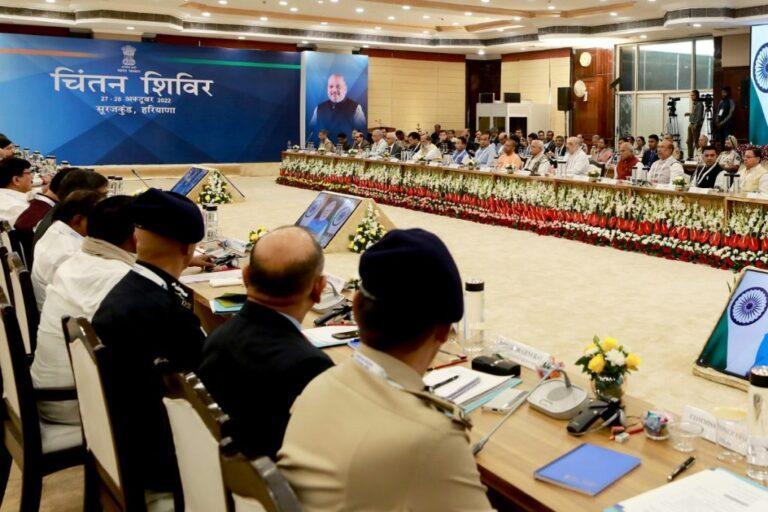
The first-ever such meeting organised on Thursday under the chairmanship of Union Home Minister Amit Shah also emphasised focusing on “cybercrime, improving conviction rates, narcotics and border security”. As the meeting concluded on Friday evening, top sources in the Ministry of Home Affairs said, the Home Minister suggested ” we (all states and the Centre) should move towards thematic approach”.
To achieve a 90 per cent conviction rate target, the states were also advised to focus on forensic sciences which play a big role.
Noting that “internal security is shared responsibility of both Centre and states”, it was decided jointly to work with the spirit of “Team India”.
All states were also advised to “constantly and annually” review goals and have a plan where their internal security will be in 2047.
The states were also advised to hold regular meetings of Narco Coordination Centre (NCORD).
In the meeting it was also mentiined that “Bihar and Jharkhand have became free from naxalism”, and that 9,200 North East militants surrendered arms in last eight years.
Besides, it was also pointed out that development taking place in North East and areas under Armed Forces (Special Powers) Act (AFSPA) have been reduced.
It was also mentiined that North East, Jammu and Kashmir and Left Wing Extremism (LWE) or naxalism are areas where Prime Minister Narendra Modi led Central government has achieved unprecedented success.
The ‘Chintan Shivir’ was attended by Governor of Punjab; 10 Chief Ministers from Uttar Pradesh, Assam, Goa, Haryana, Kerala, Manipur, Punjab, Sikkim, Tripura and Uttarakhand; Deputy Chief Ministers of Maharashtra and Nagaland; Lieutenant Governors of Ladakh as well as Jammu and Kashmir.
Home Ministers of Arunachal Pradesh, Andhra Pradesh, Chhattisgarh, Gujarat, Haryana, Karnataka, Meghalaya, Madhya Pradesh, Odisha, Puducherry and Rajasthan as well as Finance Minister of Jharkhand also atttended the event.
Development of eco-system for cyber crime management, modernization of police forces, increase in usage of IT in criminal justice system, land border management and coastal security and other internal security issues were also key focus areas of the event which has the objective to prepare an action plan for the implementation of ‘vision 2047’ and ‘Panch Pran’ announced in the Independence Day speech of Prime Minister Narendra Modi.
Speaking at the inaugural session of the event, the Home Minister on Thursday had said that the initiative of the ‘Chintan Shivir’ was taken by current Prime Minister and former Chief Minister of Gujarat Narendra Modi.
Shah said both Centre and States can fight against cross-border crime when all states will jointly plan and take steps accordingly.
The Minister said that the ‘Chintan Shivir’ will help formulate a joint plan to deal with crimes and other issues.
The aim of the conference was also to facilitate national policy-making and better planning and coordination. Various topics were also discussed in the six sessions of the ‘Chintan Shivir’.
Many important issues such as Home Guards, Civil Defense, Fire Protection and Enemy Property was also discussed with focus on cyber security, drug trafficking, women’s safety and border management.
IndiGo plane bound to Bengaluru catches fire before take-off in Delhi

An IndiGo plane declared an emergency at the Delhi airport on Friday after one of its engines caught fire. The fire aroused in its engine, while it was at full speed on the runway at the time of taxiing, and sparks appeared “just before take-off”.
The Bengaluru-bound A320 aircraft had 184 people on board out of which 177 were passengers and seven were part of the crew. They returned to the bay at the Indira Gandhi International (IGI) Airport in New Delhi, the source said.
A video on Twitter showed one of the plane’s engines on fire and sparks flying at the time of taxiing at the airport.
All passengers and crew on board IndiGo flight 6E-2131 are safe, the Delhi Police informed.
The incident took place around 9:45 pm on Friday night however the passengers were not immediately evacuated. The passengers got off the plane after 11 pm and we were shifted to another flight around midnight.
In a statement, IndiGo said, “An aircraft operating flight 6E2131 from Delhi to Bangalore experienced an engine stall during the take-off roll. The take-off was aborted, and the aircraft safely returned to the bay.”
Udhampur LS constituency gets highest number of BRO bridges: Dr Jitendra
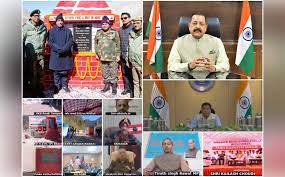
NEW DELHI, October 28 : Defence Minister Rajnath Singh today dedicated 75 projects to the nation, a number of them falling in the Union Territories of Jammu and Kashmir and Ladakh, from village Shyok in Leh district of Ladakh. The projects are of very vital importance for the troops as well as the civilians.
Union Minister of State (Independent Charge) Science & Technology; Minister of State (Independent Charge) Earth Sciences; MoS PMO, Personnel, Public Grievances, Pensions, Atomic Energy and Space, Dr Jitendra Singh said, highest number of projects including seven bridges and one road were inaugurated today in his Parliamentary constituency of Udhampur-Kathua-Doda.
Seven bridges e-inaugurated by the Defence Minister in Kathua district of Dr Jitendra Singh’s constituency include Jantriya, Konyali-I, Konyali-II, Chenab Badi, Pakka Kotha, Challa Nallah and Benadi.
Dr Jitendra Singh informed that Benadi bridge has been constructed in just 90 days by the Border Roads Organisation (BRO) which is a BRO record till date while Pakka Kotha bridge, which is 181 metres long multi span bridge, has been built in 102 days. The BRO has started construction of Ramban bridge on accelerated pace and Brihon bridge has been sanctioned under DGBR’s emergent powers and soon work will start there, the Minister added.
Commenting on the inauguration of 10 percent of total projects in his Parliamentary segment, Dr Jitendra Singh remarked: “With inauguration of new roads in Kathua district, road connectivity up to Zero Line on the International Border has been achieved”.
Dr Jitendra Singh thanked Prime Minister Narendra Modi for prompt approval of projects in his Parliamentary constituency of Udhampur-Kathua-Doda and said, with 200 bridges including small puliyas, a sort of record has been made in the last 8 years of Modi Government.
Dr Jitendra Singh also informed that in terms of PMGSY, for the last three years consecutively, Udhampur has stood first or second among all the districts in the country for constructing maximum numbers of all-weather rural roads. In May, this year, the Minister e-inaugurated nine newly completed PMGSY roads and four bridges in different parts of his constituency.
In December, 2021, out of nine bridges inaugurated in Jammu and Kashmir, four were in Udhampur-Doda Parliamentary constituency that included Birham bridge-I, Birham bridge-II (both in Udhampur district), Gutassa bridge in Doda, Nagrah bridge (Kishtwar).
Dr Jitendra, while highlighting government’s initiatives towards strengthening road connectivity in the UT, said that it is the firm commitment of present dispensation that every part of the UT gets a durable road network for rapid growth and development.
He said that the prime objective of PMGSY is to provide connectivity, by way of all-weather road to the unconnected habitations in rural areas.
SMVDU Organizes a talk on “Application of Geosynthetics for Sustainable Development”

School of Civil Engineering, SMVD University organized an expert talk on “Application of
Geosynthetics for Sustainable Development: Case Study from Indian Perspective” by Er.
Minimol Korulla Vice President & Head Strategy-Maccaferri group in Indian Subcontinent and
South East Asia Pacific (ISEAP) in an online mode.The talk was delivered to B.Tech.
students of SoCE. This lecture was an extension activity for the course ‘Reinforced Earth and
Geotextiles’ which is a part of the curriculum of B.Tech. (Civil Engineering). Er. Korulla
shared the basic requirements for sustainable construction materials with the attendees.
Further, she also discussed the application of geosynthetics as a sustainable solution in the
construction of roads. She also highlighted the beneficial effects of using geosynthetic
materials in terms of reducing the thickness of the pavement, and savings in initial and life
cycle cost apart from enhancing strength and durability. The talk was organised by Dr.
Balbir Pandey, Assistant Professor, SoCE and coordinated by Mr. Srijan and Mr. Ankur,
Assistant Professor, SoCE under the guidance of the Head, School of Civil Engineering. The
talk concluded with a vote of thanks.
Be smart, formulate ‘common technology’ to check crime, improve policing: PM Modi to states
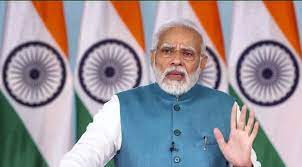
SURAJKUND (Haryana), Oct 28: Prime Minister Narendra Modi on Friday insisted on having a police technology mission that will enable all states to have the best common technology and mutual cooperation for crime prevention.
Addressing a gathering of home ministers of states to deliberate on issues of internal security — ‘Chintan Shivir’ — here, he said while ensuring the best technology the states should avoid any budgetary constraints that may come in the way of adoption of technological advancements.
The prime minister said the criminal world has globalised and stressed that ”we need to be ten steps ahead” of them (criminals).
The prime minister pointed out that crime is no longer localised and instances of interstate, international crimes are going up.
”That is why mutual cooperation between state agencies and between central and state agencies is becoming crucial,” Modi said.
He said whether it is cybercrime or the use of drone technologies for the smuggling of weapons or drugs, the government needs to keep working towards new technologies to tackle the menace.
”The law and order system can be improved with the help of smart technology,” the prime minister said.
He said 5G technology, along with its benefits, brings the need for a heightened alert.
”With the help of 5G, the performance of facial recognition technology, automatic number plate recognition technology, drone and CCTV related technology, are going to improve manifolds,” Modi said.
But, the pace we move forward to, the world that is into committing crime has also been globalised and they have also become interstate, he said.
”They have also become forward in technology, meaning we need to be ten steps ahead of them,” the prime minister said.
He requested the chief ministers and home ministers to seriously assess the need for technology, going beyond the constraints of the budget as this technology will percolate the confidence of security among common citizens.
”We need to make our law and order system smart… My request is that please don’t weigh technology with budget (constraints),” Modi said in his address.
The prime minister mentioned the police technology mission of the central government and stressed the need for a common platform as differing technologies of different states do not talk to each other.
”Many states are working on it (technological upgrades) in their own capabilities. But what has come to the fore is that our technologies do not talk to each other and that is why our energy gets wasted,” Modi said.
He asked the states to ”think with a big heart” about a common platform. ”We should have a pan India outlook, all our best practices should be interoperable and should have a common link,” Modi said. (Agencies)
Committed to improve health delivery system in J&K: Advisor Bhatnagar
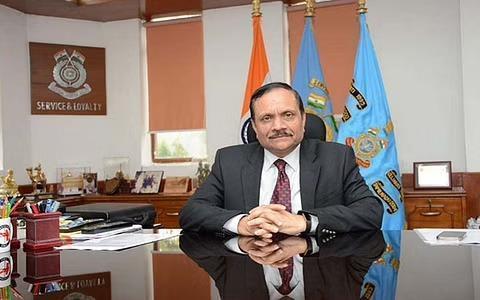
Srinagar, Oct 28: Advisor to Lieutenant Governor, Rajeev Rai Bhatnagar on Friday said that the government is committed to improve the health delivery system as well as the medical education system in the Union Territory.
Bhatnagar made these remarks while addressing the two-day international workshop on Artificial Intelligence and Information Technology in Surgery and Medical Research at GMC Srinagar.
“We are in the process of establishing two AIIMS in J&K. Several new medical colleges have come up and we are coming up with two state-of-the art cancer institutes, Bone & Joint hospitals and paediatric hospitals,” Advisor said.
He also appreciated the medical fraternity of J&K for playing an important role during the COVID-19 pandemic.
Highlighting the importance of Artificial Intelligence and Information Technology in Surgery and Medical Research, Advisor said that we are moving towards digitization of health records and that will improve the patient care in the UT.
“We can understand the role of Artificial Intelligence in today’s world. We are assisted by large computing systems, by large data networks and deep data analysis and this technology can be very helpful,” he said.
He also congratulated GMC Srinagar for organising a conference on this topic, which is the need of the hour.
“We can understand the role of Artificial Intelligence in today’s world. We are assisted by large computing systems, by large data networks and deep data analysis and this technology can be very helpful,” he said.
He also congratulated GMC Srinagar for organising a conference on this topic, which is the need of the hour.
During the conference international experts will present their lectures virtually and physically. Also, people who are associated with medical science, mathematics, and computer sciences were also present.
Govt forms committee on cadre restructuring of Central Secretariat Service
NEW DELHI, Oct 28: The Government has formed a committee on cadre restructuring of Central Secretariat Service (CSS) mandated to suggest measures to enhance the effectiveness of the service and capacity building of its members.
The CSS officers form the backbone of the central secretariat working.
The committee will assess the present and future career progression of the CSS officers and suggest remedial measures, both short term and long term, so as to reduce promotion blocks and at the same time prevent gaps from building up, an order issued by the Department of Personnel and Training (DoPT) said. It will also “suggest measures to enhance the effectiveness of the service and capacity building of its members”, it said.
The four-member committee will be headed by Establishment Officer and Additional Secretary (DoPT) and will have a joint secretary each from the DoPT and from the Department of Expenditure respectively.
A Deputy Secretary of CS-I division of the DoPT will be the member secretary, said the order dated October 27.
The panel on fourth cadre restructuring of the CSS will also review the present training needs of the service members besides examining any issue “as referred to it by the cadre controlling authority (CCA) of CSS and Central Secretariat Clerical Service (CSCS)”, it said.
The Committee will also review the existing cadre structure of CSS along with the feeder cadre and project the manpower requirement for next 10 years taking into account the encadrements already made after the third Cadre Restructuring (CRC) of CSS and also the functional needs of the cadre units among others, read the panel’s terms of reference. (Agencies)