Monday, July 13, 2026
Home Blog Page 74

Security Forces Intensify Search Operation in Kathua’s Remote Villages

0

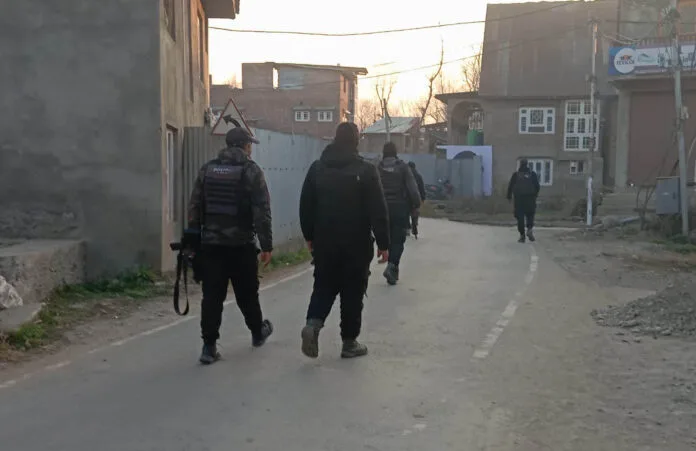
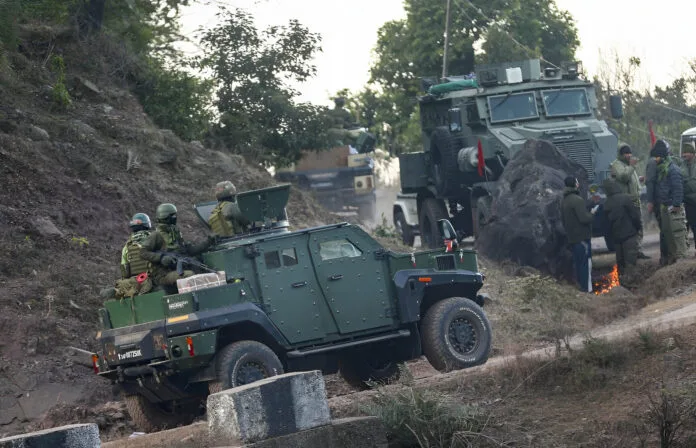
 Security forces on Wednesday stepped up an ongoing search operation by extending the cordon to track down and neutralise terrorists in the remote forested areas of Kathua district, officials said.

The operation was launched on Tuesday in the Najote forest area of Billawar tehsil following specific inputs about the presence of a terrorist. Several gunshots were heard when security forces moved in to sanitise the area.

However, there was no direct contact between the terrorist and the security forces. Fresh intelligence inputs suggest that the suspect managed to escape the initial cordon by taking advantage of the treacherous terrain and darkness, officials said.

According to officials, the terrorist allegedly took food from a shepherd in a nearby area around midnight before moving deeper into the forest.

Reinforcements have since been deployed in multiple directions, and more than a dozen villages around Najote have been cordoned off as part of the expanded operation to track down the terrorist and any possible associates.

Meanwhile, the Jammu and Kashmir Police’s Special Operations Group (SOG) also launched a separate cordon-and-search operation in Jakhole Baira and adjoining villages in the Rajbagh area after a local resident reported suspicious movement of two persons near his cattle shed.

“No trace of the suspicious persons has been found so far,” officials said.

With Republic Day approaching, security has been tightened across the Jammu region, particularly in border villages and high-altitude areas, to thwart any terrorist activity.

Officials said frequent drone intrusions from across the border over the past few days have emerged as a major security concern, prompting the deployment of additional forces at vulnerable locations.

Intensified patrolling, area domination exercises and night surveillance are being conducted to prevent infiltration attempts or airdropping of arms and narcotics, officials added.
Operation Sindoor Showed India’s Resolve and Restraint: Army Chief

0

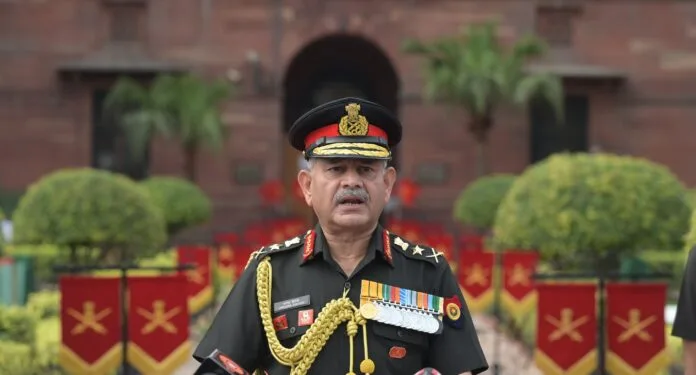
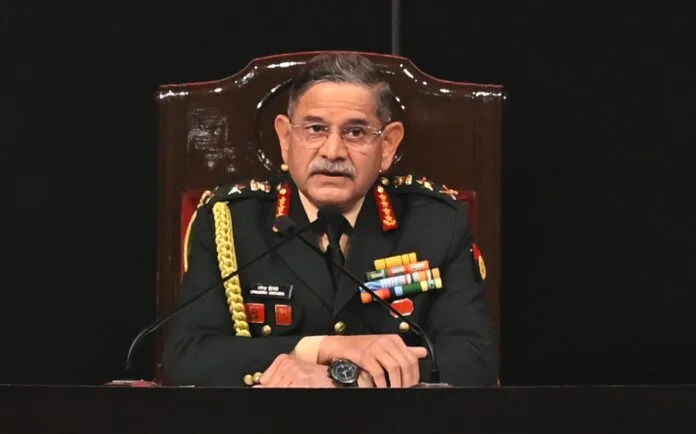
Army Chief General Upendra Dwivedi on Wednesday said Operation Sindoor was a “defining demonstration” of India’s resolve and restraint, reflecting the moral strength and professional excellence of the country’s armed forces as well as its youth.

Addressing cadets at the National Cadet Corps (NCC) Republic Day Camp here, General Dwivedi said the operation highlighted India’s firm response to terrorism while maintaining strategic discipline.

“Operation Sindoor was a defining demonstration of India’s resolve and restraint, a reflection of the moral strength and professional excellence of our armed forces and our youth alike,” the Army Chief said.

The operation was carried out by the Indian armed forces in the early hours of May 7 last year, eliminating at least 100 terrorists in response to the Pahalgam terror attack in April, in which 26 civilians were killed.

A day earlier, General Dwivedi had sent a strong message to Pakistan, stating that Operation Sindoor remains ongoing and that “any misadventure by the adversary will be resolutely responded to”.

At the Army’s annual press conference on January 13, the Army Chief said the operation helped reset strategic assumptions, as Indian forces struck deep to dismantle terror infrastructure, puncturing Islamabad’s “longstanding nuclear rhetoric”.

Recalling the role of the NCC during the operation, General Dwivedi said more than 75,000 NCC cadets volunteered across the country, contributing to civil defence, hospital management, disaster relief and community services.

“Recent events have shown what Indian youth are capable of. You are the most powerful generation — Generation Z. Our youth are a reservoir of strength that must be channelised with discipline, purpose and national commitment,” he said.

The Army Chief said the NCC continues to be a sought-after pathway for young people aspiring to join the armed forces and stressed the need for ‘civilisational atmanirbharta’ — self-reliance in thought, technology, innovation and character.

He highlighted initiatives such as Army cells at IITs, technology clusters and the Army Internship Programme 2025-26 aimed at fostering innovation and national security awareness.

“We invite you to actively participate in national security, innovation and development initiatives,” he said.

Emphasising the vision of Viksit Bharat @ 2047, General Dwivedi said a developed, secure and self-reliant India cannot be achieved by the government alone.

“It will be achieved by young leaders, NCC cadets, innovators, teachers, engineers, doctors, soldiers and responsible citizens like you,” he said.

“So, let’s march with discipline, innovate with integrity and serve with pride. Together, we shall build a strong, self-reliant, united and developed India,” the Army Chief added.

PM Modi Greets Nation on Makar Sankranti, Extends Wishes on Magh Bihu

0

Prime Minister Narendra Modi on Wednesday greeted the nation on the occasion of Makar Sankranti, a harvest festival celebrated across different parts of the country according to local traditions and customs.

Makar Sankranti marks the transition of the Sun into the zodiac sign of Capricorn (Makar) and is observed as a mid-winter harvest festival.

“This sacred occasion of Sankranti is celebrated in various parts of the country according to local customs and traditions. I pray to Lord Surya for everyone’s happiness, prosperity and excellent health,” Modi said in a post on X.

In a separate post, the Prime Minister extended greetings on Uttarayan, another name for the festival in several regions.

“Heartfelt greetings on the auspicious occasion of Uttarayan! May this sacred festival of Makar Sankranti fill your life with happiness, and may everyone be blessed with good health and well-being,” he said.

“May this joyful celebration also strengthen bonds of togetherness and usher in prosperity and positivity for all,” Modi added.

The Prime Minister also conveyed his wishes on Magh Bihu, which is celebrated in Assam and parts of the Northeastern region.

“Magh Bihu celebrates the joy of harvest, abundance and togetherness. May this festival bring prosperity, good health and happiness to every home,” he said.

“May the spirit of gratitude and harmony continue to guide us towards a brighter and more prosperous future,” the Prime Minister added.

Over 9 Lakh Devotees Take Holy Dip at Sangam Ahead of Makar Sankranti at Magh Mela

0

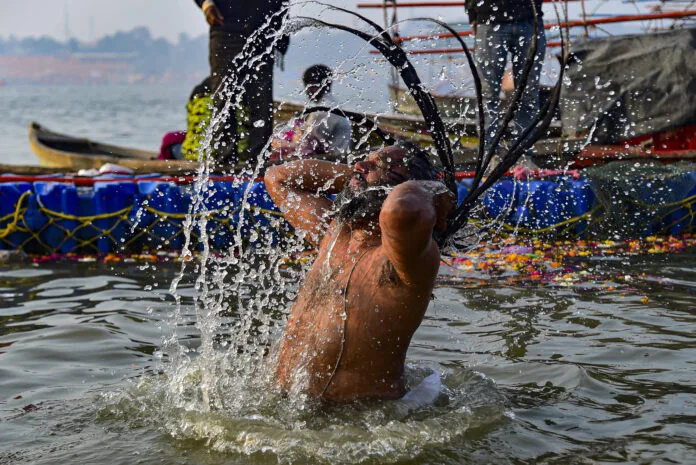
More than nine lakh devotees took a holy dip in the Ganga and at the Sangam here by Wednesday morning as part of Makar Sankranti festivities, officials said.

While many parts of the country are observing the harvest festival on Wednesday, Uttar Pradesh will celebrate Makar Sankranti on Thursday, which also marks the second major bathing festival of the ongoing Magh Mela.

Superintendent of Police (Magh Mela) Neeraj Pandey said devotees began arriving at the ghats in the early hours.

“By 6 am, over nine lakh devotees had taken a dip in the Ganga and at the Sangam. The number of pilgrims is expected to rise to between one crore and 1.5 crore by Wednesday evening on the occasion of Makar Sankranti,” Pandey said.

To manage the massive influx of pilgrims, over 10,000 police personnel have been deployed across the mela area to ensure security and smooth traffic movement.

Officials said more than 31 lakh devotees took a holy dip during the Paush Purnima bathing festival this year, while 28.95 lakh pilgrims participated in the Paush Purnima bath during Magh Mela 2024.

Magh Mela Officer Rishiraj said that 42 temporary parking facilities have been set up this year with the capacity to accommodate over one lakh vehicles, helping ease congestion and ensure smooth traffic flow.

He added that a total of 12,100 feet-long bathing ghats have been constructed for Magh Mela 2025–26, equipped with basic facilities such as changing rooms and toilets.

To maintain adequate water levels in the Ganga during the fair, 8,000 cusecs of water are being released daily from the Ganga barrage in Kanpur, officials said.

The 44-day-long Magh Mela, held annually during the Hindu month of Magh (January–February), takes place at the Triveni Sangam, the confluence of the Ganga, the Yamuna and the mythical Saraswati.

Magh Mela Prayagraj 2026 is being held from January 3 to February 15 and is marked by several age-old traditions, including Kalpavas and the Panchkosi Parikrama.

Key bathing dates for the Magh Mela include January 15 (Makar Sankranti), January 18 (Mauni Amavasya), January 23 (Vasant Panchami), February 1 (Maghi Purnima) and February 15 (Maha Shivratri).

Future Media Journalists Welfare Association was inaugurated in Coimbatore on 09.01.2026

0

Coimbatore:

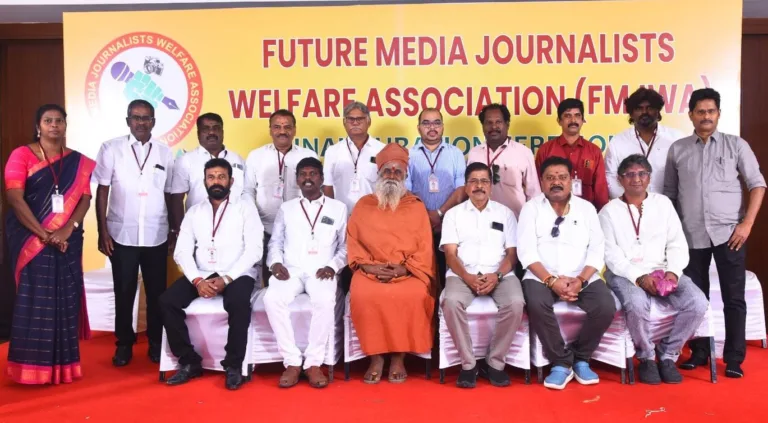
The Future Media Journalists Welfare Association (FMJWA) was inaugurated at Jenneys Residency in a grand manner. The event was presided over by Perur Adheenam Thiruperundhiru Santhalinga Marudachala Adigalar.Swamiji graced the event and emphasized the social responsibility of the media fraternity.

The function was organised by FMJWA National President Mr. S. Balaji. Honorary President Mr. M. Suresh graced the dais. Ms. S. Kavitha, National Deputy General Secretary outlined the role and responsibilities of FMJWA, and Dr. S. Selva Ganesh Ji, President of Bharatiya Hindu Parivar, delivered the welcome address.

Delivering the keynote address, Mr. S.R. Sekar, Tamil Nadu State Treasurer of the Bharatiya Janata Party, appreciated the formation of an organized body dedicated to journalists’ welfare, stating that such institutions are the need of the hour to safeguard media professionals and uphold ethical journalism.

The event witnessed participation from several senior office bearers, including Mr. G. Nagendran (State President, Andaman & Nicobar Islands), Mr. Veera Vijayan (Tamil Nadu State Vice President), Mr. Thirumalaichamy (State Treasurer),Mr. Balasubramanian(Organization Secretary) , Mr. Murugesan (Coimbatore District President), Mr. Amalraj (Virudhunagar District President), and Mr. Gunasekaran (Karur District President), 

Prominent Political Leaders, Industrialists, Quarry and Crusher Association owners, Engineering Association Representatives, Private School Management members, and over 100 Advocates, Journalists, and Media Professionals across Tamil Nadu participated in the inaugural ceremony. Identity cards were distributed to registered members of the association.

Addressing the gathering, National President Mr. S. Balaji reiterated the association’s vision with the slogan,

“Let us join hands… protect freedom of expression… our actions will define our identity.”

He assured that FMJWA would work continuously to protect journalists’ rights, safety and welfare.

The event was coordinated by Professor Moorthy, Vice President of the association.

Special invitees included retired DSP Ramachandran, Mr. Senthilkumar (Partner, Mayil Mark), Mr. Thirumalai M. Ravi (President, Coimbatore District Grill Manufacturers Welfare Association), Mr. Deva Kumar (President, Chinnavedampatti Industrial Association), Mr. Jayakumar (Codia Park), Mr. S. Ragunathan Subbiah (President, Coimbatore Handicraft Gold Jewellery Manufacturers Association), Mr. Rajkumar (Director, Home Zone), Mr. Zakir Hussain (Owner, Optical Palace), Mr. Manivannan (Correspondent, RBM School), Mr. Logu (Secretary, Coimbatore Consumer Voice), Mr. Rajadurai (State Secretary, CRIC Organisation), Mr. Umabathi (Owner, Coimbatore Biryani), Mr. Sivaram (Owner, Breze Software), and Dr. Thamaraiselvan, Homeopathy Physician, Ex Coimbatore Criminal Bar Association President Advocate Sivasamitamilan etc..

The inaugural event marked a significant milestone in strengthening unity, welfare, and professional integrity within the media community.

Cold Wave Persists in J&K as Srinagar Records Minus 4.9°C; Dense Fog Disrupts Life in Jammu

0

 The cold wave continued across Jammu and Kashmir on Tuesday as clear night skies led to a further dip in minimum temperatures, with Srinagar recording minus 4.9 degrees Celsius, the lowest overnight temperature in the Valley.

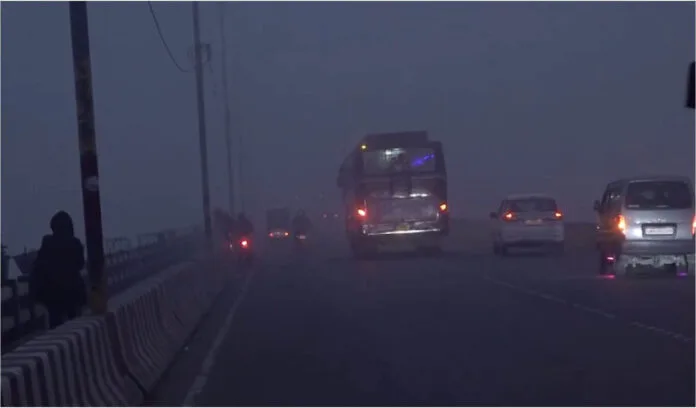
In Jammu city, dense morning fog severely affected daily life, leading to the suspension of both surface and air traffic due to extremely poor visibility.

In Srinagar, only a few residents ventured outdoors early in the morning as harsh, icy winds swept into the Valley from the surrounding mountain ranges, intensifying the chill.

With no major snowfall forecast over the next week, officials said the bitter winter cold is likely to persist.

According to the Meteorological Department, Gulmarg recorded a minimum temperature of minus 3.5 degrees Celsius, while Pahalgam was colder at minus 6.2 degrees.

In the Jammu region, Jammu city recorded 3.8 degrees Celsius, Katra 6.2, Batote 4.1, Banihal 8.9, and Bhaderwah minus 0.2 degrees as the night’s lowest temperatures.

Weather Forecast

The Meteorological Department (MeT) said partly to generally cloudy weather is expected on January 18 and 19.

“On January 20, generally cloudy weather with light rain or snowfall at isolated places is likely. Between January 21 and 23, partly to generally cloudy weather with light rain or snow at scattered places is expected,” the department said.

From January 24 to 25, the weather is expected to remain partly cloudy across the Union Territory.

The MeT Department also issued an advisory stating that a gradual rise in minimum temperatures is expected at many locations.

Moderate fog over the plains of the Jammu division, with dense fog at isolated places, is likely to continue during the next five days,” the advisory said.

Concerns Over Prolonged Dry Spell

Meanwhile, the forecast of mostly cold and dry weather till January 25 has raised concerns, particularly in the Kashmir Valley.

The ongoing dry spell has triggered alarm as water bodies critical for agriculture, horticulture and drinking water depend heavily on heavy snowfall during ‘Chillai Kalan’, the 40-day-long harsh winter period.

Chillai Kalan, which began in late December, is already more than halfway through, yet the plains of the Valley have not witnessed the season’s first snowfall.

Chillai Kalan ends on January 30. Officials noted that snowfall in February and March is of limited benefit, as it melts quickly and fails to adequately recharge perennial water reservoirs in the mountains.

Authorities Begin Profiling of Mosques, Madrassas in Kashmir After ‘White-Collar’ Terror Module Bust

0

 Authorities in Kashmir have initiated a process to profile mosques, madrassas and individuals associated with their management following the busting of a so-called ‘white-collar’ terror module last year, officials said.

As part of the exercise, a detailed proforma has been distributed to village numberdars (village-level revenue officials) to collect information on mosques, madrassas, prayer leaders (imams), teachers and members of management committees, they said.

Officials said the focus of the enumeration drive is primarily on finances, including the sources of funds used for construction of religious institutions and for meeting their day-to-day expenses.

In addition to basic personal details, imams and madrassa teachers have been asked to furnish information related to their Aadhaar cards, bank accounts, property ownership, social media handles, passports, ATM cards, ration cards, driving licences, SIM cards, mobile phone models and IMEI numbers, officials said.

A senior official, speaking on condition of anonymity, said the objective of the exercise is to create a comprehensive database of mosques, madrassas and persons associated with them.

“During the investigation into the ‘white-collar’ terror module busted in November last year, it emerged that some suspects were radicalised through madrassas or social media platforms. The role of certain imams, including Moulvi Irfan, has also come under scrutiny,” the official said.

The proforma also seeks information on the Islamic sect followed by each mosque or madrassa, including Barelvi, Deobandi, Hanafi or Ahle Hadeeth.

Officials said the growing influence of puritanical interpretations of Islam, which stand in contrast to the Sufi traditions historically prevalent in Kashmir, is being examined as a potential factor in youth radicalisation.

Imams, teachers and management committee members have also been asked to disclose any past or present involvement in terrorist or subversive activities, including details of pending cases or convictions by courts of law.

Background of the Terror Module

The Jammu and Kashmir Police, with assistance from the Uttar Pradesh and Haryana Police, busted the alleged ‘white-collar’ terror module in the first week of November last year, arresting nine people, including three doctors, and seizing 2,900 kg of explosives.

The network was found to have links with Jaish-e-Mohammed (JeM) and Ansar Ghazwat-ul-Hind, with operations spanning Kashmir, Haryana and Uttar Pradesh.

Those arrested included Dr Adeel Rather in Saharanpur, Dr Muzammil Ganaie in Faridabad and Dr Shaheen from Lucknow.

The seized explosive material included ammonium nitrate, potassium nitrate and sulphur. Of this, 360 kg of inflammable material, suspected to be ammonium nitrate, along with arms and ammunition, was recovered from Ganaie’s rented accommodation in Faridabad.

Another Kashmiri, Dr Umer Nabi, was driving an explosive-laden vehicle that blew up near the Red Fort Metro station in Delhi on November 10, officials said.

Ganaie, a teacher at Al Falah University in Faridabad, was arrested after J&K Police named him a wanted accused in a case involving JeM posters pasted in Srinagar.

On October 19, multiple JeM posters were found in the Bunpora Nowgam area of Srinagar, threatening and intimidating police and security forces — an incident that triggered the investigation and led to the unravelling of the inter-state terror network.

Police said the probe revealed a ‘white-collar’ terror ecosystem, involving radicalised professionals and students allegedly in touch with foreign handlers based in Pakistan and other countries.

Ayush Badoni Replaces Injured Washington Sundar for Remaining ODIs Against New Zealand

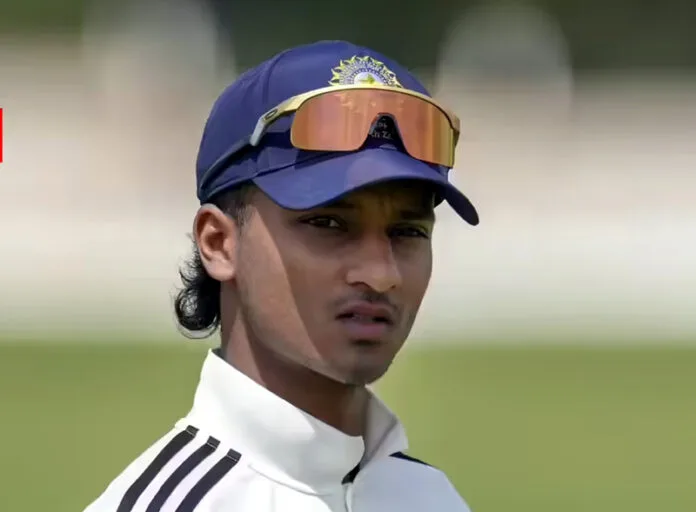
 Uncapped all-rounder Ayush Badoni was on Monday named as a replacement for Washington Sundar in India’s squad for the remaining two ODIs against New Zealand after the latter was ruled out due to a rib injury.

Washington sustained the injury during the series opener in Vadodara on Sunday. The 26-year-old bowled five overs for 27 runs before walking off the field midway through New Zealand’s innings and did not return to field. Despite the discomfort, he came out to bat at No. 8 as India clinched a four-wicket victory.

“India all-rounder Washington Sundar reported an acute onset discomfort in his left lower rib area while bowling during the first ODI against New Zealand at the BCA Stadium, Vadodara, on Sunday,” the BCCI said in a statement.

“He will undergo further scans, following which the BCCI Medical Team will seek expert opinion. Washington has been ruled out of the remaining two matches,” it added.

The BCCI further said the Men’s Selection Committee has named Ayush Badoni as his replacement. Badoni will join the squad in Rajkot, the venue for the second ODI scheduled on Wednesday.

Badoni’s inclusion in the national squad means he will miss Delhi’s quarterfinal clash against Vidarbha in Bengaluru on Tuesday.

Primarily a batter who bowls off-spin, the 26-year-old has captained Delhi and served as deputy to Rishabh Pant during the team’s recent Vijay Hazare Trophy campaign. He rose to prominence through his performances for Lucknow Super Giants in the Indian Premier League, where he played under the mentorship of current India head coach Gautam Gambhir.

While Badoni boasts an impressive first-class batting average of 57.96, his List A numbers are relatively modest, averaging 36.47 from 27 matches. However, he has made notable contributions with the ball in the ongoing Vijay Hazare Trophy.

Delhi head coach Sarandeep Singh highlighted Badoni’s growth as an off-spinner over the past year.

“He bowls at least 30 balls in every practice session after batting in the nets. He realises that he needs to improve his off-spin to make a strong case as an all-rounder,” Sarandeep said.

“He has improved considerably as a bowler over the last 12 months. His off-spin turns sharply and he has a good carrom ball and arm ball as well,” the former India spinner added.

Washington is the third Indian player to be sidelined by injury during the ongoing series. Earlier, wicketkeeper-batter Rishabh Pant was ruled out with a side strain, while Tilak Varma is unavailable for the first three T20Is against New Zealand following groin surgery.

Resilience, Innovation, Cooperation, Sustainability to Guide India’s BRICS 2026 Chairship: Jaishankar

0

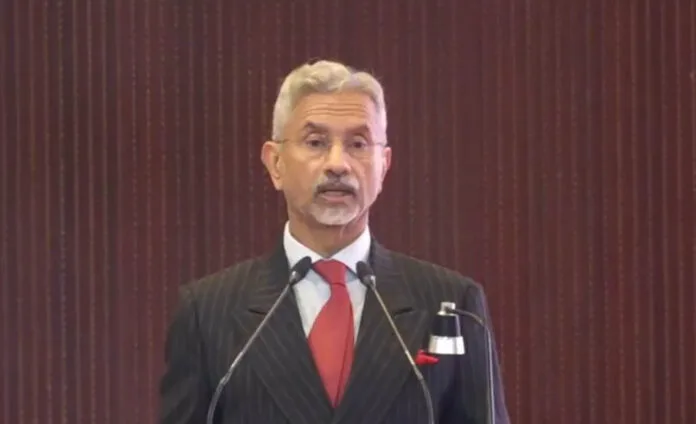
External Affairs Minister S Jaishankar on Tuesday outlined **four broad priorities—resilience, innovation, cooperation and sustainability—**that will guide India’s BRICS 2026 Chairship, saying these principles will shape the agenda of the 18th BRICS Summit.

Speaking at the launch of the BRICS 2026 logo and official website, Jaishankar said the priorities would provide a coherent framework across the grouping’s three foundational pillars—political and security, economic and financial, and cultural and people-to-people exchanges.

“Under the resilience pillar, we will endeavour to build structural and institutional strengths capable of weathering global shocks,” the External Affairs Minister said. “India intends to work with BRICS partners to build resilience in agriculture, health, disaster risk reduction, energy and supply chains, including through cooperative frameworks that enhance collective preparedness and response.”

Highlighting innovation as a key driver of global economic growth, Jaishankar said leveraging new and emerging technologies was essential to addressing socio-economic challenges, particularly in developing countries.

“The deployment of new and emerging technologies is crucial to tackling socio-economic challenges while maintaining a people-centric approach. Enhanced cooperation in areas such as start-ups, MSMEs and emerging technologies can meaningfully contribute to building a more equitable world,” he said.

Emphasising cooperation and sustainability, the minister said India would work closely with BRICS partners to advance climate action and promote clean energy and sustainable development pathways.

“India will work to advance climate action, promote clean energy, and support sustainable development in a manner that is fair and sensitive,” he added.

Logo, Website Unveiled

Jaishankar said the newly unveiled BRICS 2026 logo reflects India’s vision for its chairship by blending tradition and modernity.

“The petals incorporate the colours of all BRICS member countries, symbolising unity in diversity and a shared sense of purpose. The logo conveys that BRICS draws strength from the collective contributions of its members while respecting their distinct identities,” he said.

The BRICS India website, launched alongside the logo, will serve as a central platform for information on meetings, initiatives and outcomes during India’s chairship, and is expected to enhance transparency, engagement and timely dissemination of information among member countries and global stakeholders.

About BRICS

The acronym BRIC was coined in 2001 by Goldman Sachs in its Global Economics paper titled ‘The World Needs Better Economic BRICs’, which projected that Brazil, Russia, India and China would emerge as major global economic powers.

In 2010, the grouping expanded to BRICS with the inclusion of South Africa, which formally joined at the 3rd BRICS Summit in Sanya in 2011.

The bloc expanded further in 2024, with Egypt, Ethiopia, Iran and the UAE becoming full members on January 1. Indonesia joined as a full member in January 2025, while Belarus, Bolivia, Kazakhstan, Cuba, Malaysia, Nigeria, Thailand, Uganda and Uzbekistan were inducted as BRICS partner countries.

If you want, I can also:

Situation on Western Front, J&K Sensitive but Under Control After Operation Sindoor: Army Chief

0

 Chief of Army Staff General Upendra Dwivedi on Tuesday said that the security situation along the Western Front and in Jammu and Kashmir has remained “sensitive but firmly under control” since May 10, following India’s launch of Operation Sindoor, which targeted nine terror outfits deep inside Pakistani territory.

Addressing a press conference, the Army chief said there were clear indicators of positive change in Jammu and Kashmir, with terrorist recruitment in 2025 being almost non-existent.

“Since May 10, the situation along the Western Front and J&K remains sensitive but firmly under control. In 2025, 31 terrorists have been eliminated, of which 65 per cent were of Pakistani origin, including the three perpetrators of the Pahalgam attack neutralised during Operation Mahadev. Active local terrorists are now in single digits,” General Dwivedi said.

He added that only two local recruitments had been recorded this year, underscoring a significant decline in terrorist mobilisation.

“Terrorist recruitment is almost non-existent. Clear indicators of positive change include robust development activity, revival of tourism, and the peaceful conduct of the Sri Amarnath Yatra, which witnessed participation of over four lakh pilgrims, exceeding the five-year average. The theme of ‘terrorism to tourism’ is gradually taking shape,” he said.

Northeast and Myanmar Situation

General Dwivedi said a multi-agency security grid comprising the Assam Rifles, the Army and the Ministry of Home Affairs has been put in place to insulate the Northeast from spillover effects of developments in Myanmar.

“In response to turbulence in Myanmar, a comprehensive security grid is working to prevent spillover effects into the Northeast. With the successful conduct of phase two elections in Myanmar, we should now be able to engage more effectively,” he said.

Northern Front Stable, Vigil Required

On the Northern Front, the Army chief said the situation remains stable but requires constant vigilance.

“Apex-level interactions, renewed contact and confidence-building measures are contributing to gradual normalisation. This has enabled activities such as grazing, hydrotherapy camps and other engagements along the Northern Borders,” he said.

He added that India’s deployment along the Line of Actual Control (LAC) remains balanced and robust, alongside ongoing infrastructure and capability enhancement through a whole-of-government approach.

Manipur, HADR Operations

General Dwivedi said the situation in Manipur has witnessed marked improvement due to neutral, transparent and decisive action by security forces and proactive government measures.

“The peaceful conduct of the Durand Cup, resumption of cultural festivals and the renewal of Suspension of Operations (SoO) agreements with Kuki insurgent groups in September 2025 have been key markers of stability,” he said.

Highlighting the Army’s role in Humanitarian Assistance and Disaster Relief (HADR), the chief said forces operated across two neighbouring countries and 10 Indian states, rescuing over 30,000 people.

“In several border states, the Army responded even before formal requests were received. These actions reaffirm our role as the natural first responder during HADR crises,” he said, recalling the daring rescue of CRPF personnel during the Punjab floods in Pathankot.