
The Delhi High Court on Friday upheld the Centre’s move to temporarily restrict access to the Telegram messaging app ahead of the June 21 NEET-UG re-exam, holding the order was “not disproportionate”.
While pronouncing the judgement, a vacation bench of Justice Tejas Karia said the Centre’s order was “least restrictive” and the government was empowered to direct blocking of access to Telegram.
A detailed order is awaited.
Telegram’s counsel had questioned the legality of the government order blocking the platform. He had said that over 150 million users had been affected by the Centre’s action.
The National Testing Agency (NTA) had on May 12 cancelled the National Eligibility-cum-Entrance Test (Undergraduate), or NEET-UG, held on May 3 for medical admissions amid allegations of paper leak.
The CBI is investigating the matter and a re-test is scheduled on June 21.
The Ministry of Electronics and Information Technology (MeitY), acting on recommendations of the NTA, had issued a direction on June 16 under Section 69A of the Information Technology Act, 2000, restricting access to the Telegram platform in India till June 22, covering the day of the NEET (UG) 2026 re-exam and its immediate aftermath.
A separate direction had also asked Telegram to disable in India the message-editing feature for already-posted messages till June 30, 2026, addressing the specific structural feature through which the platform has been used to fabricate after-the-event “paper leak” evidence in respect of national examinations. (Agencies)
Delhi HC Rejects Telegram’s Challenge Against Temporary Ban Ahead Of NEET-UG Retest

Odisha: IPS Officer Suspended Following Harassment Allegations By Lynched Constable’s Family
Senior IPS officer Dayal Gangwar was suspended over allegations of harassment levelled by the family of GRP constable Soumya Ranjan Swain, who was lynched on the outskirts of Bhubaneswar last month.
Chief Minister Mohan Charan Majhi has ordered the suspension of Gangwar, who was serving as Officer on Special Duty (OSD) in the Home Department, said a statement issued on Thursday.
Gangwar’s name had surfaced during the investigation into the lynching of Swain, who was allegedly tied to a pole and beaten to death in Bhingarpur-Kaja in the Balianta Police Station area on May 7.
The mob attack took place after a woman accused the constable of attempting to rape her following a collision between his motorcycle and her two-wheeler, according to police.
As the incident triggered a furore in the state, Swain’s family had alleged that he was subjected to both physical and mental harassment by Gangwar, who was then ADG (Communication), and demanded that he be brought within the ambit of the investigation.
The 1998-batch IPS officer was subsequently transferred and posted as OSD in the Home Department by the state government.
Following this, ADG (Railways) Arun Bothra was directed to conduct an inquiry into allegations that Gangwar had subjected Swain to mental harassment by allegedly compelling him to perform personal and domestic chores unrelated to official duties.
Bothra was also tasked with examining whether the stress described in Swain’s personal diary had any bearing on the circumstances leading to his death. The inquiry report was submitted to the DGP last month.
The opposition BJD had also raised questions over the alleged connection between the deceased constable and the senior IPS officer, who was ADG (Railways) two years back and supposedly knew Swain since then.
The party claimed that Swain had been engaged in work at Gangwar’s residence and gymnasium instead of performing official police duties.
As part of the probe into the mob-lynching case, the state government had earlier suspended four police personnel, disengaged two home guards and transferred the inspector-in-charge of Balianta police station over their alleged roles and conduct in the incident.
Police have so far arrested 18 persons, including the prime accused, in connection with the lynching. (Agenciese)
Assets Worth Rs 2.08 Crore of Alleged Drug Peddler Attached in Samba
Police on Friday attached assets worth over Rs 2.08 crore belonging to an alleged drug peddler in Jammu and Kashmir’s Samba district as part of the ongoing campaign against narcotics trafficking.
The accused has been identified as Narayan Sharma alias Shunna, a resident of Vijaypur in Samba district.
According to officials, the action was carried out under Section 68-F of the Narcotic Drugs and Psychotropic Substances (NDPS) Act after investigations established that the assets were allegedly acquired through proceeds generated from illicit drug trafficking.
The attached properties include a residential house valued at approximately Rs 48.50 lakh, a car worth around Rs 10 lakh, and land valued at nearly Rs 1.50 crore. The total value of the attached assets has been estimated at about Rs 2.08 crore.
Police said a detailed investigation and inquiry revealed prima facie evidence indicating that the properties were acquired through proceeds of illegal narcotics trade. Consequently, the assets were seized and attached under the relevant provisions of the NDPS Act.
Officials stated that further legal proceedings are being initiated in accordance with the law.
Narayan Sharma is currently lodged in Central Jail Kot Bhalwal, Jammu, under the provisions of the Prevention of Illicit Traffic in Narcotic Drugs and Psychotropic Substances (PITNDPS) Act.
Police reiterated their commitment to intensifying efforts against drug trafficking and dismantling the financial networks of individuals involved in the illegal narcotics trade.
PM Modi Meets Top French CEOs, Highlights India as a Trusted Global Partner
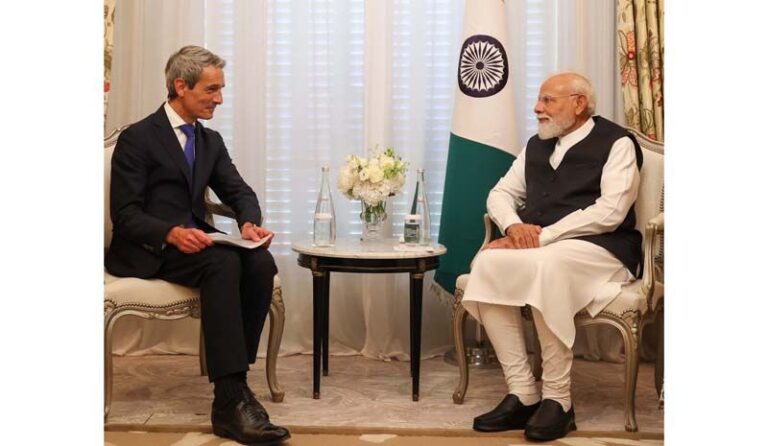
Prime Minister Narendra Modi held a series of high-level meetings with leading French business executives in Paris on Thursday, discussing investment opportunities, expansion plans, and strengthening economic cooperation between India and France.
The discussions covered key sectors including shipping and logistics, railways, construction, sustainability, and artificial intelligence. The meetings took place during Modi’s visit to France following his participation in the G7 Summit.
Among the prominent business leaders who met the Prime Minister was Rodolphe Saade, Chairman and CEO of CMA CGM. Their discussions focused on maritime shipping, logistics, global supply chains, shipbuilding, ship recycling, deep-sea ports, and container manufacturing.
Saade expressed confidence in India’s growing role in global supply chains and highlighted opportunities for deeper cooperation between French and Indian companies in the shipping and logistics sectors.
Modi also met Benoit Bazin, Chairman and CEO of Saint-Gobain, to discuss sustainable construction and advanced materials. The Prime Minister appreciated the company’s strong investments in India and its contribution to employment generation and industrial growth.
In a separate meeting with Martin Sion, CEO of Alstom, discussions centered on railway modernization and mobility solutions. Modi acknowledged Alstom’s significant manufacturing presence in India and its role in strengthening the country’s rail infrastructure.
The Prime Minister also interacted with Arthur Mensch, Co-founder and CEO of Mistral AI. The discussions focused on India’s rapidly growing artificial intelligence ecosystem and potential collaborations with Indian companies to drive innovation and technological advancement.
Addressing the Indian diaspora in Paris, Modi described India as a “trusted partner” in an increasingly uncertain global environment. He emphasized that trust has become as important as trade in international relations and noted that countries around the world are seeking reliable long-term partners.
Highlighting India’s progress over the last 12 years, Modi said the country has witnessed remarkable economic and social transformation, lifting millions out of poverty while investing in sectors that will define the future, including technology, innovation, infrastructure, and sustainable development.
The Prime Minister also underscored the strength of the India-France relationship, describing it as a pillar of trust, stability, and cooperation. He announced that India and France are set to launch the TRISHNA satellite next year, which will contribute to global water and food security efforts.
Modi is also scheduled to participate in VivaTech 2026, Europe’s leading technology and innovation event, alongside French President Emmanuel Macron.
Operation Sheruwali Enters 28th Day in Rajouri’s Dorimal Forests, Security Forces Intensify Search Operations
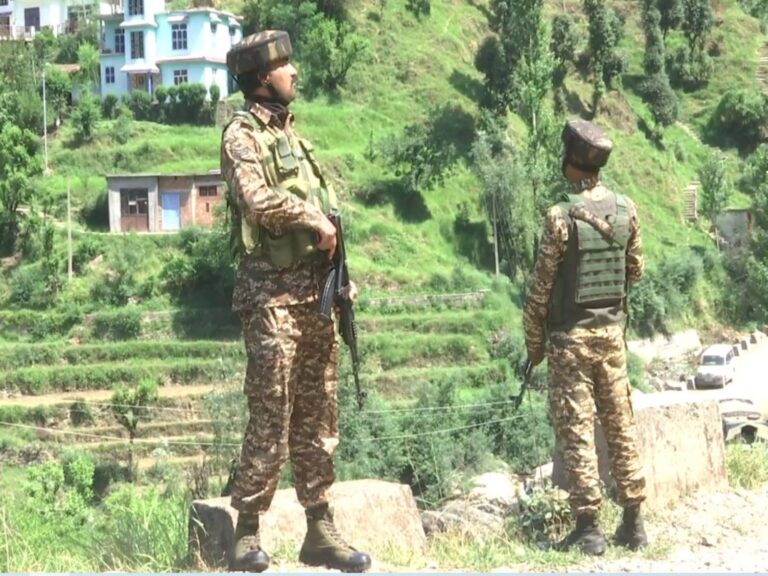
Operation Sheruwali entered its 28th day on Friday in the dense Dorimal forests of the Gambhir Mughlan area in the Manjakote sector of Rajouri district, making it one of the longest ongoing counter-terror operations in the region.
Security forces have intensified search and cordon operations across the challenging forest terrain. The operation is being conducted in the rugged and densely forested hills of Dorimal, where steep slopes, rocky mountains and thick vegetation continue to pose significant challenges for troops deployed on the ground.
Despite the difficult conditions, security personnel remain on high alert and are carrying out extensive searches throughout the forest belt to track any suspicious movement. Additional surveillance measures and area domination exercises are also continuing as part of the ongoing operation.
The prolonged mission underscores the determination of security forces to maintain peace and security in the border district of Rajouri. Search operations in the Dorimal forest area are continuing.
Operation Sheruwali is an ongoing large-scale counter-terrorism combing mission being carried out in the dense forest belts of the Dorimal-Gambhir Mughlan sector of Rajouri district. Launched in late May, the multi-agency operation aims to locate and neutralise armed infiltrators believed to be hiding in the region’s rugged mountainous terrain.
Earlier, on June 7, an Indian Army jawan lost his life after accidentally slipping from a rock during Operation Sheruwali. According to sources, the soldier was moving through the difficult mountainous terrain during the anti-terror operation when he lost his footing and fell from a rocky slope, sustaining serious injuries. He was immediately evacuated for medical treatment but later succumbed to his injuries.
On May 28, heavy firing and shelling erupted in Rajouri’s Dorimal forest area as Operation Sheruwali reached a critical stage, with security forces tightening the cordon around suspected militants believed to be hiding in the dense terrain.
According to officials, a massive deployment of security forces, along with additional reinforcements and logistical support, was rushed to the encounter site to establish a strong and impenetrable cordon and prevent any attempt by militants to escape through the thick forest cover.
Security agencies continue to maintain a robust presence in the area as the operation enters its fourth week, with efforts focused on locating and neutralising any remaining militant presence in the forested belt of Rajouri district.
Supreme Court Refuses Interim Relief on Plea Against CBSE Three-Language Policy
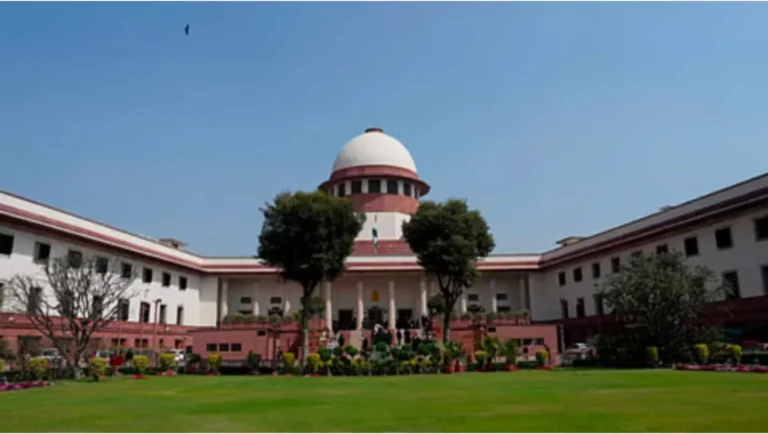
The Supreme Court on Thursday declined to grant interim relief on a plea challenging the implementation of the CBSE’s three-language policy for Class 9 students from the 2026-27 academic session. A bench comprising Chief Justice Surya Kant and Justice V. Mohana ordered that the petition be tagged with similar matters already pending before the court.
The plea, filed by NGO Friends of People for Active Democracy, questioned the implementation of the policy rather than the three-language formula itself. During the hearing, the bench observed that no interim order could be passed at this stage, stating that the matter had already been argued extensively. The case has been listed for further hearing on July 14.
In a lighter moment, Chief Justice Surya Kant remarked on the NGO’s name, asking whether such nomenclature was intended to create fear among the court or the public. The counsel clarified that the trust was established in 2013 and informed the bench that CBSE was expected to issue detailed guidelines by June 15.
Earlier, on May 27, the apex court had issued notices to the Centre, the Central Board of Secondary Education (CBSE), and the National Council of Educational Research and Training (NCERT), seeking comprehensive responses. It had also directed the Centre to submit a report on the preparedness of the CBSE to implement the policy.
Under a circular issued by the CBSE, the study of three languages, including at least two native Indian languages, has been made compulsory for Class 9 students from July 1, 2026. The move is aimed at aligning the curriculum with the National Education Policy (NEP) 2020 and the National Curriculum Framework for School Education (NCF-SE) 2023.
According to the board, students choosing a foreign language may do so only as a third language after studying two native Indian languages or as an additional fourth language. No board examination will be conducted for the third language at the Class 10 level, and all assessments for the subject will be school-based. The performance of students in the third language will, however, be reflected in the CBSE certificate.
The board has also provided for case-by-case exemptions for foreign students returning to India and relaxations for children with special needs under the Rights of Persons with Disabilities Act, 2016. Schools facing a shortage of qualified language teachers have been advised to adopt flexible arrangements, including inter-school resource sharing and virtual teaching support.
The three-language formula forms part of broader curriculum reforms announced by the CBSE, which also include the introduction of two-level systems for mathematics and science from the 2026-27 academic session.
Six Shiv Sena (UBT) MPs Skip Meeting, Signal Possible Switch to Shinde Camp
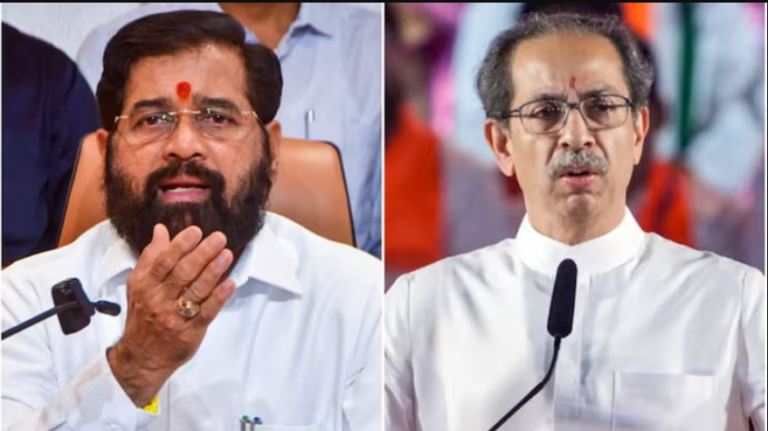
Signs of a fresh split emerged in Shiv Sena (UBT) on Thursday after six of its nine Lok Sabha MPs skipped a parliamentary party meeting, indicating that a formal crossover to the ruling Shiv Sena led by Maharashtra Deputy Chief Minister Eknath Shinde could be imminent.
Only MPs Arvind Sawant, Anil Desai and Rajabhau Waje attended the meeting, along with the party’s lone Rajya Sabha member Sanjay Raut. The absence of six MPs—Nagesh Aashtikar, Sanjay Deshmukh, Sanjay Jadhav, Sanjay Dina Patil, Omprakash Rajenimbalkar and Bhausaheb Wakchaure—fuelled speculation of a split in the party’s parliamentary ranks.
According to sources, the six dissident MPs have signed a letter seeking a merger with the Shinde-led Shiv Sena and submitted it to Lok Sabha Speaker Om Birla. The process is still underway, with the Speaker’s office expected to verify the signatures through the physical appearance of some of the MPs in the coming days.
Ahead of the meeting, Shiv Sena (UBT) had issued a three-line whip directing all its MPs to attend. The move was seen as an attempt to pave the way for possible disqualification proceedings against rebel lawmakers. Under the anti-defection law, at least two-thirds of the parliamentary party, or six MPs in this case, are required to avoid disqualification.
Senior party leader Arvind Sawant said action would be taken against those violating the whip after consultation with party chief Uddhav Thackeray. However, leaders from the Shinde camp argued that the whip has no legal consequence under the Tenth Schedule, as it applies only to proceedings and voting inside the House and not to internal party meetings.
On Wednesday, Sawant, Anil Desai and Sanjay Raut met Lok Sabha Speaker Om Birla and urged him to prevent any unlawful defection. Desai maintained that even with the support of two-thirds of MPs, a group cannot independently merge with another party unless the original party itself decides to merge.
The latest development comes nearly four years after Eknath Shinde engineered the 2022 split in the undivided Shiv Sena, which led to the collapse of the Maha Vikas Aghadi government in Maharashtra.
12 Years of Modi Government Marked by Blend of Development and Heritage: Amit Shah
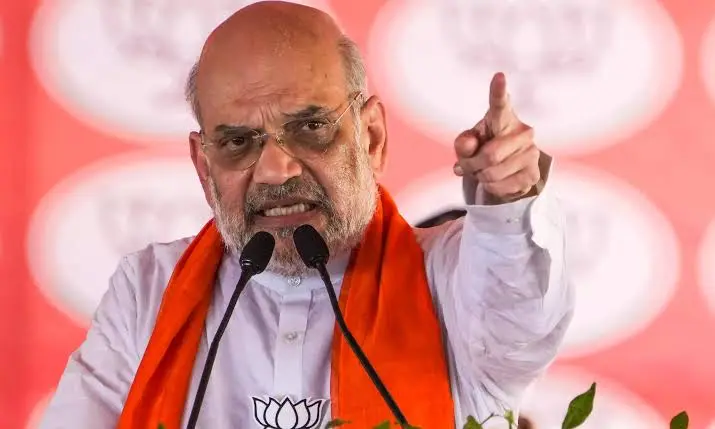
Union Home Minister Amit Shah on Thursday said the 12 years of the Narendra Modi-led government have been characterized by a unique confluence of development and heritage, highlighting major cultural and infrastructure initiatives undertaken since 2014.
In a post on X, Shah described the period as a “golden era” where projects such as the Shri Ram Temple, Kashi Vishwanath Corridor, and Ujjain Mahakal Lok were developed alongside welfare schemes including PM Awas Yojana, Ayushman Bharat, Ann Bhandar, and initiatives like Make in India. He said these measures have provided unprecedented momentum to India’s development journey.
The remarks came as the Centre showcased achievements under the theme “Vikas Bhi, Virasat Bhi,” emphasizing the preservation and promotion of India’s cultural heritage while integrating it with broader development goals.
According to an official statement, the government has digitised over one crore historical records, facilitated the return of 668 ancient artefacts to India, established 11 tribal freedom struggle museums, and granted classical language status to 11 Indian languages. Programmes aimed at restoring iconic sites, conserving temples and monuments, and developing heritage cities and pilgrimage circuits have also been implemented.
The statement noted that India’s monuments, manuscripts, antiquities and historic sites represent a shared legacy that has been preserved through various initiatives launched since 2014. These efforts have sought to combine heritage conservation with economic growth, tourism development, livelihood generation and cultural diplomacy.
Highlighting the government’s approach under Prime Minister Narendra Modi, the statement pointed to the return of stolen antiquities, the development of spiritual infrastructure including the Kashi Vishwanath Corridor and Shri Ram Janmbhoomi Temple, and measures aimed at increasing global recognition of Indian traditions.
The government said initiatives such as manuscript digitisation, expansion of pilgrimage infrastructure and improvements in tourism connectivity have been undertaken to preserve and promote India’s rich cultural legacy for future generations.
Pakistani Currency, Mobile Numbers Recovered During Search Operation in Poonch
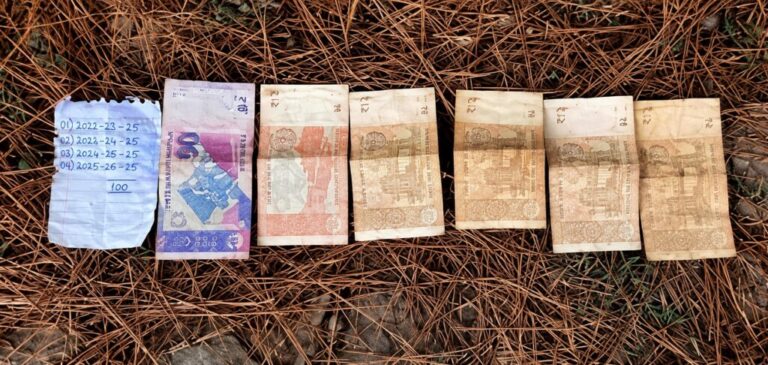
Security forces recovered Pakistani currency notes and a slip containing several suspected Pakistani mobile phone numbers during a search operation in the Mendhar sector of Jammu and Kashmir’s Poonch district on Thursday.
According to officials, the recovery was made during an area domination and search operation conducted by a Road Opening Party (ROP) of the 118 Territorial Army near Bhattaduriyan along National Highway-144A.
During the operation, security personnel recovered a cache of Pakistani currency notes along with a handwritten slip carrying multiple mobile numbers believed to be linked to Pakistan.
The recovered material was seized and taken into custody for further examination by the concerned security and intelligence agencies.
Officials said an investigation has been launched to ascertain the origin of the recovered items and determine whether they have any links to cross-border networks or other security-related activities.
Security agencies are analysing the documents and exploring all possible angles as part of the ongoing probe.
CM Omar Abdullah visits Kheer Bhawani temple in Ganderbal
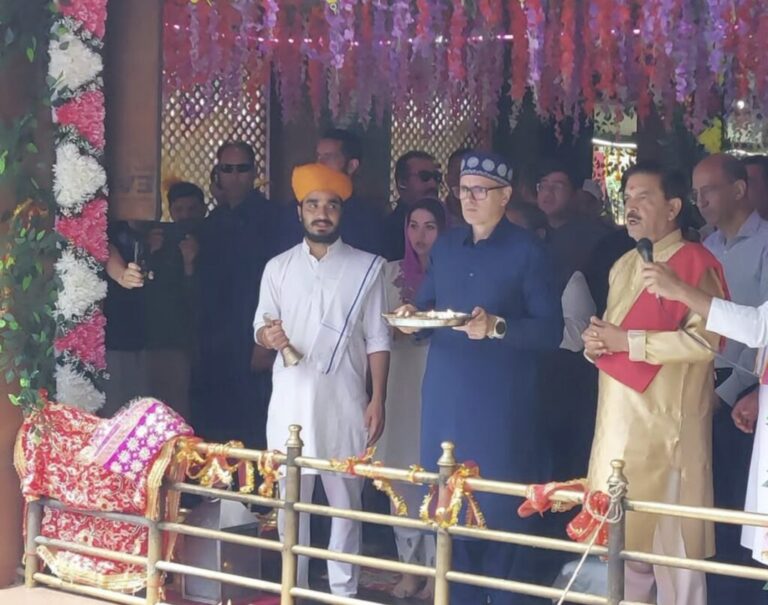
Chief Minister Omar Abdullah on Thursday visited the Kheer Bhawani temple in Ganderbal district to assess the arrangements for the upcoming annual mela at the shrine.
Hundreds of devotees, mostly Kashmiri Pandits, are expected to visit the temple of Ragnya Devi, popularly known as Mata Kheer Bhawani, at Tulmulla in the central Kashmir district, to celebrate the annual Mela on Monday.
The chief minister inspected various facilities put in place for the devotees and reviewed the arrangements for the smooth conduct of the mela.
Abdullah also paid obeisance at the temple.
“It is a sacred day. People come here from various parts of the country and world to pay obeisance and get blessings of the mata. I have come here in the capacity of the chief minister of J&K, and more so as the MLA Ganderbal, to assess the arrangements and review the preparations,” Abdullah told reporters after the visit.
The chief minister said he spoke to the priests and others at the temple who raised some issues about the arrangements and assured them that attempts will be made to address them before the mela on June 22.
To a question about the upcoming annual Amaranth yatra, Abdullah said the Shri Amarnath Shrine Board oversees the arrangements for the pilgrimage which begins this year on July 3.
“The board oversees the yatra and the biggest responsibility about the smooth yatra lies with the board. However, whatever support we have to give from the government side, we are doing that,” he added.
The CM appealed to the pilgrims to pray for peace and brotherhood in Jammu and Kashmir
“We hope that whether Mata Kheer Bhawani or Amamrnath yatra, the pilgrims pay obeisance and pray smoothly. We hope that when they pray, they also pray for peace and brotherhood in J&K,” Abdullah said.
Asked about farmers facing irrigation issues in the constituency, the CM said the government is doing everything to mitigate the crisis.
“There are such reports from a few places, not the whole Ganderbal. Whatever can be done through canals, etc, is being done so that there is no lack of irrigation water. We thank God that it rained over the last few days and so, the water scarcity was mitigated a bit. But, I will send the Minister Javed Rana and officials to the spot wherever is needed so that whatever remains to be done, will be done,” he added.
When asked about the reports that Kashmiri Pandit colonies are being built in Shopian and Pulwama, the CM said those were transit accommodations and are being built everywhere.
“It is being built for PM package employees so that they get a good living space and work smoothly. The work started in PM Manmohan Singh’s time and is going on,” Abdullah said.