Wednesday, July 15, 2026
Home Blog Page 66

Jammu & Kashmir Young Entrepreneur Develops SolarHelpdesk: A Digital Revolution in Solar Project Monitoring

In a remarkable example of innovation emerging from Jammu & Kashmir, a young entrepreneur has introduced a pioneering digital platform that is set to transform the way solar projects are monitored, controlled, and maintained across India. SolarHelpdesk, (https://Solarhelpdesk.in) a web-based monitoring and service management platform developed by Ecoepicsolar Private Limited under the leadership of Er. Sarabjeet Singh, Chief Executive Officer, is being hailed as a breakthrough solution for one of the solar industry’s biggest challenges — efficient after-sales service and real-time project performance tracking.

India is witnessing an unprecedented expansion in renewable energy, with the Government of India investing thousands of crores every year in solar street lighting, rooftop solar plants, solar water pumping systems, and large-scale solar installations. While the installation numbers continue to rise, a critical gap has remained unaddressed for years: there has been no unified digital platform to monitor solar assets after commissioning, manage complaints, track warranties and AMC contracts, and ensure timely service delivery. As a result, many solar projects across rural and urban India become non-functional within a short period due to lack of monitoring and poor after-sales coordination.

Recognizing this gap from years of field experience, Er. Sarabjeet Singh and his dedicated team at Ecoepicsolar conceptualized and developed SolarHelpdesk — a comprehensive web portal and digital service ecosystem designed specifically for solar project stakeholders. The platform enables real-time monitoring, complaint management, and complete after-sales service tracking for all types of solar projects, including solar street lights, Solar High mast Lighting System, Solar Rooftop systems, mini grids, and smart solar infrastructure.

What makes SolarHelpdesk truly unique is its end-to-end lifecycle approach. From the moment a solar project is installed, every asset can be digitally registered on the platform. Performance data, Date of Installation, Warranty Period, Installer Data, Manufacturer data, fault alerts, can be monitored remotely through a centralized dashboard. In case of any fault, the system automatically generates service tickets, assigns them to vendors or technicians, and records the complete service history. This ensures transparency, accountability, and faster resolution — something the solar sector has long been missing.

One of the strongest features of the platform is its focus on bridging the gap between buyers and sellers. Until now, government departments, municipalities, EPC contractors, and private buyers had no standard system to track warranty obligations, AMC schedules, or vendor performance. SolarHelpdesk provides a common digital workspace where all stakeholders can collaborate, monitor project health, and maintain long-term service records. This not only protects public investments but also enhances the credibility and efficiency of solar vendors.

In a visionary move that reflects social responsibility, Ecoepicsolar has ensured that SolarHelpdesk is available free of cost for users. At a time when digital platforms often come with heavy subscription fees, making such an advanced monitoring and service management system freely accessible demonstrates a strong commitment to strengthening India’s renewable energy ecosystem. The objective is clear: to maximize uptime of solar assets, reduce wastage of public funds, and ensure that clean energy systems continue to deliver reliable performance for years.

Equally important is the platform’s compliance and regulatory readiness. SolarHelpdesk is built as a TRAI-approved compliant system, ensuring secure data handling, reliable communication protocols, and adherence to national telecom and digital governance standards. This compliance makes the platform suitable for deployment in large government projects, smart city initiatives, and sensitive infrastructure applications.

The development of SolarHelpdesk is also a proud moment for Jammu & Kashmir’s growing startup and technology ecosystem. Er. Sarabjeet Singh, hailing from the region, represents a new generation of engineers and entrepreneurs who are not only building businesses but also creating nationally relevant digital infrastructure from within the Union Territory. His leadership and team effort reflect how innovation from smaller regions can create solutions of national importance.

Industry experts believe that platforms like SolarHelpdesk will play a crucial role in the next phase of India’s renewable energy journey. As the country moves toward ambitious targets of solar capacity and smart infrastructure, digital monitoring, predictive maintenance, and transparent service systems will become indispensable. By preventing project failures, reducing downtime, and improving accountability, SolarHelpdesk can significantly enhance the long-term sustainability of solar investments.

With SolarHelpdesk, Ecoepicsolar has not just launched a web portal — it has introduced a digital backbone for India’s solar after-sales ecosystem. The initiative stands as a powerful example of how technology, vision, and social commitment can come together to solve real-world problems and strengthen the nation’s clean energy future.

As India accelerates toward a greener tomorrow, innovations like SolarHelpdesk remind us that the true success of renewable energy lies not only in installations, but in intelligent monitoring, responsible maintenance, and continuous performance — all made possible by the vision of young entrepreneurs from Jammu & Kashmir.

Jammu & Kashmir Young Entrepreneur Develops SolarHelpdesk: A Digital Revolution in Solar Project Monitoring

0

In a remarkable example of innovation emerging from Jammu & Kashmir, a young entrepreneur has introduced a pioneering digital platform that is set to transform the way solar projects are monitored, controlled, and maintained across India. SolarHelpdesk, (https://Solarhelpdesk.in) a web-based monitoring and service management platform developed by Ecoepicsolar Private Limited under the leadership of Er. Sarabjeet Singh, Chief Executive Officer, is being hailed as a breakthrough solution for one of the solar industry’s biggest challenges — efficient after-sales service and real-time project performance tracking.

India is witnessing an unprecedented expansion in renewable energy, with the Government of India investing thousands of crores every year in solar street lighting, rooftop solar plants, solar water pumping systems, and large-scale solar installations. While the installation numbers continue to rise, a critical gap has remained unaddressed for years: there has been no unified digital platform to monitor solar assets after commissioning, manage complaints, track warranties and AMC contracts, and ensure timely service delivery. As a result, many solar projects across rural and urban India become non-functional within a short period due to lack of monitoring and poor after-sales coordination.

Recognizing this gap from years of field experience, Er. Sarabjeet Singh and his dedicated team at Ecoepicsolar conceptualized and developed SolarHelpdesk — a comprehensive web portal and digital service ecosystem designed specifically for solar project stakeholders. The platform enables real-time monitoring, complaint management, and complete after-sales service tracking for all types of solar projects, including solar street lights, Solar High mast Lighting System, Solar Rooftop systems, mini grids, and smart solar infrastructure.

What makes SolarHelpdesk truly unique is its end-to-end lifecycle approach. From the moment a solar project is installed, every asset can be digitally registered on the platform. Performance data, Date of Installation, Warranty Period, Installer Data, Manufacturer data, fault alerts, can be monitored remotely through a centralized dashboard. In case of any fault, the system automatically generates service tickets, assigns them to vendors or technicians, and records the complete service history. This ensures transparency, accountability, and faster resolution — something the solar sector has long been missing.

One of the strongest features of the platform is its focus on bridging the gap between buyers and sellers. Until now, government departments, municipalities, EPC contractors, and private buyers had no standard system to track warranty obligations, AMC schedules, or vendor performance. SolarHelpdesk provides a common digital workspace where all stakeholders can collaborate, monitor project health, and maintain long-term service records. This not only protects public investments but also enhances the credibility and efficiency of solar vendors.

In a visionary move that reflects social responsibility, Ecoepicsolar has ensured that SolarHelpdesk is available free of cost for users. At a time when digital platforms often come with heavy subscription fees, making such an advanced monitoring and service management system freely accessible demonstrates a strong commitment to strengthening India’s renewable energy ecosystem. The objective is clear: to maximize uptime of solar assets, reduce wastage of public funds, and ensure that clean energy systems continue to deliver reliable performance for years.

Equally important is the platform’s compliance and regulatory readiness. SolarHelpdesk is built as a TRAI-approved compliant system, ensuring secure data handling, reliable communication protocols, and adherence to national telecom and digital governance standards. This compliance makes the platform suitable for deployment in large government projects, smart city initiatives, and sensitive infrastructure applications.

The development of SolarHelpdesk is also a proud moment for Jammu & Kashmir’s growing startup and technology ecosystem. Er. Sarabjeet Singh, hailing from the region, represents a new generation of engineers and entrepreneurs who are not only building businesses but also creating nationally relevant digital infrastructure from within the Union Territory. His leadership and team effort reflect how innovation from smaller regions can create solutions of national importance.

Industry experts believe that platforms like SolarHelpdesk will play a crucial role in the next phase of India’s renewable energy journey. As the country moves toward ambitious targets of solar capacity and smart infrastructure, digital monitoring, predictive maintenance, and transparent service systems will become indispensable. By preventing project failures, reducing downtime, and improving accountability, SolarHelpdesk can significantly enhance the long-term sustainability of solar investments.

With SolarHelpdesk, Ecoepicsolar has not just launched a web portal — it has introduced a digital backbone for India’s solar after-sales ecosystem. The initiative stands as a powerful example of how technology, vision, and social commitment can come together to solve real-world problems and strengthen the nation’s clean energy future.

As India accelerates toward a greener tomorrow, innovations like SolarHelpdesk remind us that the true success of renewable energy lies not only in installations, but in intelligent monitoring, responsible maintenance, and continuous performance — all made possible by the vision of young entrepreneurs from Jammu & Kashmir.
Landslide in Kishtwar Kills Dozens of Livestock; Shepherds Escape Unhurt

0

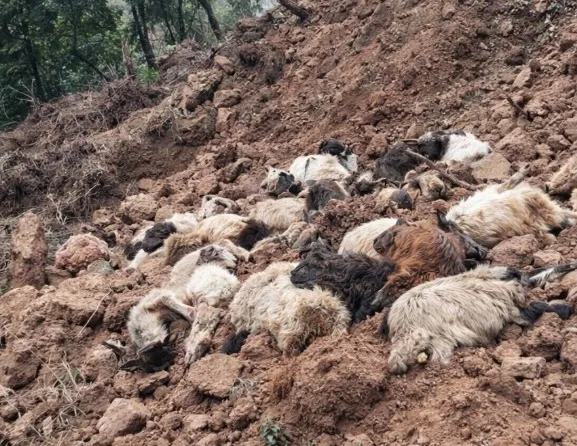
Dozens of livestock, including sheep and goats, were killed after a landslide struck near the Hasti bridge area of Jammu and Kashmir’s Kishtwar district on Wednesday, officials said.

The incident occurred when a group of shepherds was crossing the area along with their livestock. Sudden movement of debris triggered a landslide, burying several animals under mud and rocks. The shepherds accompanying the herd narrowly escaped and were reported to be safe.

Officials said rescue and clearance operations were underway to retrieve the buried animals, adding that the exact number of livestock lost would be known only after the operation is completed.

The incident comes amid adverse weather conditions in the Union Territory. Most parts of Jammu and Kashmir have witnessed fresh snowfall in higher reaches and rainfall in the plains over the past two days, increasing the risk of landslides in vulnerable areas.

Authorities have advised people, particularly nomadic shepherds and travellers, to remain cautious and avoid landslide-prone routes during the ongoing spell of inclement weather.

Opposition Protests in Parliament Over VB-G RAM G Act During President’s Address

0

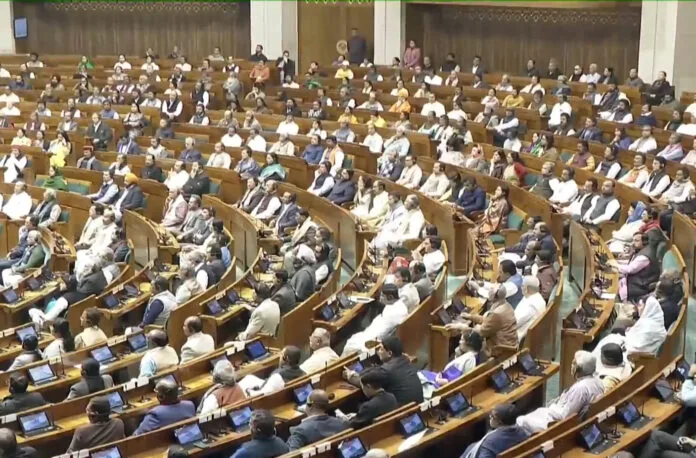
President Droupadi Murmu’s reference to the Viksit Bharat – Guarantee for Rozgar and Ajeevika Mission (Gramin) (VB-G RAM G) Act in her address to the joint sitting of Parliament on Wednesday triggered protests from Opposition parties, which raised slogans demanding rollback of the law.

While addressing members of both Houses at the start of the Budget Session, the President said the VB-G RAM G Act would provide a guarantee of 125 days of employment, curb corruption and leakages, and give fresh momentum to rural development. Her remarks were welcomed by members of the treasury benches, who thumped their desks in approval.

However, Opposition MPs strongly objected to the reference, raising slogans such as “vapas lo” (roll back the Act), forcing President Murmu to briefly pause her address.

The VB-G RAM G Act is set to replace the Mahatma Gandhi National Rural Employment Guarantee Act (MGNREGA). Opposition parties have demanded withdrawal of the new law and restoration of MGNREGA in its original, rights-based form, including the guaranteed right to work and the authority of panchayats.

The government, meanwhile, has maintained that the VB-G RAM G Act will further strengthen the rural employment guarantee system and improve transparency and efficiency in implementation.

Operation Sindoor Showcased India’s Strength, Any Terror Act Will Get Decisive Reply: President Murmu

0

President Droupadi Murmu on Wednesday asserted that India has sent a clear message to the world that any act of terrorism will be met with resolute and decisive action, saying the valour of the Indian armed forces was evident during Operation Sindoor, when terror camps were destroyed using indigenous capabilities.

Addressing a joint sitting of Parliament to mark the beginning of the Budget Session, the President said India had demonstrated that power can be exercised with responsibility and wisdom. “The world has seen the valour and courage of Indian armed forces through Operation Sindoor. Our nation, on the strength of our own resources, destroyed terror camps,” she said, amid loud desk-thumping by Prime Minister Narendra Modi and members of the treasury benches.

Murmu said the suspension of the Indus Water Treaty was also part of India’s broader fight against terrorism. She added that the government is working on Mission Sudarshan Chakra to further strengthen national security, while security forces have also taken firm action against Maoist violence. Following Operation Sindoor, she said, trust in Indian defence platforms has increased globally.

Highlighting the government’s social agenda, the President said her government remained committed to “true social justice” and empowering the poor. She said nearly 95 crore citizens are now covered under social security schemes, and around 25 crore people have moved out of poverty over the past decade.

Murmu also said the government has succeeded in tackling corruption and scams, ensuring better utilisation of public funds. “In the last 10–11 years, India has strengthened its foundation in every sector,” she said, describing the period as one marked by major achievements and transformative experiences.

Referring to national commemorations, the President said celebrations marking the 350th martyrdom anniversary of Guru Tegh Bahadur and the 150th birth anniversary of tribal leader Birsa Munda inspired the younger generation and strengthened the journey towards Viksit Bharat (Developed India). She also mentioned events linked to Sardar Vallabhbhai Patel and Bhupen Hazarika, saying they reinforced the spirit of unity and Ek Bharat, Shresht Bharat.

However, her reference to the Viksit Bharat–Guarantee for Rozgar and Ajeevika Mission (Gramin) (VB-G RAM G) scheme triggered sharp protests from Opposition benches. Murmu said the scheme would guarantee 125 days of work, curb corruption and leakages, and provide a boost to rural development.

Opposition members raised slogans demanding rollback of the Act, forcing the President to briefly pause her address. The Opposition has sought restoration of MGNREGA in its original, rights-based form, while the government maintains that the new legislation strengthens the rural employment guarantee framework.

Ajit Pawar Dies in Chartered Aircraft Crash at Baramati Airport

0

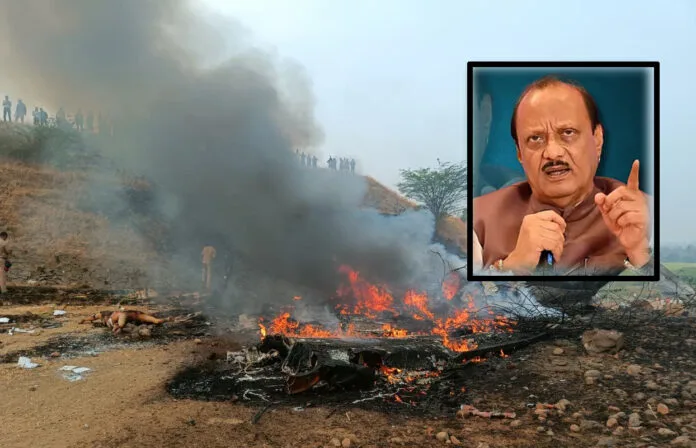
Maharashtra Deputy Chief Minister Ajit Pawar was killed on Wednesday morning after a chartered aircraft carrying him and others crash-landed at Baramati airport, officials said. The tragic incident occurred around 8.45 am as the aircraft was attempting to land after departing from Mumbai.

According to initial reports from aviation sources and state officials, the plane veered off the runway during the landing approach. Visuals from the crash site showed wreckage near the landing strip, with smoke billowing from the aircraft.

Authorities confirmed that Pawar and several others on board lost their lives in the accident. Emergency response teams, including local police, fire services and medical personnel, rushed to the spot immediately. Victims were pulled out of the wreckage and taken to nearby medical facilities, where they were declared dead.

The Directorate General of Civil Aviation (DGCA) is expected to launch a detailed investigation into the crash to determine its exact cause. Preliminary indications suggest that technical factors during the landing phase may have contributed to the accident, though officials said conclusions would be drawn only after a thorough probe.

Ajit Pawar, a senior leader of the Nationalist Congress Party (NCP) and nephew of veteran politician Sharad Pawar, was one of the most influential figures in Maharashtra politics. He served as the Deputy Chief Minister and held key portfolios in the state government, playing a central role in governance and political strategy.

News of his sudden death sent shockwaves across Maharashtra and the country, with political leaders across party lines expressing grief and condolences.

Official statements from the Maharashtra government, the DGCA and the local administration regarding the exact number of casualties and details of the investigation are awaited.

26 Chandigarh Schools Receive Bomb Threat Emails; Students Evacuated, Searches Yield Nothing Suspicious

0

As many as 26 schools in Chandigarh received bomb threat emails on Wednesday, prompting immediate evacuation of students and staff and triggering extensive anti-sabotage checks by police and security agencies.

Chandigarh Senior Superintendent of Police (SSP) Kanwardeep Kaur said anti-sabotage operations had been completed in 10 schools so far, with no suspicious material found. Similar checks were continuing in the remaining schools.

Following the receipt of threat emails on Wednesday morning, school authorities alerted the police, after which teams comprising local police, bomb disposal squads, sniffer dog units, fire brigades and ambulances were rushed to the affected campuses. Students and staff were evacuated as a precautionary measure, while students en route to schools were sent back home. Security was also heightened around the institutions.

The schools that received the threat emails include several government and private institutions located in sectors 25, 19, 45, 16 and other areas of the city.

Speaking to reporters, SSP Kaur said the threat emails were sent from a Gmail account and the Chandigarh Police cyber team is examining the source. “We received calls from 26 schools regarding bomb threat emails. An FIR has been registered at Sector 17 police station, and investigations are underway,” she said. She added that schools which did not receive threat emails remained open.

The SSP appealed to the public to remain calm and advised citizens to immediately dial the emergency helpline number 112 if they receive any threatening calls or messages.

In an official statement, the Chandigarh administration urged people not to panic and advised schools to strictly follow established protocols. “In case any threatening e-mail or message is received, it should be immediately reported to the police so that appropriate action can be taken,” the statement said.

The administration also cautioned schools against declaring holidays without verification, warning that such steps could lead to unnecessary panic among students, parents and the general public.

Chandigarh Deputy Commissioner Nishant Kumar Yadav also appealed to parents and citizens to remain calm, assuring them that the situation was under control.

The incident comes close on the heels of similar bomb threat emails sent to schools in parts of Punjab, including Amritsar, Jalandhar and Patiala, and in Ambala in Haryana, which later turned out to be hoaxes.

J&K Govt Constitutes District-Level Panels to Monitor Student Mental Health, Prevent Suicides

0

The Jammu and Kashmir Government has constituted District Level Monitoring Committees in all districts to strengthen mental health protection measures and prevent suicides among students.

According to a government order issued by the General Administration Department, each committee will be headed by the respective Deputy Commissioner. The Chief Education Officer, Chief Medical Officer, District Social Welfare Officer and a representative from civil society will be members of the panel.

The committees have been tasked with monitoring the mental well-being of students, identifying stress-related issues at an early stage and ensuring coordinated intervention by education, health and social welfare departments. They will also oversee awareness programmes, counselling initiatives and other preventive measures aimed at addressing mental health challenges among students.

The move is part of the government’s broader effort to create a supportive and responsive ecosystem for students, particularly in view of rising concerns over academic stress, anxiety and related mental health issues.

CM Omar Abdullah Mourns Death of Maharashtra Dy CM Ajit Pawar in Plane Crash

0

Jammu and Kashmir Chief Minister Omar Abdullah on Wednesday expressed deep grief over the death of Maharashtra Deputy Chief Minister Ajit Pawar, who was killed in a plane crash in Pune district earlier in the day. Describing Pawar as an able administrator and a consummate political organiser, Abdullah said his loss would be deeply felt across the political spectrum.

In a message posted on X, the Chief Minister recalled his long association with the senior Nationalist Congress Party (NCP) leader, dating back to his college days in Mumbai. Abdullah said he had known Ajit Pawar closely during the period when he stayed with NCP chief Sharad Pawar and his family at Varsha, the official residence of the Maharashtra Chief Minister.

“Shocked to hear about the untimely demise of Ajit Pawar Saab. I’ve known Ajit da since my days in college in Bombay when I stayed with Sharad Pawar Saab and his family at Varsha. Ajit da was an able administrator and a consummate political organiser whose loss will be greatly felt,” Abdullah wrote.

The Chief Minister also conveyed condolences on behalf of his family, saying he joined National Conference president Farooq Abdullah in extending sympathies to Sharad Pawar, Supriya Sule and other members of the bereaved family.

Ajit Pawar (66) was among five people killed when a private aircraft carrying them attempted an emergency landing at Baramati airfield in Pune district on Wednesday morning. The aircraft had taken off from Mumbai and was headed to Baramati, where Pawar was scheduled to address a public meeting ahead of the February 5 zilla parishad elections in Maharashtra.

The tragic incident has sent shockwaves across the country, with leaders from across party lines expressing grief over the sudden demise of one of Maharashtra’s most influential political figures.

Operation Sindoor shows strength of indigenous systems: Rajnath Singh

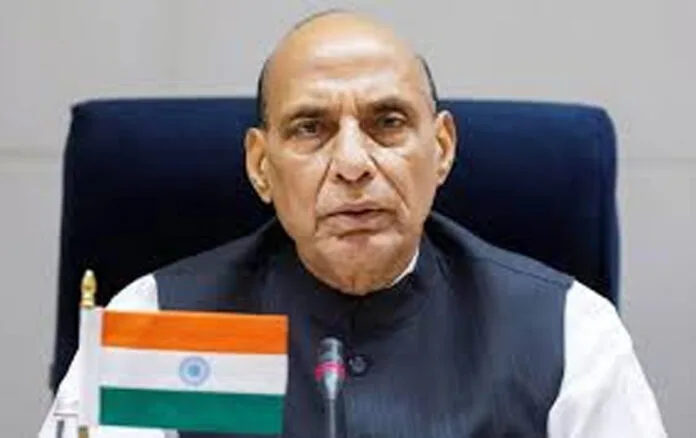
Defence Minister Rajnath Singh on Tuesday said Operation Sindoor demonstrated how indigenous defence systems are strengthening India’s operational readiness, underlining the crucial role played by the Defence Research and Development Organisation (DRDO) in advancing self-reliance, which he described as a “national mindset” under Prime Minister Narendra Modi’s leadership.

Addressing a gathering at a DRDO event here, Singh stressed that in an era of rapid technological change—particularly on the battlefield—India must prioritise speed in innovation and deployment. “Today, especially in warfare, we must think in terms of ‘survival of the fastest’, not just ‘survival of the fittest’. The country that thinks, decides and deploys technology quickly stays ahead,” he said.

Singh highlighted the need to significantly reduce the time lag between research and prototype development, testing and eventual deployment, asserting that timely induction into the armed forces should be the primary benchmark of success.

Referring to Operation Sindoor, the defence minister said DRDO-developed technologies were effectively used during the operation, underscoring the organisation’s role in the rapid transformation of India’s defence sector driven by indigenisation. DRDO-made platforms were deployed by Indian forces during the decisive military action in May 2025.

India launched Operation Sindoor on May 7 in response to the Pahalgam terror attack, carrying out air strikes on terrorist infrastructure in Pakistan-controlled territories. The strikes led to four days of intense military exchanges, which ended with an understanding to halt hostilities on May 10.

Singh urged the DRDO to move beyond areas where the private sector has already built strong capabilities and suggested creating a separate wing within the organisation to take calculated risks in emerging and high-uncertainty domains. “If success is achieved in such sectors, the outcome will be historic,” he said.

Calling for deeper collaboration, Singh emphasised the need to bridge the gap between design, prototyping and production. He advocated a co-development model, with industry involvement from the early stages of system design through production, drawing parallels with international best practices.

He cited the Light Combat Aircraft Tejas as a successful example of collaboration between the DRDO and Hindustan Aeronautics Limited, and said many more such achievements were possible if the DRDO worked closely with public sector undertakings, private industry, MSMEs, start-ups and academia. “Government support will be meaningful only when the DRDO moves from a monopolistic R&D model to a collaborative ecosystem,” he said.

Highlighting the growth in defence exports, Singh said exports had risen from less than Rs 1,000 crore in 2014 to nearly Rs 24,000 crore at present. He reiterated the government’s target of achieving defence exports worth Rs 50,000 crore by 2029–30, and urged the DRDO to factor in export potential from the design stage, particularly in areas such as drones, radars, electronic warfare systems and ammunition.

Focusing on human capital, Singh described scientists, engineers and technicians as the real strength of the DRDO and stressed the need to provide them with learning opportunities, leadership roles and an environment where innovation is encouraged. “Failures are a part of research, and we must learn from them,” he said.

On the occasion, Singh presented awards under the DRDO Award Scheme 2024. A book titled ‘The Unprecedented Success Story of the First Indigenous Supersonic Multi-Target Surface-to-Air Missile System — AKASH’ was also released.