Monday, July 13, 2026
Home Blog Page 53

Six Skiers Rescued After California Avalanche, Search Continues for Nine Others

0

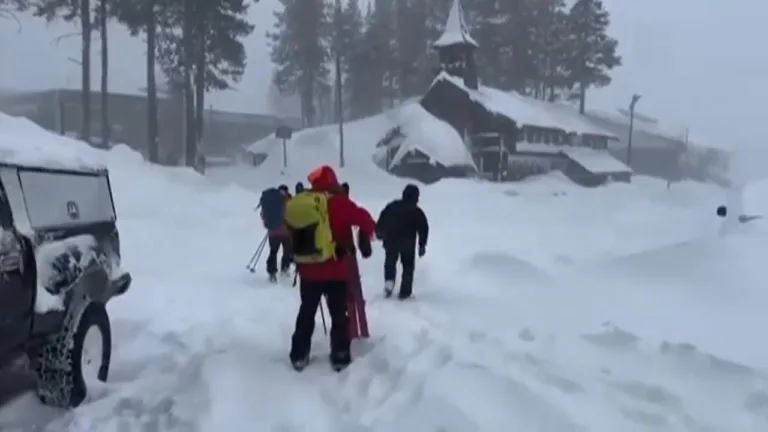
Nevada County, California – Six skiers trapped in an avalanche in the mountains of California have been rescued, while search teams continue looking for the remaining nine, according to the Nevada County Sheriff’s Office.

Authorities initially reported that 16 skiers were caught in the avalanche on Tuesday, with six surviving and 10 missing. They later corrected the total to 15 people involved.

“The six skiers who survived the avalanche have been successfully rescued this evening by search and rescue teams. They sustained varying injuries. Due to extreme weather conditions, it took several hours for rescue personnel to safely reach them and transport them to safety, where they were medically evaluated by Truckee Fire. Two of the six have been transported to a hospital for treatment,” the local police said on social media.

Search operations continue for the other nine skiers, officials added.
Jammu and Kashmir to Get Adi Shankaracharya Temple and International Goddess Museum in Katra, LG Announces

0

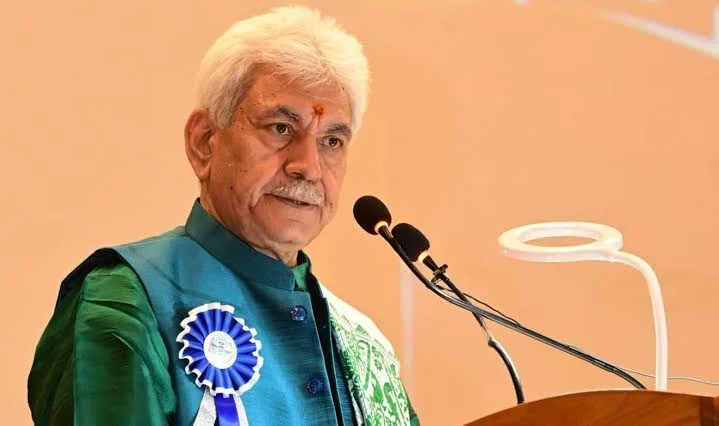
 Jammu and Kashmir Lieutenant Governor Manoj Sinha on Thursday unveiled a series of major initiatives for the development of Katra, including the construction of a grand temple dedicated to Adi Shankaracharya and the establishment of an International Museum of Goddess Devi.

Addressing the public, Sinha said several facilities have already been set up in Katra and announced plans to launch helicopter services from Katra to the Shiv Khori cave shrine of Lord Shiva, expected to be operational within three months.

Shankaracharya Temple and Goddess Museum

Sinha laid the foundation stone of the Shankaracharya temple, a project first conceived in 1967, describing it as a state-of-the-art facility. The initiative follows the proposed International Museum of Goddess Devi, which will feature replicas and representations of major ‘devi’ pilgrimage sites from across India at Katra, the base camp of Mata Vaishno Devi.

“Adi Shankaracharya undertook a cross-country visit and set up four maths. He also visited Jammu and Kashmir. A temple in Srinagar dedicated to Shankaracharya attracts hundreds of pilgrims,” Sinha said. “Now, the Shrine Board, district administration, and residents have collectively decided to construct a grand temple dedicated to him. A temple for the local deity will also be built.”

Infrastructure and Pilgrim Facilities

The LG highlighted plans to strengthen road infrastructure and construct 50 shops to support local livelihoods. Renovation of the Bhoomika temple and improved facilities for devotees are also in the pipeline.

The International Museum of Goddess Devi will feature a light and sound show inspired by those at Somnath Temple and the Statue of Unity, offering visitors a rich spiritual and cultural experience.

Helicopter Service to Shiv Khori

To ease pilgrim access to the Shiv Khori shrine, the Shiv Khori Shrine Board and Shri Mata Vaishno Devi Shrine Board have decided to operationalise helicopter services between Katra and Shiv Khori. Helipads at both locations are nearing completion, with flights expected to begin within three months.

Social Welfare and Disaster Relief

Sinha also announced a joint rehabilitation programme for ponywalas and laborers, following recommendations by an empowered committee under the National Green Tribunal. The Shrine Board will take full responsibility for their phased rehabilitation.

He praised the Shrine Board for its role during recent floods, including organising health camps, supplying essential materials, and reconstructing 15 schools damaged by heavy rainfall. Last year, the Board constructed five temples, with five more under construction and another five planned in Diggar for local residents.

“Along with the municipality and the Jammu and Kashmir administration, the Shrine Board will provide financial support for the town’s modernisation and infrastructure development,” Sinha added, emphasizing holistic development for Katra.

At Least Five Detained as Hunt Intensifies for Gangster Who Escaped Juvenile Home in Jammu

0

Officials on Wednesday said that at least five suspected persons have been detained for questioning as the search continues for a gangster who escaped from a juvenile home in a border village of Jammu two Pakistani nationals, Mohammad Suna-ullah (20) and Ahsan Anwar (21), were arrested on Tuesday, within 20 hours of the incident near Ambala railway stationitive, Karajeet Singh alias Gugga, a resident of Dablehar in R S Pura, along with the two Pakistani nationals, allegedly attacked police personnel and fled from the juvenile home around 5 pm on Monday (February 16), injuring two cops.

A video purportedly showing Singh, reportedly linked to the ‘Khauff’ gang, firing rounds inside the juvenile home has been circulating on social media, raising public concern. Officials said Singh, believed to be the mastermind of the escape, is still at large and special teams have been deployed across Jammu and nearby areas to apprehend him.

It was further stated that Singh’s mother is also missing from her Jammu residence and is believed to be accompanying him. The five people detained for questioning were in regular contact with Singh inside the juvenile home.

Singh had earlier been arrested in connection with the murder of rival gang leader Sumit Jandiyal alias Gataru in the Jewel Chowk area in January last year, and was lodged in the juvenile home.

Following the escape, six police personnel, including an assistant sub-inspector, have been suspended for dereliction of duty.

An FIR has been registered under sections 109 (attempt to murder), 132 (assault on public servant), 262 (resisting lawful custody), 307 (preparatory acts for causing death or hurt), 111 (organized crime) of the Bharatiya Nyaya Sanhita and sections 3 and 25 of the Arms Act (unauthorized possession and use of firearms).

Jal Shakti Minister Javed Ahmed Rana Announces Strengthening of Drinking Water Infrastructure in Basohli

0

Minister for Jal Shakti, Javed Ahmed Rana on Wednesday stated that the government is taking multiple measures to strengthen drinking water infrastructure in the Basohli constituency through various Water Supply Schemes (WSSs) across rural and urban areas.

Replying to a question raised by MLA Darshan Kumar in the Jammu and Kashmir Legislative Assembly, the Minister said that for rural areas, drinking water supply is being strengthened through 43 schemes, including 42 under the Jal Jeevan Mission worth ₹242.46 crore and one under NABARD. “Of these, six schemes have been completed while the remaining are at advanced stages of completion,” he added.

For urban areas, water supply is being maintained through existing schemes, which are further enhanced under AMRUT 2.0. Under this, a project titled “Augmentation and Improvement of Water Supply System in Basohli Town under AMRUT 2.0” has been sanctioned at an estimated cost of ₹12.60 crore to boost the overall water infrastructure.

To ensure uninterrupted drinking water access during the execution of these schemes, water is being supplied through existing systems and water tankers are deployed wherever needed.

The Minister also provided details on the progress of completed, ongoing, and commissioned water supply schemes under the Jal Jeevan Mission in the constituency. He informed that the Government of India has extended the Jal Jeevan Mission timeline up to December 2028 and assured that all pending schemes will be completed within this period, with strenuous efforts underway for timely completion.

Regarding contractor payments, Rana said that Call Deposit Receipts (CDRs), Security Deposits, and Performance Security amounts are being released strictly as per the terms and conditions of the respective contracts.

J&K CM Omar Abdullah Moves 13 Demands and 19 Supplementary Demands in Assembly

0

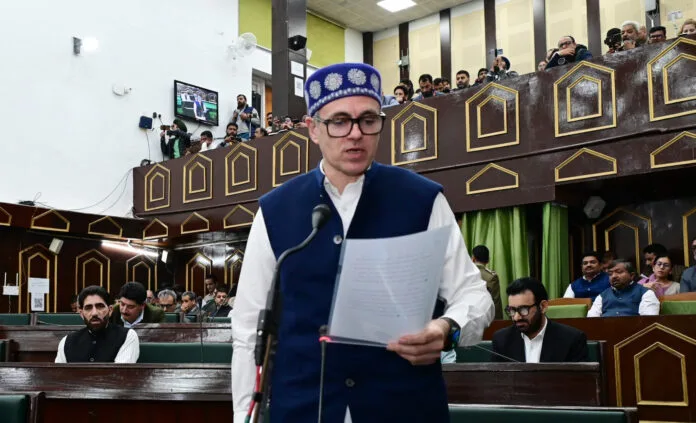
Chief Minister Omar Abdullah on Wednesday presented 13 Demands and 19 Supplementary Demands in the Jammu and Kashmir Legislative Assembly. The proposals were tabled before the House for discussion by Speaker Abdul Rahim Rather.

Addressing the House, the Chief Minister said, “I move that a sum not exceeding the aggregate amount mentioned in Demand Nos. 1, 3, 4, 6, 8, 9, 10, 14, 19, 20, 24, 31 and 33 be granted to the Government to defray charges during the year ending 31st March, 2027 in respect of Heads indicated in the List of Business against each demand.”

These Demands for Grants pertain to several departments under the Chief Minister’s charge, including the General Administration Department, Planning, Monitoring and Development, Information, Power, Finance, Parliamentary Affairs, Law & Justice, Revenue, Housing, Tourism, Hospitality & Protocol, Estates, Culture, and Disaster Management.

He further added, “I also move that a sum not exceeding the aggregate amount mentioned in Supplementary Demand Nos. 1, 2, 3, 6, 7, 8, 10, 12, 13, 17, 18, 19, 20, 25, 26, 30, 32, 35 and 36 be granted to the Government to defray charges during the year ending 31st March, 2026 in respect of Heads indicated in the List of Business against each demand.”

The discussion on Demands for Grants will continue on February 18 and 19, with the Chief Minister scheduled to reply on February 19 afternoon. This will be followed by a voice vote in the House to pass the demands.

Netherlands PM Dick Schoof Arrives in India for Global AI Impact Summit 2026

0

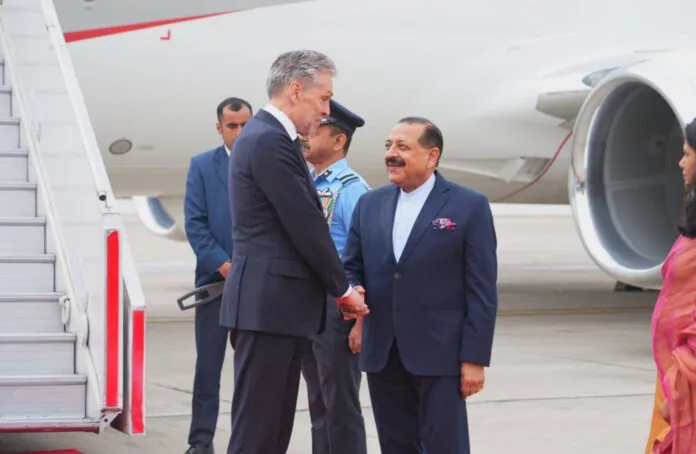
Prime Minister of the Netherlands Dick Schoof arrived in India on Wednesday to attend the India AI Impact Summit 2026, as New Delhi hosts one of the most significant global gatherings on artificial intelligence.

Schoof was received at the airport in New Delhi by Minister of State Jitendra Singh.

In a post on X, the Ministry of External Affairs said his participation in the summit would further deepen and strengthen the bilateral partnership between India and the Netherlands.

The India AI Impact Summit 2026 is being held at Bharat Mandapam from February 16 to 20. The summit has brought together global policymakers, AI industry leaders, academicians, technology innovators and civil society representatives to advance discussions on artificial intelligence governance, safety and societal impact.

Earlier in the day, Prime Minister Narendra Modi held several bilateral meetings on the sidelines of the summit with Croatia’s Prime Minister Andrej Plenković, Google CEO Sundar Pichai, Serbian President Aleksandar Vučić, Finland’s Prime Minister Petteri Orpo and Spanish Prime Minister Pedro Sánchez.

Among other dignitaries who arrived in the national capital for the summit are Seychelles Vice President Sebastien Pillay, Mauritius Prime Minister Navinchandra Ramgoolam and Sweden’s Deputy Prime Minister and Minister for Energy, Business and Industry Ebba Busch.

The summit, the first global AI gathering to be hosted in the Global South, seeks to reflect on the transformative potential of artificial intelligence in line with the national vision of “Sarvajana Hitaya, Sarvajana Sukhaya” (welfare for all, happiness for all) and the broader principle of AI for Humanity.

With participation from more than 110 countries and 30 international organisations — including around 20 Heads of State or Government and about 45 ministers — the summit forms part of an evolving international effort to strengthen cooperation on AI governance, safety and its societal impact.

The India AI Impact Summit 2026 is guided by three foundational pillars — People, Planet and Progress — aimed at promoting human-centric AI, environmentally sustainable technological advancement and inclusive economic growth.

Rahul Gandhi Calls AI Summit a ‘Disorganised PR Spectacle’, Alleges Chinese Products Showcased

0

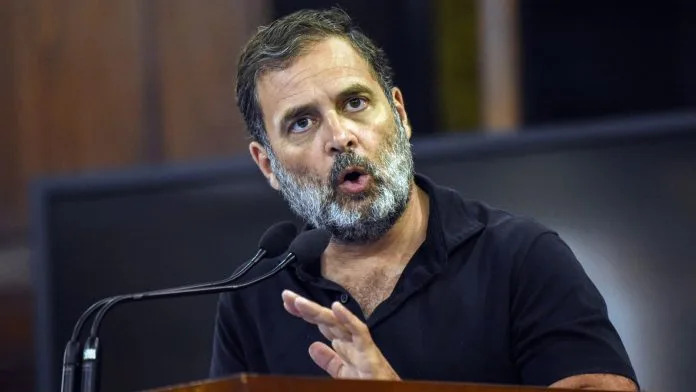
Congress leader Rahul Gandhi on Wednesday termed the AI Summit a “disorganised PR spectacle” and alleged that Chinese products were being showcased at the event instead of promoting indigenous innovation.

In a post on X, the former Congress president said, “Instead of leveraging India’s talent and data, the AI summit is a disorganised PR spectacle – Indian data up for sale, Chinese products showcased.”

The remarks came amid a controversy involving Galgotias University, which allegedly displayed a robotic dog labelled “Orion” at the AI Summit Expo. Critics claimed that the robot was actually a Chinese-made Unitree Go2 and not an in-house innovation.

According to sources, the university has been asked to vacate its stall at the expo immediately.

Gandhi also tagged a post by the Indian National Congress alleging that the Modi government had made India a “laughing stock” globally on the issue of artificial intelligence. The party claimed that Chinese robots were being presented as Indian innovations at the summit.

“The Chinese media has mocked us. This is truly embarrassing for India. What is even more shameful is the fact that Modi’s minister Ashwini Vaishnaw is indulging in the same falsehood, promoting China’s robots at the Indian summit,” the Congress said.

The party further alleged that the government had caused “irreparable damage” to the country’s image and reduced AI — a field where India could emerge as a global leader — to a subject of ridicule.

President Droupadi Murmu Says Indian Navy Vigilant in Safeguarding Maritime Interests at International Fleet Review

0

February 18: Droupadi Murmu on Wednesday said the Indian Navy remains vigilant in safeguarding the country’s maritime interests and contributes to stability across wider maritime commerce.

Presiding over the International Fleet Review (IFR) off the coast of Visakhapatnam aboard an Indian naval warship in the Bay of Bengal, the President said the Navy is deployed in the region as a credible instrument of deterrence and defence against emerging maritime threats and challenges.

“Indian Navy is vigilant in safeguarding India’s maritime interests and is contributing to stability across wider maritime commerce,” Murmu said.

She noted that the Navy also plays a vital role in promoting goodwill and building bridges of trust, confidence and friendship with navies across the globe.

Highlighting the maritime legacy of Visakhapatnam, which houses the Eastern Naval Command, the President said the city has a glorious maritime past and that the fleet review underlines its enduring naval significance.

Expressing happiness at witnessing the impressive fleet of warships and displays by naval personnel from India and friendly countries, Murmu conveyed her compliments to the participating contingents.

She said the IFR reflects unity, trust and mutual respect among nations for maritime traditions, with ships bearing different flags and sailors from diverse countries symbolising the spirit of togetherness.

Reflecting on India’s deep and enduring relationship with the seas, stretching back centuries, the President described the oceans as pathways of commerce, connection and cultural exchange.

Referring to the festival of Bali Jatara celebrated in Cuttack during the week beginning on Karthik Purnima, she said it honours ancient sailors from present-day Odisha. The festival commemorates the maritime tradition of regular voyages to Southeast Asia since the era of the ancient Kalinga empire.

“These travels contributed to the exchange of trade and goods, ideas and values, shaping a shared cultural consciousness across the region,” she said.

Murmu added that the fleet review advances India’s vision of ‘Mahasagar’, symbolising mutual and historic advancement of security and growth across regions.

Jammu and Kashmir Enter Ranji Trophy Final for the First Time with Six-Wicket Win Over Bengal

0

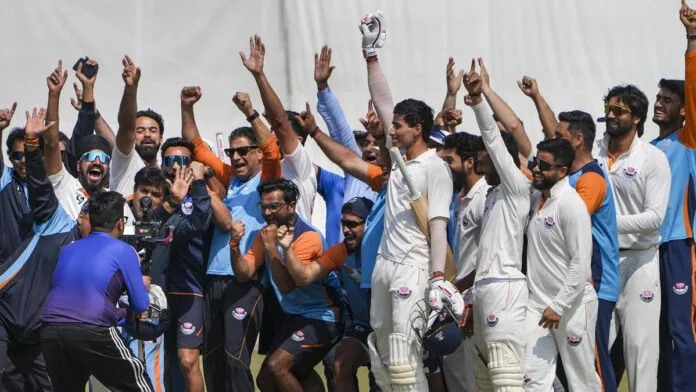
February 18: Jammu and Kashmir cricket team scripted history by reaching the final of the Ranji Trophy for the first time in their 67-year history, defeating two-time former champions Bengal cricket team by six wickets on the fourth day of their semifinal on Wednesday.

Chasing a modest target of 126 set by the hosts, Jammu and Kashmir completed the run chase in 34.4 overs, finishing at 126 for 4. Vanshaj Sharma remained unbeaten on 43, while Abdul Samad scored an unbeaten 30, as the duo guided the team home with a crucial 55-run partnership.

The victory was set up by pace spearhead Auqib Nabi, who claimed nine wickets in the match to dismantle Bengal’s batting and put his side in a commanding position.

Jammu and Kashmir first participated in the Ranji Trophy in the 1959–60 season and had never been considered serious title contenders. In the 2013–14 season, they reached the knockout stage for the first time in over a decade, but this marks their maiden appearance in the final.

Resuming day four at 43 for 2, Jammu and Kashmir lost overnight batter Shubham Pundir (27) and skipper Paras Dogra (9) early in the morning session. However, Sharma and Samad held their nerve to steer the side to a historic triumph.

Brief Scores:

Bengal: 328 and 99 (25.1 overs)

Jammu and Kashmir: 302 and 126/4 (34.4 overs) – Vanshaj Sharma 43*; Abdul Samad 30*

Saffron Output in J&K Drops to 19.58 MT in 2024–25; Govt Cites Productivity Fluctuations

0

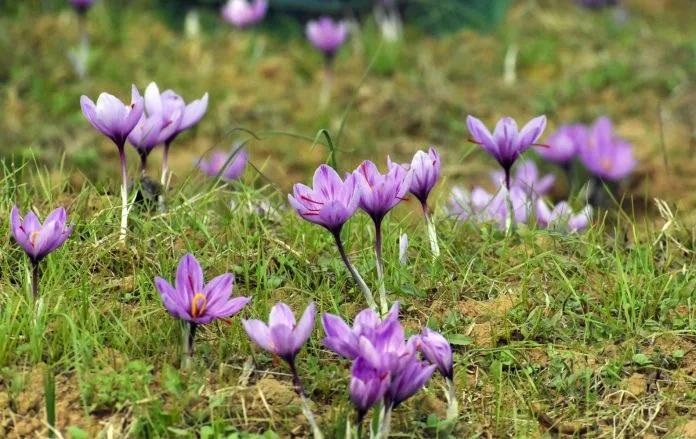
Saffron production in the Union Territory of Jammu and Kashmir has declined to 19.58 metric tonnes (MT) in 2024–25 from 23.53 MT recorded in 2023–24, according to official data tabled in the House.

In a written reply to a question raised by Hasnain Masoodi, Deputy Chief Minister Surinder Kumar Choudhary said that while the total area under saffron cultivation has remained constant at 1,116.27 hectares, overall output and productivity have fluctuated over the past five years.

As per the data shared, saffron production stood at 17.33 MT in 2020–21, declining to 14.87 MT in 2021–22 and marginally improving to 14.94 MT in 2022–23. The sector witnessed a sharp rise in 2023–24 with output reaching 23.53 MT, before falling again in 2024–25.

Average productivity, combining traditional and rejuvenated fields, improved from 4.02 kg per hectare in 2022–23 to 6.33 kg per hectare in 2023–24. However, it slipped to 5.27 kg per hectare in 2024–25.

Exports also registered a dip during the period under review. Saffron exports in 2024–25 were recorded at 17.82 MT, compared to 20.47 MT in the previous year. The total value of saffron production during 2024–25 stood at ₹534.53 crore, while export earnings were pegged at ₹486.43 crore.

Providing details of traditional (non-rejuvenated) saffron areas, Choudhary said production from these fields was 5.02 MT in 2024–25, with a productivity of 4.5 kg per hectare. In 2023–24, traditional areas produced 5.44 MT, with productivity of 4.87 kg per hectare.

The Deputy Chief Minister said the government is making efforts to stabilise and enhance saffron productivity through improved agronomic practices and rejuvenation measures aimed at strengthening the sector.