Thursday, July 23, 2026
Home Blog Page 252

J&K BJP Chief Spokesperson Accuses NC and Congress of Misrepresenting Maharaja Hari Singh’s Legacy

0

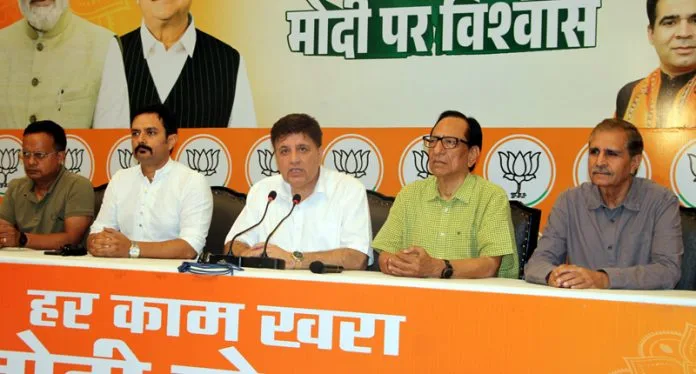
Sunil Sethi, the chief spokesperson of the Jammu and Kashmir BJP, today criticized both the National Conference (NC) and Congress for distorting history and diminishing the contributions of Maharaja Hari Singh. During a press conference, Sethi alleged that these parties portrayed the Maharaja in a negative light to glorify Sheikh Abdullah and undermine the Maharaja’s role in the state’s history.

Sethi, alongside BJP spokespersons Abhijeet Jasrotia, Lt Gen (retd) Rakesh Sharma, Dr. Tahir Chowdhary, and YV Sharma, emphasized that it was due to Maharaja Hari Singh’s leadership that Jammu and Kashmir became an integral part of India. However, he claimed that NC and Congress repeatedly belittled the Maharaja’s contribution, particularly his work on social reforms, while promoting Sheikh Abdullah as a “hero.”

Maharaja’s Exile and NC-Congress Policies
Sethi highlighted that NC and Congress were responsible for exiling Maharaja Hari Singh and never allowing him to return to Jammu and Kashmir until his death. He pointed out that while these parties celebrated the birthdays of Sheikh Abdullah and observed Martyr’s Day, they ignored the Maharaja’s contributions, leading to public agitation in Jammu demanding a holiday on his birthday.

The BJP, according to Sethi, corrected this historical wrong by declaring a holiday on September 23, Maharaja Hari Singh’s birthday. He challenged Rahul Gandhi and the NC to explain why the Maharaja was “insulted,” sent into exile, and barred from returning to his homeland.

Contradictions in Congress’ Relationship with Sheikh Abdullah
Sethi also accused the Congress of hypocrisy in its dealings with Sheikh Abdullah, first imprisoning him on charges of being anti-national, and later appointing him as Chief Minister. He further questioned why a holiday was declared in Sheikh’s honor, while Maharaja Hari Singh’s legacy was ignored.

BJP’s Role in Honoring the Maharaja
Sethi underscored that the BJP has given Maharaja Hari Singh the rightful place in history, unlike NC and Congress. He argued that it is only the BJP that has consistently celebrated the Maharaja’s birthday and upheld his contributions to Jammu and Kashmir.

Abhijeet Jasrotia’s Remarks on Jammu Discrimination
Abhijeet Jasrotia, speaking at the same event, reiterated that both NC and Congress have historically discriminated against Jammu and its people. He criticized the allocation of more Lok Sabha and Assembly seats to Kashmir, despite Jammu having a larger area and population. Jasrotia further condemned these parties for removing the Dogra certificate, which is a significant identity marker for the people of Jammu.

He concluded by stating that only the BJP is committed to safeguarding the future and identity of Jammu and its Dogra community, while Congress has consistently let down the region.
DGP RR Swain Sanctions Rs 2.04 Crore as Special Welfare Relief for Families of Deceased J&K Police Personnel

0

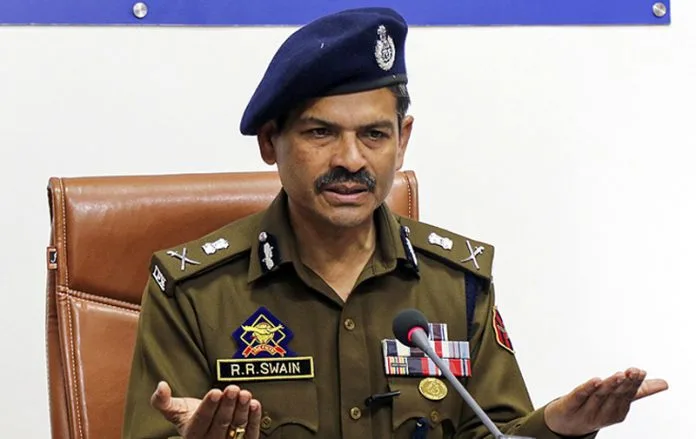
Director General of Police (DGP) of Jammu & Kashmir, RR Swain, has sanctioned Rs 2.04 crore as special welfare relief for the next of kin (NoK) of deceased police personnel and Special Police Officers (SPOs) who passed away while in service.

The relief includes Rs 22 lakh each for the legal heirs or dependents of nine police personnel who succumbed to illness during their service. Additionally, the families of the deceased had already been granted Rs 1 lakh for performing the last rites. The relief is drawn from the Contributory Police Welfare Fund, established to support families of police personnel.

In another case, Rs 6 lakh has been sanctioned for the family of SPO Deepak Sharma, who passed away while actively serving in the department. His family had earlier received an immediate relief of Rs 50,000 for last rites.

Marriage Assistance for Martyr’s Daughter
In a separate announcement, Rs 1 lakh has been sanctioned for the marriage of a martyr’s daughter, demonstrating the police department’s ongoing commitment to supporting the families of fallen personnel.

This welfare initiative underscores the department’s dedication to the well-being of the families of its officers and personnel, ensuring that those who serve the community are remembered and their families cared for.

Over 7,000 Polling Staff, Thousands of Security Personnel Deployed for Phase 2 of Central Kashmir Assembly Elections

0

Over 7,000 polling staff and thousands of security personnel have taken positions across 1,838 polling stations in Central Kashmir’s 15 Assembly constituencies, as the region gears up for the second phase of Assembly elections scheduled for tomorrow. The constituencies span across the districts of Srinagar, Budgam, and Ganderbal, where voting will decide the fate of 160 candidates.

Polling staff began arriving at distribution centers early in the morning, with the exercise completed by afternoon. The distribution centers were heavily secured, with roads around them blocked to ensure smooth operations. Polling staff, accompanied by electronic voting machines (EVMs), were dispatched to polling stations by vehicles parked near the distribution centers since yesterday.

Multi-Tier Security Blanket
To ensure the safety and smooth conduct of the elections, a multi-layered security arrangement has been put in place. The security force deployment includes personnel from the local police, armed police, and Central paramilitary forces. Sensitive areas have been identified, with additional forces stationed in these locations to prevent any disruptions.

“The safety of voters is our top priority,” said Inspector General of Police (IGP), Kashmir, VK Birdi. “We have made elaborate arrangements to create a fear-free atmosphere at each polling station. Voters can come out in large numbers without hesitation.”

EVMs Secured with Round-the-Clock Surveillance
Post-election, strong rooms where EVMs will be stored have been secured with round-the-clock digital surveillance to safeguard their integrity. In addition, all polling stations will be equipped with webcasting facilities, allowing real-time monitoring by election officials to ensure transparency and prompt response to any issues.

15 Lakh Voters to Decide the Fate of 160 Candidates
An estimated 14,96,556 voters—including 7,51,572 male voters, 7,44,941 female voters, and 43 third-gender voters—are eligible to cast their ballots in tomorrow’s election. Polling will take place from 7:00 am to 6:00 pm.

Srinagar District has the highest number of voters with 7,76,674 registered voters, spread across 932 polling stations in eight constituencies. Budgam District has 5,11,864 voters in five constituencies, and Ganderbal District has 2,08,018 voters across two constituencies.

Prominent Candidates in the Fray
Some of the prominent candidates include:

Omar Abdullah, National Conference (NC) Vice President, contesting from Ganderbal and Budgam.
Ali Mohammad Sagar, NC General Secretary.
Abdul Rahim Rather, former NC Finance Minister.
Mubarak Gul, former Speaker and NC leader.
Aasia Naqash and Ghulam Nabi Hanjoora, former ministers from the People’s Democratic Party (PDP).
Syed Mohammad Altaf Bukhari, Chief of the Apni Party.
Hakeem Mohammad Yasin, former minister.
Sarjan Ahmad Wagay (Barkati), jailed separatist leader contesting from two constituencies: Ganderbal and Beerwah.
Webcasting for Transparency
The Election Commission of India (ECI) has ensured that all polling stations will be equipped with webcasting facilities to bolster transparency and maintain public confidence in the voting process. This initiative is aimed at minimizing electoral malpractices and ensuring that the elections proceed smoothly.

The results of tomorrow’s polling will shape the future political landscape of Central Kashmir as voters across 15 constituencies make their voices heard.

Union Minister Ashwini Vaishnaw: Railway Administration on High Alert for Potential Sabotage Threats

0

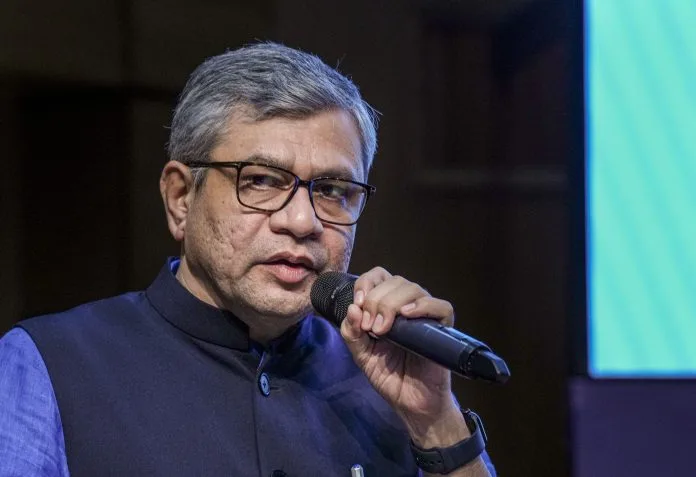
Jaipur, September 24: Union Minister Ashwini Vaishnaw announced on Tuesday that the railway administration is on high alert to prevent potential sabotage attempts targeting trains. Speaking to reporters at the Jaipur airport, Vaishnaw emphasized the seriousness with which the central government treats any security threat to the railway network, assuring that strict action will be taken against anyone attempting to sabotage trains.

“There is ongoing dialogue with state governments, DGPs, and home secretaries. The NIA (National Investigation Agency) is also involved, and our commitment is firm—strict action will be taken against anyone who tries to cause such accidents,” Vaishnaw stated.

The minister arrived in Jaipur to inspect the Kavach-fitted train at Sawai Madhopur. Kavach, also known as the Automatic Train Protection (ATP) system, has been developed by the Research Designs and Standards Organisation (RDSO) to enhance safety on the Indian Railways. This system can automatically apply brakes in an emergency if the train driver fails to respond in time.

Vaishnaw boarded the Kavach-equipped train engine at Sawai Madhopur Railway Station and traveled for 45 minutes up to Indargarh to test the system’s efficiency. He also inspected the newly constructed roof plaza at Gandhi Nagar Railway Station in Jaipur as part of his visit.

The railway minister stressed that divisions and zones of the railway administration, along with the Railway Protection Force (RPF) and local state police, are working vigilantly to ensure the security of the rail network.

During his visit to Jaipur, Vaishnaw also met with Chief Minister Bhajanlal Sharma and later interacted with BJP workers at Bhatia Bhawan in the Rajapark area of the city.

The Kavach system has been under development for the past eight years, and the railway ministry is implementing it in phases to improve train safety across the country.

Central University of Jammu Celebrates the Birth Anniversary of Maharaja Hari Singh Ji with Enthusiasm and Reverence

0

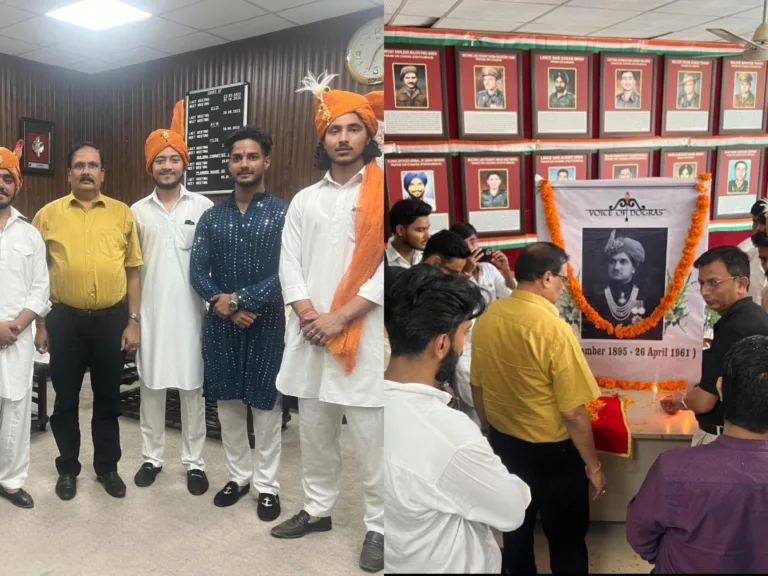
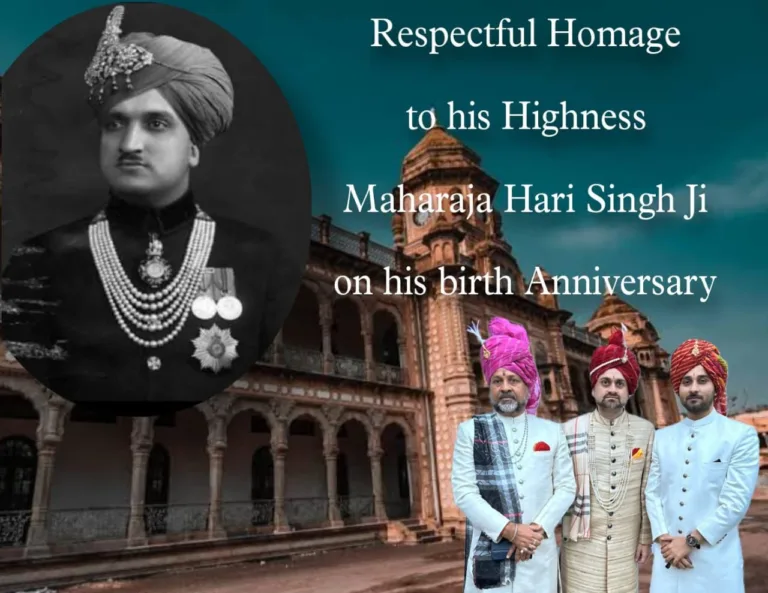
Jammu, 23 Sept 2024: Central University of Jammu commemorated the birth anniversary of Maharaja Hari Singh Ji with great pride and enthusiasm, honoring the legacy of the last Dogra ruler. The event took place in the university’s main DDE building Corridor and was attended by faculty, staff and students.

The program began with a keynote address by the Honourable Vice Chancellor, Prof. Sanjeev Jain, who paid tribute to Maharaja Hari Singh Ji. Prof. Jain highlighted Maharaja’s contributions to the region and his progressive vision for Jammu and Kashmir. In his address, Prof. Jain emphasized the Maharaja’s unwavering commitment to social reforms, education, and equality. He urged students to draw inspiration from the Maharaja’s life, encouraging them to work for the betterment of society, just as the Maharaja had during his reign.


Prof. Jain, highlighted Maharaja Hari Singh Ji’s leadership, particularly his efforts in promoting education and social justice. He stressed the importance of celebrating historical events in educational institutions, as they play a crucial role in instilling cultural and historical awareness in young minds. He reflected on the Maharaja’s role in shaping modern Jammu and Kashmir, and how his reforms continue to influence the region today.

The celebration further saw students from various departments dressed in traditional attire, symbolizing the rich cultural heritage of the Dogra community.The event concluded with the echo of the slogan “Jai Duggar! Jai Dogra!” which filled the hall, representing the unity and pride of the Dogra people.

Ghulam Nabi Azad: I Was the Only Leader to Speak Against Article 370 Abrogation in Parliament

0

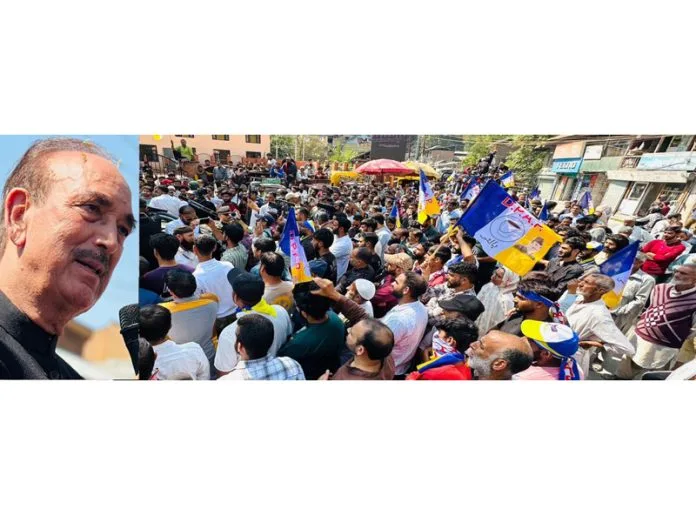
Democratic Progressive Azad Party Chief and former Chief Minister of Jammu and Kashmir, Ghulam Nabi Azad, reaffirmed his position as the sole leader who vocally opposed the abrogation of Articles 370 and 35-A in Parliament. Speaking to reporters during a roadshow in Ganderbal, which will go to polls on September 25, Azad claimed that his opposition to the move prompted Home Minister Amit Shah to promise the restoration of statehood to Jammu and Kashmir.

Azad, in his remarks, emphasized that the restoration of Article 370, statehood, and the Legislative Council can only be achieved through Parliament, regardless of which political party is in power. He asserted, “Whether it is Congress, BJP, or any other party in power, Parliament holds the authority to restore these provisions.”

Reflecting on his parliamentary speeches, Azad said, “I was the only leader to give six speeches in Parliament against the abrogation of Article 370. No other leader from Jammu and Kashmir, whether from the Rajya Sabha or the Lok Sabha, spoke on the issue. It was only after my speeches that the Home Minister assured the restoration of statehood.”

Azad also clarified a common misconception regarding Article 35A, stating that it was not a post-independence law but was instituted by Maharaja Hari Singh at the request of Jammu Hindus and Kashmiri Pandits. This historical fact, according to Azad, was unknown to many before he spoke about it in Parliament.

When asked about Home Minister Amit Shah’s tough stance on Kashmir and regional parties, Azad stated that political parties should be free to express their views and that both the state and central governments must act according to the Constitution. He argued that meaningful dialogue requires the devolution of power to state leaders, ensuring their voices are heard in the political process.

In addition, Azad underscored the importance of secularism in politics, stating, “For me, all religions in India are the same, and there should be no discrimination.” He called for all parties to use clean and secular language, stressing that political competition should not turn adversarial.

Azad also took a stand against political autocracy, asserting, “I have made it clear that neither my son nor my daughter will become Chief Ministers. I am fighting against autocratic rule, whether it is in Delhi or Jammu and Kashmir.”

He further noted that the state subject law, which had been established by Maharaja Hari Singh, was the identity of the people of Jammu and Kashmir. This law, he said, was later enshrined in both the Indian and state constitutions.

Azad’s remarks come at a crucial time, as the Ganderbal constituency prepares for the second phase of polling, with statehood and Article 370 remaining significant issues in the political discourse of Jammu and Kashmir.

Prime Minister Narendra Modi Highlights Humanity’s Collective Strength at UN’s Summit of the Future

0

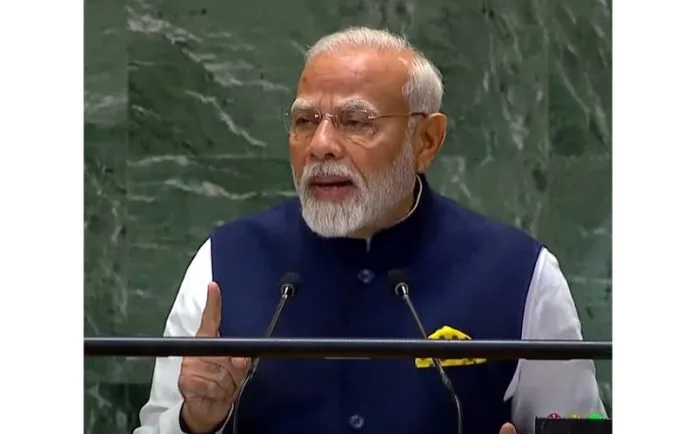
Addressing the UN’s Summit of the Future, Prime Minister Narendra Modi emphasized the importance of humanity’s collective strength in overcoming challenges, stating that “success lies not on the battlefield but in our shared efforts.” His remarks were made in light of ongoing global conflicts, including the Israel-Hamas crisis and the war in Ukraine.

Modi, representing 1.4 billion Indians, began his address with a traditional “Namaskar” and stressed the need for a human-centric approach when discussing the global future. His speech underscored the significance of global cooperation in achieving sustainable development, peace, and security.

The summit saw world leaders adopting the Pact of the Future, which prioritizes sustainable development, reforms in global governance, and international cooperation. Modi highlighted India’s success in lifting 250 million people out of poverty, reflecting the country’s commitment to sustainable development.

Modi also called for global digital governance, stressing the need for balanced regulations to ensure technology is used responsibly, without compromising national sovereignty. He reiterated India’s readiness to share its digital public infrastructure with the global community for the greater good, stating, “Digital Public Infrastructure should be a Bridge, not a Barrier!”

On the issue of reforms in global institutions, Modi praised the inclusion of the African Union as a permanent G20 member, calling it a step towards making global governance more inclusive. He also advocated for further reforms in the United Nations Security Council, asserting that the body must adapt to reflect current geopolitical realities.

In the backdrop of rising global tensions, Modi urged world leaders to address issues like terrorism, cyber conflicts, and space security. He called for global action that aligns with global ambition, especially in addressing these newer challenges.

UN Secretary-General Antonio Guterres echoed Modi’s concerns, urging world leaders to take decisive action as global conflicts escalate. He emphasized the need for 21st-century solutions to address modern-day problems, warning that the UN Security Council risks losing credibility if it fails to reform.

The summit, which followed the UN’s General Assembly high-level week, is seen as a crucial platform for charting a path toward a more peaceful, sustainable, and inclusive world for future generations.

High-Profile Campaigning Concludes in Rajouri, Poonch, and Reasi Ahead of Second Phase of Polls

0

Campaigning for the second phase of Assembly elections in 11 constituencies across Rajouri, Poonch, and Reasi districts of Jammu division ended this evening. The fate of several prominent leaders, including former ministers and legislators, will be decided when voting takes place on September 25.

Among the high-profile candidates are BJP UT chief Ravinder Raina (Nowshera), former ministers Zulfkar Choudhary (Budhal), Jugal Kishore Sharma (Shri Mata Vaishno Devi), Syed Mushtaq Ahmed Bukhari (Surankote), Shabir Khan (Thannamandi), and Aijaz Khan (Gulabgarh). The list also includes ex-legislators like Vibodh Gupta (Rajouri), Baldev Sharma (Katra), Javed Rana and Murtaza Khan (Mendhar), and Mumtaz Khan (Reasi).

In the final days of campaigning, the BJP rolled out its heavyweights. Prime Minister Narendra Modi addressed a major rally at Katra, targeting the Reasi district constituencies. Union Home Minister Amit Shah followed with five rallies in Rajouri and Poonch on September 21 and 22. Defence Minister Rajnath Singh also campaigned in the border districts. Union Minister Nitin Gadkari addressed voters in Budhal.

For the Congress, Rahul Gandhi led the charge with a rally in Surankote, accompanied by National Conference (NC) president Dr. Farooq Abdullah. Other NC leaders, including Omar Abdullah, also campaigned in key constituencies, as did PDP chief Mehbooba Mufti.

Rajouri, Poonch, and Reasi districts had 10 Assembly constituencies in 2014, which have now increased to 11 following the delimitation process. In the 2014 elections, the BJP, Congress, and PDP each won three seats, while the NC secured one (Mendhar). The BJP will contest all 11 seats this time, while NC and Congress have split the constituencies per their seat-sharing arrangement. PDP and BSP have also fielded candidates across many constituencies.

Several constituencies are seeing intriguing battles. In Budhal, former minister Zulfkar Choudhary (BJP) is contesting against his nephew, Javed Choudhary (NC). In Sunderbani-Kalakote, BJP’s Thakur Randhir Singh faces his nephew, Thakur Yasuvardhan Singh of the NC, in a family showdown.

In Nowshera, BJP’s Ravinder Raina is set to face a repeat of his 2014 contest with Surinder Choudhary, now running under the NC banner after switching from PDP. Rajouri is also seeing a high-stakes contest where BJP general secretary Vibodh Gupta will compete against Congress’s Iftikhar Ahmed and prominent spiritual leader Mian Mahfooz.

Surankote, a key constituency in Poonch, is witnessing a fierce battle between BJP’s Mushtaq Ahmed Bukhari, Congress’s Shahnawaz Choudhary, Independent candidate Choudhary Akram, and PDP’s Javid Iqbal.

In Reasi, the newly formed Shri Mata Vaishno Devi seat has drawn a triangular contest between Independent Jugal Kishore Sharma, BJP’s Baldev Sharma, and Congress’s Bhupinder Jamwal. In the Reasi constituency itself, BJP’s Kuldeep Raj Dubey faces Congress’s Mumtaz Khan.

The second phase of polling in these crucial constituencies is set to take place on September 25, as voters prepare to decide the political future of these key districts.


Akhil Bhartiya Kshatriya Mahasabha Celebrates Maharaja Hari Singh Ji’s Birth Anniversary with Enthusiasm

Jammu, September 23: The Akhil Bhartiya Kshatriya Mahasabha (ABKM) celebrated the birth anniversary of Maharaja Hari Singh Ji with great fervor at its Ghou Manhasa office in Jammu. The event was marked by tributes and recognition of the great contributions made by the last ruling Maharaja of the princely state of Jammu and Kashmir.

Aadil Manhas, State President of ABKM, along with National President Rishipal Singh Parmar, National General Secretary Parshotam Amit Manhas, and Sukhdev Singh Jamwal, paid floral tributes to Maharaja Hari Singh Ji and acknowledged his pivotal role in the history of Jammu and Kashmir. The ABKM leadership emphasized that it was due to Maharaja Hari Singh Ji’s decision to sign the Instrument of Accession on October 26, 1947, that Jammu and Kashmir became an integral part of India.

In addition to his role in shaping the political landscape of the region, Maharaja Hari Singh Ji was remembered as a progressive and far-sighted ruler who implemented significant social and economic reforms for the welfare of his people. One of his notable reforms was the declaration that all temples in Jammu and Kashmir be open to Dalits, a landmark step towards social equality.

ABKM members, including Anirudh, Shikha, Harish, Vikram, and others, highlighted the life and legacy of Maharaja Hari Singh Ji. They called upon the people of Jammu and Kashmir to celebrate the Maharaja’s birth anniversary as a festival, honoring his immense contributions to the region and its people.

The event was a reminder of Maharaja Hari Singh Ji’s enduring legacy as a unifier, reformer, and visionary leader whose efforts continue to inspire the people of Jammu and Kashmir.

Rajnath Singh: India Ready for Dialogue with Pakistan, But Only If Terrorism Ends

0

Jammu:
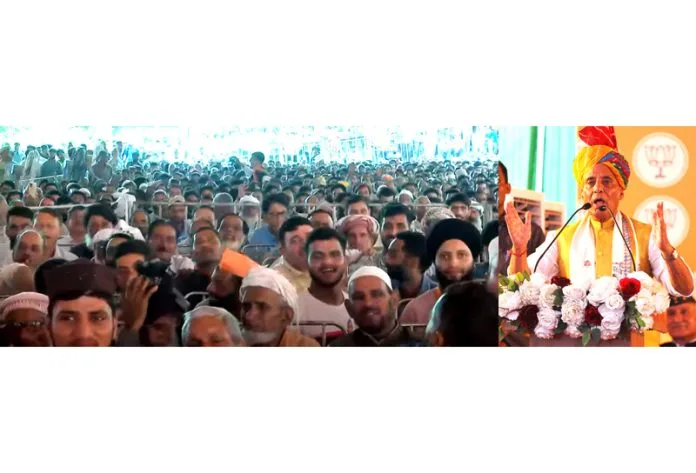
Defence Minister Rajnath Singh stated today that India is ready to embrace Pakistan and engage in dialogue, but only if Pakistan guarantees that it will cease promoting terrorism on Indian soil. His remarks came during a series of poll rallies held in the districts of Rajouri, Poonch, and Jammu, where he emphasized the need for Hindu-Muslim unity for the country’s progress.

In a strong message directed at the National Conference (NC), Congress, and People’s Democratic Party (PDP), Singh accused these parties of acting as “proxies of Pakistan” and asserted that the Bharatiya Janata Party (BJP) would not permit anyone to advance Islamabad’s “impure agenda” in Jammu and Kashmir.

“NC and PDP are advocating dialogue with Pakistan, a nation that is aiding and abetting terrorism in Jammu and Kashmir. Terrorism and dialogue cannot coexist. However, if Pakistan guarantees an end to terrorism, we are ready to embrace it and initiate talks,” Singh declared.

The Defence Minister also condemned Pakistan-sponsored terrorism, noting that it has claimed thousands of lives in Jammu and Kashmir, with 80% of the victims being Muslims. He criticized Pakistan’s interference in India’s internal affairs, referencing recent remarks by Pakistan’s Defence Minister Khawaja Asif, who claimed that Pakistan and the NC-Congress alliance are aligned on the restoration of Article 370.

Singh ridiculed Pakistan for its economic woes, highlighting that the country is seeking a $7 billion bailout from the International Monetary Fund (IMF)—an amount smaller than the package announced by Prime Minister Narendra Modi for Jammu and Kashmir.

“Pakistan, which has become an international brand of poverty and destitution, cannot manage its own affairs but meddles in India’s internal matters,” Singh said, stressing that terrorism would be eradicated from Jammu and Kashmir. He added that the Union Territory has suffered due to terrorism for three decades, but the BJP is determined to build a “new Jammu and Kashmir.”

Singh also praised the BJP government’s achievements, noting the restoration of peace and development in Jammu and Kashmir since the abrogation of Article 370 in 2019. He criticized opposition parties for attempting to mislead the public on issues such as statehood and restoration of Article 370.

“Prime Minister Modi has already promised to restore statehood to Jammu and Kashmir, and no power can bring back Article 370,” Singh said. He accused the Congress, NC, and PDP of dividing the country on religious lines and stated that progress can only be achieved through unity between Hindus and Muslims.

Singh also addressed the ongoing assembly elections in Jammu and Kashmir, pointing out that Pakistani refugees and members of the Valmiki Samaj will be voting for the first time in seven decades. He credited the BJP for ensuring justice for these and other deprived populations, including Scheduled Tribes, who were granted reservation in the Assembly.

Highlighting the improved situation in the Union Territory, Singh said there has not been a single incident of stone-pelting since 2022. He also lauded the participation of the people in the first phase of the assembly elections, which saw a record 61% voter turnout—the highest in 30 years.

Singh underscored the BJP’s commitment to restoring Jammu and Kashmir’s pride and condemned previous rulers for keeping the region backward through divisive politics. He reiterated that Jammu and Kashmir is now known as a tourism capital, not a hub of terrorism.

In a broader discussion, Singh touched on India’s progress, including its growing self-reliance in the manufacture of defense equipment and the country’s aim to become the third-largest economy by 2027. He took a dig at opposition leader Rahul Gandhi, accusing him of defaming India during his recent visit to the United States, and emphasized the BJP’s focus on unity and nation-building.

The Defence Minister concluded his remarks by reaffirming that the BJP is the only party capable of restoring Jammu and Kashmir’s lost glory and taking it forward into a prosperous future. He stressed that the party is committed to fulfilling its promises and upholding its credibility, which he described as the “biggest asset” in politics.