Wednesday, July 15, 2026
Home Blog Page 133

LG calls for landslide warning sensors in Himalayan region using nanotechnology

0

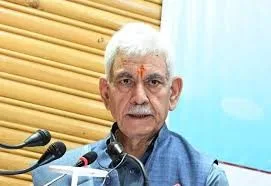
Lieutenant Governor Manoj Sinha on Sunday called on the scientific community to explore possibilities of developing soil sensors using nanotechnology for the Himalayan region, as part of an early warning system to address the dangers of landslides.

“Keeping in mind the challenges of climate change, we should focus on creating nanomaterials that can reduce pollution in chemical manufacturing. We must also explore the new possibilities to develop soil sensors specifically for the Himalayan regions,” Sinha said in his address to the inaugural session of the international conference on nanotechnology for better living at the University of Kashmir here.

Sinha emphasised that these sensors would be integral to an Advanced Early Warning System, capable of alerting authorities about potential landslides based on changes in soil saturation levels.

He further noted that these projects will prove to be game changers in preventing losses from natural disasters in India’s Himalayan region in the future.

The five-day mega event, organised by the University of Kashmir in collaboration with the Indian Institute of Technology (IIT) Hyderabad, brought together leading scientists and researchers to showcase recent advancements in nanotechnology and its applications for sustainable living.

The Lieutenant Governor highlighted how advancements and breakthroughs in nanotechnology are reshaping lives and work environments while ensuring a better standard of living.

“Today, evolution in nanoscience and nanotechnology is having a transformative impact across various sectors. The cutting-edge research in the future will address critical global challenges in industries, healthcare and the environment,” he said.

In his address, Sinha urged scientists and experts to establish a group dedicated to developing an Advanced Early Warning System for flash floods, focusing on creating more sensitive and accurate sensors through nanotechnology.

He also called upon nanotechnology experts to contribute significantly to the defence sector, especially in the production of lighter components for defence equipment. “Nanotechnology experts and scientists must join this effort and strengthen the self-reliance campaign in the defence sector,” he said.

The Lieutenant Governor called for devising a plan to incentivise talent in nanotechnology across academic institutions.

“Our focus should be on developing and using nanotechnology for the benefit of humanity. We simply cannot ignore the daunting challenges of climate change that confront us. Our inventions and initiatives show how quickly we are leading various areas of nanotechnology,” he added.

Gold Retreats From Record Highs; Declines Rs 606 To Rs 1,07,122/10 G On Profit-Booking

0

Gold prices retreated from record highs by declining Rs 606 to Rs 1,07,122 per 10 grams in the domestic futures market on Monday, as investors booked profits in tandem with a weak trend in the international markets.

On the Multi Commodity Exchange (MCX), gold futures for October delivery declined Rs 606 or 0.56 per cent to Rs 1,07,122 per 10 grams. It had surged to a lifetime high of Rs 1,07,807 per 10 grams on Friday. Similarly, the precious metal futures for December delivery slipped Rs 612 to Rs 1,08,176 per 10 grams.

Silver too witnessed a pullback after touching a fresh peak last week.

The white metal futures for December delivery dropped Rs 977 or 0.78 per cent to trade at Rs 1,23,720 per kilogram. Silver had scaled a record Rs 1,26,300 per kg on September 3.

On Saturday, bullion prices in the spot markets rose to hit fresh peaks in the national capital.

Gold of 99.9 per cent and 99.5 per cent advanced Rs 900 each to hit a fresh high of Rs 1,07,870 per 10 grams and Rs 1,07,000 per 10 grams, respectively, according to the All India Sarafa Association.

Silver prices jumped Rs 1,400 to hit a fresh peak of Rs 1,27,000 per kilogram in New Delhi.

In the overseas markets on Monday, Comex gold futures for December delivery fell 0.68 per cent to USD 3,628.35 per ounce after scaling a record USD 3,655.50 per ounce in the previous session. Spot gold eased to USD 3,584.40 per ounce in the global markets.

Jigar Trivedi, Senior Research Analyst at Reliance Securities, said, “China’s central bank, the People’s Bank of China (PBoC), increased its gold holdings for a 10th straight month in August as it continues to diversify its reserves away from the US dollar.” The PBoC on Sunday said it has added purchases of gold to its reserves in August, extending it into a 10th consecutive month, as per the official data.

China’s gold reserves stood at 74.02 million fine troy ounces at the end of August, up from 73.96 million at the end of July.

The gold reserves were valued at USD 253.84 billion as compared to USD 243.99 billion at the end of the previous month, according to the data.

Trivedi noted that the US administration on Friday moved to exempt gold, along with some other metals, from its country-based tariffs, a step expected to lend further support to demand.

Also, Comex silver futures slipped 0.7 per cent to trade at USD 41.26 per ounce in the international markets. Spot silver eased by 0.88 per cent to USD 40.64 per ounce.

Last week, gold and silver continued their upward momentum, with the precious metal touching a fresh record high and silver scaling a 14-year peak in global markets.

Rahul Kalantri, VP Commodities, Mehta Equities, said disappointing US job numbers have raised expectations of an interest rate cut by the Federal Reserve, bolstering safe-haven demand for the bullion prices.

“Growing global uncertainties and a weakening dollar index further fuelled safe-haven demand, while a weaker rupee lent additional support to gold and silver in domestic markets,” Kalantri added.

According to the World Gold Council, central banks’ purchases of gold globally have slowed as prices surged, although geopolitical risks are likely to sustain demand.

On the market outlook, global investment bank Goldman Sachs said in a note that gold could rally towards USD 5,000 per ounce if the Fed’s independence comes under threat and investors move even a small share of holdings from Treasuries to bullion. (Agencies)

1 Terrorist Killed In Ongoing Encounter In J&K’s Kulgam

0

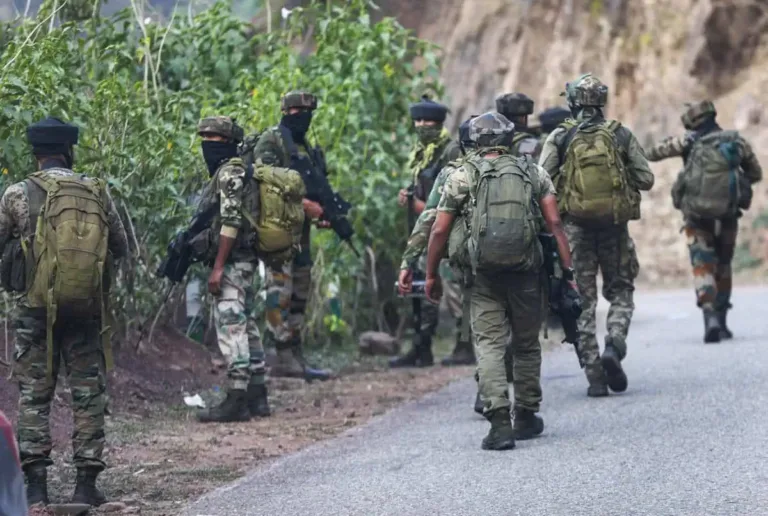
Srinagar, Sept 8: One unidentified terrorist has been killed in an ongoing encounter at Gudar area of South Kashmir’s Kulgam district on Monday morning.

A top police officer said that one terrorist has been killed so far, however identity of the slain terrorist is being ascertained.

Earlier, a joint team of Police and army launched a cordon and search operation in the area on a specificinput, during the searches hiding terrorists fired upon the search party which was retaliated triggering off a gunfight. (Agenices)

Mockery Of Legal, Deliberative Processes: Sonia Slams Govt On Nicobar Project

0

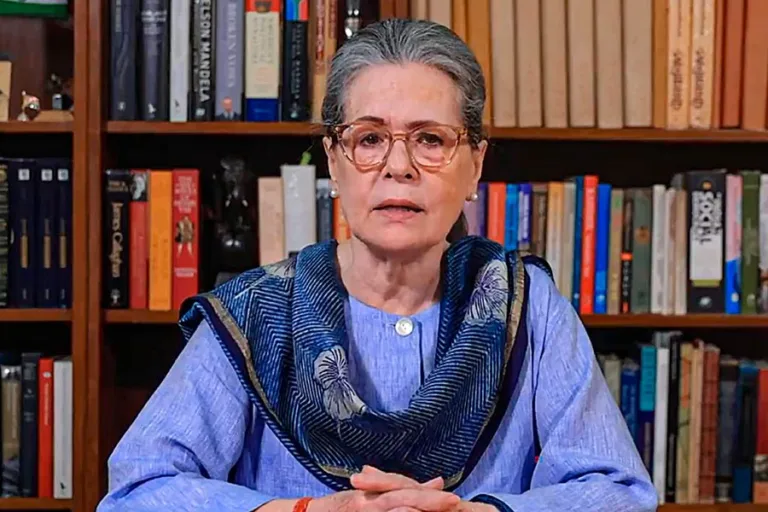
New Delhi, Sep 8: Terming the Great Nicobar infrastructure project a “planned misadventure”, Congress Parliamentary Party chairperson Sonia Gandhi on Monday said it poses an existential danger to the island’s indigenous tribal communities and is being insensitively pushed through, making a “mockery of all legal and deliberative processes”.

The collective conscience cannot, and must not, stay silent when the very survival of the Shompen and Nicobarese tribes is at stake, Sonia Gandhi said in an article published in ‘The Hindu’.

“Our commitment to future generations cannot permit this large-scale destruction of a most unique ecosystem. We must raise our voice against this travesty of justice and this betrayal of our national values,” she said in her article titled ‘The making of an ecological disaster in the Nicobar’.

Her remarks come days after Leader of Opposition in the Lok Sabha Rahul Gandhi wrote to Tribal Affairs Minister Jual Oram, expressing deep concern over the alleged violation of the Forest Rights Act (FRA) in the grant of clearances to the Great Nicobar Project, and urged the government to ensure adherence to the due process prescribed under the law.

Congress leader and former environment minister Jairam Ramesh has also been highlighting concerns over the Great Nicobar project, claiming that it is inimical to ecology and the rights of forest dwellers and tribals in the area.

In her article, Sonia Gandhi hit out at the Modi government and said there has been no shortage of “half-baked and ill-conceived policymaking” in the last 11 years.

“The latest in this series of planned misadventures is the Great Nicobar mega-infrastructure project. The totally misplaced Rs 72,000 crore expenditure poses an existential danger to the island’s indigenous tribal communities, threatens one of the world’s most unique flora and fauna ecosystems and is highly susceptible to natural disasters,” she said.

“Nevertheless, it is being insensitively pushed through, making a mockery of all legal and deliberative processes,” Sonia Gandhi said.

She pointed out that the Great Nicobar Island is home to two indigenous communities, the Nicobarese tribe and the Shompen tribe, a particularly vulnerable tribal group.

“The ancestral villages of the Nicobarese tribals fall in the project’s proposed land area. The Nicobarese were forced to evacuate their villages during the Indian Ocean tsunami of 2004. This project will now permanently displace this community, ending its dream of returning to its ancestral villages,” she said.

“The Shompen face an even greater threat. The Island’s Shompen Policy, notified by the Union Ministry of Tribal Affairs, specifically requires the authorities to prioritise the tribe’s welfare and ‘integrity’ when considering ‘large-scale development proposals’.

“Instead, the project denotifies a significant part of the Shompen tribal reserve, destroys the forest ecosystems where the Shompen live, and will cause a large-scale influx of people and tourists on the island,” she argued.

Ultimately, the Shompen will find themselves cut off from their ancestral lands and unable to sustain their social and economic existence, Sonia Gandhi said.

Yet, the government is stubbornly adamant and shockingly insistent, she added.

Sonia Gandhi alleged that the constitutional and statutory bodies set up to preserve tribal rights have been sidestepped throughout this process.

“As in Article 338-A of the Constitution, the Government should have consulted the National Commission for Scheduled Tribes. It has failed to do so.

“The Government should have consulted the Tribal Council of Great Nicobar and Little Nicobar Island. Instead, the Council Chairman’s plea that the Nicobarese tribals be allowed to return to their ancestral villages has been neglected,” she pointed out.

Sonia Gandhi further said that the letter of no objection was secured from the Council, but it has since been revoked, with the Council noting that the authorities had “rushed them” into signing the letter.

“The Forest Rights Act (2006), which empowers the Shompen as the authority to protect, preserve, regulate and manage the forests, should have underpinned any policy action. Instead, the Shompen have not been consulted on this issue — a fact which the Tribal Council has now confirmed,” she said in the article.

“The country’s laws are being mocked wholesale. Unconscionably, one of the country’s most vulnerable groups may have to pay the ultimate price for it,” she asserted.

“Ecologically, this project is nothing short of an environmental and humanitarian catastrophe. The project will require the cutting down of trees on an estimated 15% of the island’s land, decimating a nationally and globally unique rainforest ecosystem,” she pointed out.

The Ministry of Environment, Forests, and Climate Change estimates that 8.5 lakh trees may be cut, Sonia Gandhi said.

“This is a depressing figure, but it may also be a gross underestimate — independent estimates have suggested that 32 lakh trees to 58 lakh trees may eventually be cut,” she said.

The government’s solution to this indiscriminate tree felling is that of “compensatory afforestation”, a rather poor substitute for the loss of natural, old-growth forests, she opined.

“Despite abundant evidence confirming the same, which includes a National Green Tribunal order, the Government has contrived ways to manipulate this truth through a high-powered committee (HPC). The report of this HPC and the ground-truthing exercise it conducted to reclassify the port site out of CRZ 1A has not been made public,” she said.

Sonia Gandhi further argued that from a wildlife standpoint too, the project raises serious concerns.

“Primatologists have written to the Government expressing grave concerns about the project’s impact on the Nicobar long-tailed macaque. These concerns have been ignored,” she said.

The biodiversity assessments for the projects have come under questioning for critical methodological flaws, Sonia Gandhi said.

“The assessment of sea turtle nesting sites was conducted in the off-season for nesting. Drones were employed to gauge the project’s impact on dugongs, but these drones have limited capacity and can only assess shallow areas,” she said.

Finally, the project, including the port, is coming up in a seismically sensitive earthquake-prone zone, she pointed out.

Locating such a massive project here deliberately jeopardises investment, infrastructure, people and the ecology, Sonia Gandhi added.

Sharing Sonia Gandhi’s article on X, Rahul Gandhi said, “Through this article, Congress Parliamentary Party Chairperson Smt. Sonia Gandhi highlights the injustices inflicted on Nicobar’s people and its delicate ecosystem by this project.” The project, titled ‘Holistic Development of Great Nicobar’, involves the construction of a transhipment port, an international airport, a township and a power plant spanning more than 160 sq km. (PTI)

Special Crime Wing Srinagar Conducts Raids In J&K’s Ganderbal

0

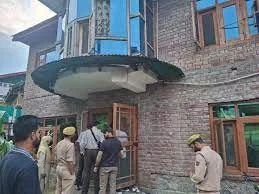
Srinagar, Sept 8: The Special Crime Wing Srinagar (Crime Branch) on Monday carried out searches at multiple locations in district Ganderbal in connection with a case registered under FIR No. 23/2024 U/S 302 IPC.

According to official statement, searches are currently underway at the residential houses of “Mohammad Afzal Sheikh, son of Ghulam Qadir Sheikh, and Farooq Ahmad Sheikh, also son of Ghulam Qadir Sheikh, both residents of Bonzila, Haripora, Ganderbal. Another location raided includes the house of Wajid Rasool Dar, son of Ghulam Rasool Dar, resident of Haripora, Ganderbal”.

The raids are being carried out in pursuance of search warrants issued by the competent court, with the assistance of a Duty Magistrate and local police.

Police said that the case was initially registered at Police Station Ganderbal but later transferred to the Special Crime Wing (Crime Branch) Srinagar for investigation by the Police Headquarters J&K. Further investigation is underway.(KINS)

Director Agriculture Anil Gupta Visits Flood-Hit Villages, Assures Relief for Farmers

0

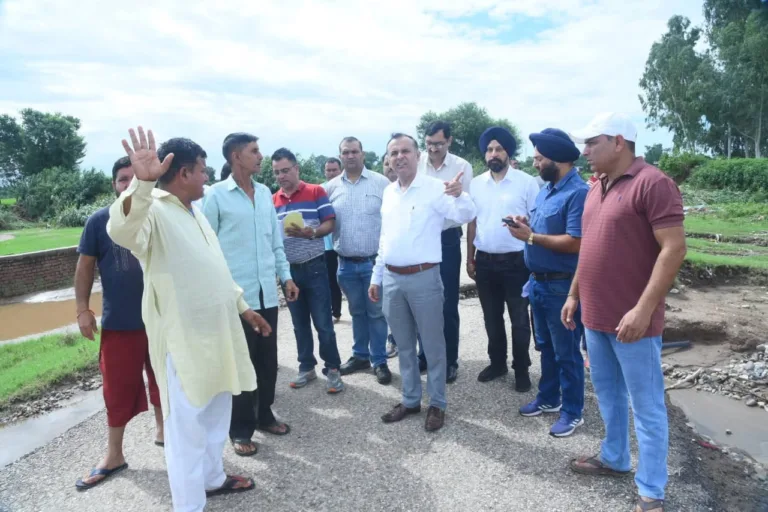
R.S. Pura, September 7: Director Agriculture Jammu, Shri Anil Gupta, on Sunday visited several flood-affected villages of R.S. Pura to take stock of the damage caused to standing crops and extend support to distressed farmers.

Gupta, accompanied by senior officials of the Agriculture Department and representatives of insurance companies under the Pradhan Mantri Fasal Bima Yojana (PMFBY), toured Badyal Brahmana, Dehrian, Chak Hansoo, and adjoining areas. The region has been reeling under crop losses following heavy rains and waterlogging.

During his visit, the Director held direct interactions with farmers, listened to their concerns, and assured them of timely assistance. He directed field staff to expedite crop loss assessment reports so that compensation under PMFBY could reach eligible farmers without delay.

“His visit and assurance have restored our hope. We feel heard and supported,” said Ramesh Kumar, a farmer from Chak Hansoo.

Gupta emphasized transparency and efficiency in handling claims, instructing insurance representatives to remain on the ground for fair and swift processing. His proactive approach drew appreciation from both officials and the farming community.

Farmers in the border belt of R.S. Pura, known as the “rice bowl of Jammu,” face recurring losses during monsoon floods. Officials said the department’s prompt response under Gupta’s leadership aims to mitigate hardships and reinforce farmer confidence in government schemes.

Dr Jitendra Launches Chandigarh University ‘Campus Tank’, Underscores ‘StartUp Linked Economy’

0

NEW DELHI, Sept 6 : Union Minister of State (Independent Charge) for Science and Technology; Earth Sciences and Minister of State for PMO, Department of Atomic Energy, Department of Space, Personnel, Public Grievances and Pensions, Dr. Jitendra Singh today said India’s future growth will increasingly depend on building a “StartUp linked economy” anchored in strong industry partnerships. He was speaking after launching the Chandigarh University “Campus Tank”, which he described as the first-of-its-kind initiative in the region, aimed at connecting young entrepreneurs with industry and investors.

The Minister said, the government has created an enabling ecosystem for innovation and entrepreneurship, but sustaining StartUps requires early and substantial engagement with industry. “This was mainly for industry linkage. The launch of Chandigarh University Campus Tank will give a push to StartUp linked economy through industry linkage. We have prioritised the industry. This is StartUp funding,” he noted.

Underscoring the need to move beyond symbolic support, the Minister added: “We need to keep industry ahead to sustain. So we pushed for industry-linked StartUp and a StartUplinked economy. Start-up linked economy is also a good expression.” He stressed that while ideas and research emerge from campuses, their long-term success depends on structured partnerships with industry that bring in financial backing, market exposure, and scale.

The Minister explained that India’s StartUp story so far has been driven by energy and innovation, but the next phase must focus on building sustainable ventures that can endure in competitive markets. He cited examples from sectors such as biotechnology, agriculture, and space, where government support and industry collaboration have already delivered measurable results. Industry participation, he said, not only strengthens start-ups but also ensures that investments are productive and generate livelihoods.

Dr. Jitendra Singh also drew attention to the regional context, observing that North India has been slower to take off in the start-up movement compared to other parts of the country. Initiatives such as Campus Tank, he said, will help bridge that gap by positioning universities as launchpads for entrepreneurship. “The priority now is to move from ideas and prototypes to real-world enterprises, and that will only happen if industry is kept at the centre,” he said.

He emphasised that India’s start-up ecosystem is no longer limited to metros or technology hubs, with smaller towns and diverse sectors increasingly contributing to new ventures. This, he added, is a sign of an aspirational India ready to harness innovation for growth.

Dr. Jitendra Singh also pointed out India’s rising global standing in innovation, noting that the country has moved up from rank 81 to 39 in the Global Innovation Index in less than a decade. He highlighted that nearly 60 percent of India’s registered start-ups are women-led, reflecting a shift where women are not just participants but leaders of major projects. Citing examples, he said women scientists are steering national missions such as Aditya L1 and Chandrayaan-3, underscoring the inclusive character of India’s scientific and start-up ecosystem. The Minister further underlined that India’s progress is also visible in patent filings, where the majority of recent patents are being filed by resident Indian innovators, reversing earlier trends.

The Campus Tank has sought to create a platform where industry, investors, and young founders can collaborate to transform ideas into sustainable businesses. Dr. Jitendra Singh said such efforts would contribute directly to building a start-up linked economy — one in which innovation, enterprise, and industry move in step to drive India’s progress towards the vision of a developed nation by 2047.

JMC Issues Comprehensive Health Advisory Amid Post-Flood Challenges

0

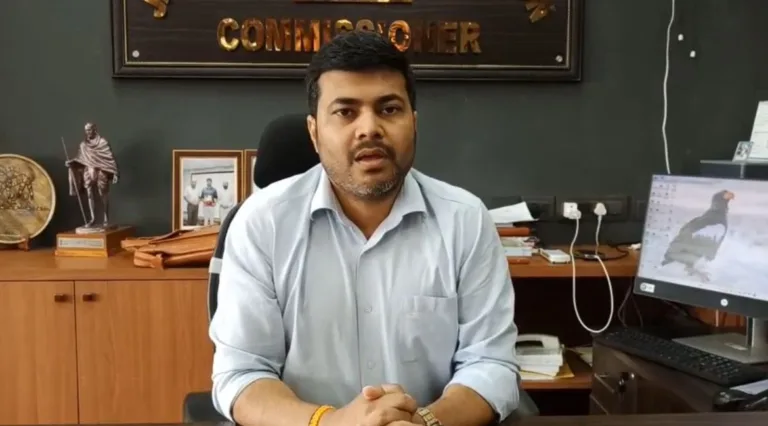
Commissioner Municipal Corporation Jammu Dr Devansh Yadav has made an urgent appeal to the people of Jammu to remain cautious and adopt preventive measures as several areas of Jammu Municipal Corporation and district Jammu continue to recover from the aftermath of recent floods. He emphasized that flood-hit regions are highly vulnerable to outbreaks of waterborne and vector-borne diseases, and immediate action is necessary to protect public health.

Speaking on the current situation, Dr. Yadav stated that contamination of drinking water is a major concern during such times and can lead to illnesses such as stomach infections, headaches, fever and diarrhea. Alongside this, the ongoing season poses an increased risk of mosquito-borne diseases including dengue and chikungunya, which are more likely to spread in areas with accumulated stagnant water.

Issuing instructions to all residents to ensure the safety of their drinking water, Dr. Yadav advised the citizens to boil water for a minimum of 10 minutes before consumption to eliminate harmful microorganisms. “Chlorine tablets should be used wherever possible, and water should be allowed to settle for at least half an hour after adding the tablets before it is used for drinking or cooking purposes. Residents are also urged to maintain their surroundings by removing stagnant water from rooftops, courtyards and nearby drains as such areas provide ideal breeding grounds for mosquitoes” he advised.

To facilitate public health services and immediate assistance, the Health Department has activated the 104 helpline number. This helpline will provide guidance and address any health-related queries from residents. In addition, the Jammu Municipal Corporation has intensified its efforts to conduct fogging and spraying activities across all wards of JMC to control mosquito breeding and minimize the risk of vector-borne diseases.

Appealing to the public, Dr. Yadav said if fogging and spraying activities have not yet reached their locality, they should promptly register their area and ward number on the JMC helpline. This will help the authorities prioritize the areas that require immediate attention and ensure that every ward receives timely preventive measures, he added.

The health and well-being of our citizens is our top priority,” said Dr. Devansh Yadav, adding that JMC is making every possible effort through coordinated actions involving our sanitation teams, health workers, and support staff. The success of these measures greatly depends on the active cooperation of the public, he said and added that together, we can prevent the spread of diseases and ensure a healthy environment for everyone. JMC is in continuous monitoring and proactive steps are being taken to safeguard the health of the people during this critical period of recovery, he maintained.

Torrential Rain Hits Restoration Work On Jammu-Srinagar National Highway

0

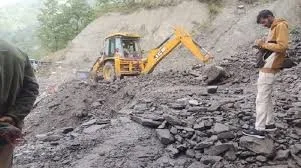
An early morning downpour on Saturday derailed the National Highways Authority of India’s (NHAI) efforts to restore traffic on the 270-km Jammu-Srinagar national highway, which remained closed for the fifth consecutive day, a senior official said.

NHAI Project Manager, Ramban sector, Shubam said efforts are going on at a war footing to clear the 250-metre stretch of the highway at Thard in Udhampur district which was buried under a hill.

“What we have gained during the day on Friday was washed away by intense half-an-hour rainfall this morning… we have mobilised the men and machinery and started the work afresh to ensure early reopening of the arterial road as soon as possible,” the official said.

He said they are expecting to clear the road later tonight or early next morning.

Barring this four-lane highway stretch, which is completely buried under a moving hill, the rest of the highway – the only all-weather road linking Kashmir with the rest of the country – has been cleared for two-way traffic, the official said.

The highway was closed for traffic amid heavy rain across the Jammu division early this week, following multiple landslides, mudslides and shooting stones from the hillocks overlooking the road besides washing away of road patches at different places between Udhampur and Banihal.

The closure of the highway left hundreds of vehicles, mostly trucks, stranded on both sides, officials said.

A traffic department official said the Mughal Road — an alternate link connecting Poonch and Rajouri districts with south Kashmir’s Shopian district — is open for light motor vehicles. The Kishtwar-Sinthan-Anantnag road, another alternate link, remained closed for the fourth day despite a massive road clearance operation.

A meteorological department spokesperson said rain or thundershowers are likely at a few places on Saturday. Light rain or thundershowers at scattered to many places across J&K with a possibility of moderate rain or thunder over a few districts of the Jammu division towards late night or early morning on September 7 and 8.

The weather office has also forecast a brief spell of rain or thundershower activity at a few places between September 9 and 12.

“Overall, there is nothing significant till September 12,” the spokesperson said. (Agencies)

GST Overhaul: Nirmala Sitharaman Writes To State Finance Ministers, Thanks Them

0

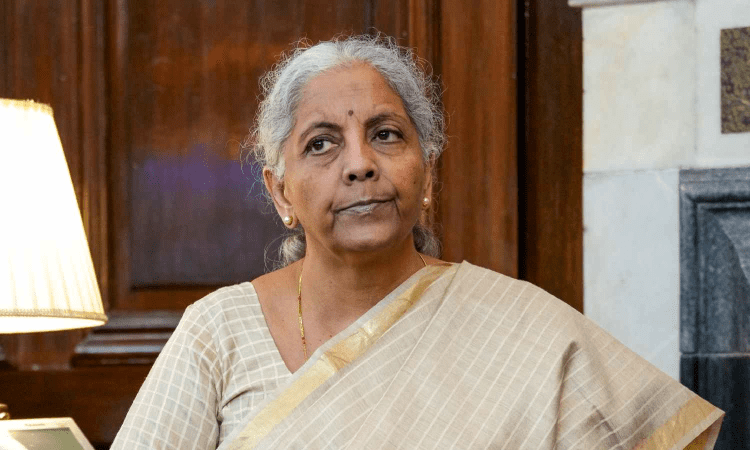
New Delhi, Sep 6: In a gesture underscoring the spirit of cooperative federalism, Union Finance Minister Nirmala Sitharaman has written to finance ministers of all states, expressing gratitude for their support and active role in helping implement the landmark overhaul of the goods and services tax (GST) regime.

In an interview with PTI, Sitharaman said states made their view on the proposal to rejig tax rates but ultimately agreed that it was for the benefit of the common man, an argument that helped reach a unanimous decision at the GST Council meeting earlier this week.

The overhaul, which will from September 22 see rates of a wide swath of products — from butter to chocolates and shampoos to tractors and air conditioners — come down, was agreed at a meeting of the GST Council on September 3.

The panel is headed by Sitharaman and includes representatives of all states and Union Territories.

“Yesterday, I have written a letter to each finance minister thanking them, saying, you can have any number of intense discussion and argument, but finally, the Council rose to the occasion and gave relief to the people of India, to all people of India. And, I am grateful for that gesture. So, I wrote that letter,” she said.

She said the work at the Council was truly “remarkable”.

Despite apprehensions over loss of revenue from classifying most products into categories: 5 per cent for common use goods and 18 per cent for everything else, and doing away with 12 and 28 per cent slabs, the GST Council took a unanimous decision for the GST rejig.

The panel was to meet for two days starting September 3 to discuss the proposal made by the Centre but ended up approving it on the very first day after a marathon daylong meeting.

“So the sense of the house was, this is a proposal which is going to undoubtedly benefit the common man. There is no point in standing against it… Ultimately everybody came together for a good cause, and I’m truly very grateful,” Sitharaman said.

The minister said states were always in favour of rate reduction and their only concern was with regard to their revenue implications post-tax cuts.

“I even appealed to them, saying, for the sake of the people of India, Please. It’s not just the states. It’s even the Centre that is going to get affected by the reduction. But we’ll make up for it because once the rates come down, people are going to come out to buy, and that will take care of it (revenue impact). That’s how consensus was arrived at,” she said.

Sitharaman, speaking at a press conference following the GST Council meeting, had expressed her gratitude to the states for their cooperation and collaborative efforts in implementing one of India’s most significant tax reforms.

On Saturday, she noted that the Council had given a patient hearing to every comment and suggestion put forward by its members.

“All points were thoroughly deliberated before arriving at a consensus,” she said.

She also highlighted the inclusive nature of the discussions, adding that several ministers who wished to speak again after their initial points had already been debated were given the opportunity to do so.

“Their additional inputs were heard and taken into account,” the Finance Minister emphasised. She also credited states for their constructive participation in the GST Council and their commitment to driving tax reform. (Agencies)