Monday, July 13, 2026
Home Blog Page 111

RSS Chief Mohan Bhagwat Emphasizes ‘Vyakti Nirman’ at Centenary Event

0

On Thursday, RSS Chief Mohan Bhagwat addressed swayamsevaks at the annual Vijayadashami function in Nagpur, marking the Rashtriya Swayamsevak Sangh’s centenary. He asserted that despite temptations to join politics, the RSS has remained committed to its core mission of ‘vyakti nirman’, which translates to character building.

Bhagwat shared insights drawn from the organization’s century-long journey, emphasizing that reforms in the global order require gradual implementation to prevent adverse consequences. He stated, “India must present a development model based on a holistic and integrated outlook, rooted in dharma, and offer it to the world.”

Delving into the essence of dharma, Bhagwat explained that it transcends mere worship and rituals. Instead, it connects all aspects of society, and social transformation stems from embodying values like integrity, selflessness, and social leadership. These principles guide the activities of RSS through its shakhas.

Highlighting the historical context, Bhagwat remarked, “Over the last 100 years, the RSS has been offered temptations and even invited to enter politics. But the Sangh has focused only on running shakhas and character-building.” He further emphasized that vyakti nirman is the sustainable path towards social change, founded on collective experience.

In discussing India’s cultural richness, Bhagwat pointed out the importance of embracing the country’s diversity of languages, faiths, lifestyles, and traditions. He affirmed that this pluralism is a strength, stating, “All communities, including those who adopted foreign religions, are part of the larger Indian identity.” He called for harmony and mutual respect while rejecting violence.

Taking a firm stance against communal discord, Bhagwat criticized hooliganism and stressed the necessity for law enforcement agencies to act impartially. He urged society, especially the youth, to remain vigilant, organized, and proactive in maintaining peace and harmony in their communities.

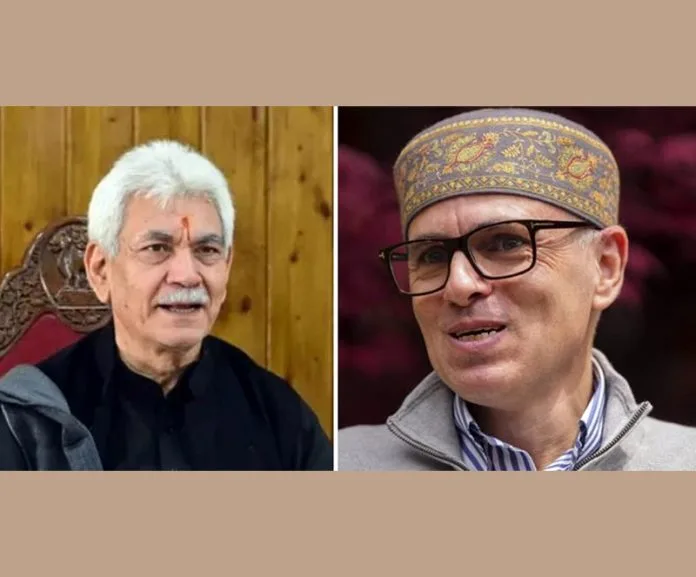
LG Manoj Sinha, CM Omar Abdullah Greet on Vijayadashami

0

On the eve of Vijayadashami and Gandhi Jayanti, Lieutenant Governor Manoj Sinha and Chief Minister Omar Abdullah extended heartfelt greetings to the people of Jammu and Kashmir. This celebration symbolizes hope for peace and unity.

In his message, Lieutenant Governor Sinha addressed the people, stating, “On the joyous occasion of Vijayadashami, I extend my warm greetings and good wishes to all for their happiness, well-being and prosperity. Vijayadashami symbolizes the victory of good over evil and righteousness over unrighteousness. May this sacred festival inspire us to work for unity, peace and progress of the country while strengthening our spirit of harmony, brotherhood and oneness.”

In conjunction with Gandhi Jayanti, which commemorates the 156th birth anniversary of Mahatma Gandhi, Sinha paid rich tributes to the Father of the Nation. He remarked, “I pay my heartfelt tribute to Bapu. This occasion prompts all of us to internalize his ideals of peace, non-violence, truth, tolerance, compassion and selfless service. Bapu dedicated his life to India’s freedom and social equity. His concept of Swadeshi emphasized self-reliance and promoting local production. I appeal to all to buy Swadeshi products and support local artisans and cottage industries.”

Sinha also urged citizens, “On this momentous day, let us pledge to follow the path of truth and non-violence, promote peace, and work for building a Viksit Bharat.”

In his own greetings, Chief Minister Omar Abdullah echoed similar sentiments regarding Vijayadashami. He hailed it as a festival that underscores the triumph of good over evil. Abdullah stated, “Dussehra inspires people to uphold the values of truth, righteousness and justice under all circumstances. It conveys a timeless message of moral courage and harmony, vital for building a better society.”

Chief Minister Abdullah also emphasized the importance of Gandhi’s teachings on Gandhi Jayanti. He remarked, “Mahatma Gandhi’s timeless teachings of Satya, Ahimsa, peace, and humanity hold greater significance in today’s conflict-ridden world. Gandhi Ji waged an unwavering struggle against untouchability, caste discrimination, and inequality. His philosophy continues to inspire generations and remains a guiding light for building a tolerant, harmonious, and just society.”

Abdullah highlighted the need for people, particularly the youth, to embrace Gandhi’s ideals, calling them essential for fostering values of peace, communal harmony, and brotherhood. In this festive season, both leaders inspire the citizens of Jammu and Kashmir to promote unity, celebrate victory over evil, and adhere to the principles of Mahatma Gandhi.

PM Modi Celebrates RSS Centenary, Releases Coin and Stamp

0

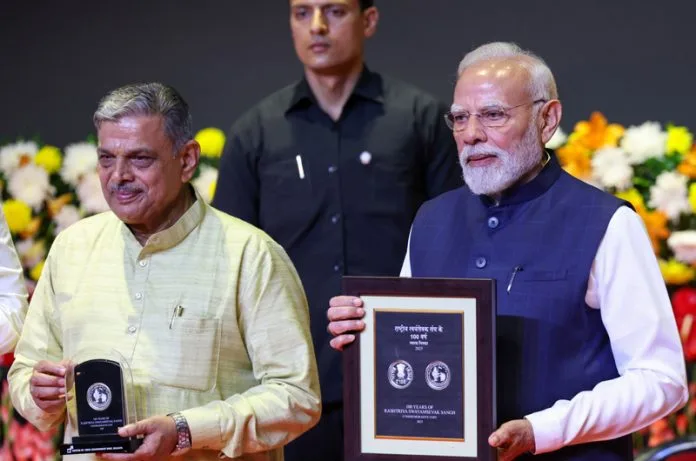
Prime Minister Narendra Modi on Wednesday commended the Rashtriya Swayamsevak Sangh (RSS) during its centenary celebrations, crediting the organisation for its unwavering commitment to the principle of “nation first” amid numerous challenges and adversities.

Participating in the grand celebrations, Modi highlighted the RSS’s critical role in nation-building, noting its relentless efforts to promote harmony by dismantling caste and creed divisions. He remarked, “The Sangh has fought against British atrocities, provided refuge to freedom fighters, and its founder Dr. Keshav Baliram Hedgewar faced imprisonment multiple times during our freedom struggle.”

The Prime Minister recalled the challenges the RSS has faced, including bans and false accusations, asserting that it has “never harboured bitterness.” He shared the wisdom of former RSS chief Madhav Golwalkar, who once stated, “At times, the tongue may get caught under the teeth, but we do not break the teeth.”

Modi emphasized the Sangh’s resilience during India’s Emergency and its unwavering faith in democracy. He said, “Two core values – unity with society and confidence in constitutional institutions – have kept swayamsevaks steadfast during every crisis.”

As part of the historic celebration, PM Modi launched a special ₹100 commemorative coin and a postal stamp. These items pay tribute to the organization’s century-long contribution to the nation. The coin depicts the national emblem on one side and for the first time in independent India, Bharat Mata depicted in Varada Mudra, flanked by a lion and swayamsevaks in reverent bow. The postal stamp captures the significance of RSS’s participation in the 1963 Republic Day Parade.

In a nostalgic tone, Modi remarked, “This is a moment of great pride as Bharat Mata has been featured on Indian currency for the first time.”

Recalling the RSS’s altruistic service, Modi mentioned its support during the 1962 war, the 1971 refugee crisis, and the 1984 riots, underscoring its steadfast commitment to equality, compassion, and unity. He lauded current Sarsanghchalak Mohan Bhagwat’s initiative for “one well, one temple, one cremation ground,” viewing it as a significant stride towards eliminating discrimination.

Receiving Modi’s praise, RSS general secretary Dattatreya Hosabale expressed sincere gratitude to the government for recognizing the Sangh’s century-long service. He described the coin and stamp as a fitting tribute to the selfless contributions of swayamsevaks since 1925.

Congress Uses Gandhi’s Words to Criticize RSS’s Outlook

0

As the Rashtriya Swayamsevak Sangh (RSS) celebrates its 100th anniversary, the Congress party has ignited a fresh debate about the organization by referencing Mahatma Gandhi’s views. They claim that Gandhi once described the RSS as a ‘communal body with a totalitarian outlook’.

On Thursday, Congress general secretary Jairam Ramesh took to X to unveil a conversation documented by Pyarelal, a significant aide of Gandhi. Ramesh emphasized that Pyarelal served on Gandhi’s personal staff for nearly thirty years and became his secretary after Mahadev Desai’s death in 1942.

Ramesh mentioned that Pyarelal’s works have earned authoritative status in the study of Gandhi. His landmark book, “Mahatma Gandhi: The Last Phase”, first published in 1956, features contributions from prominent figures including the then President Dr. Rajendra Prasad and Vice President Dr. S. Radhakrishnan.

In the second volume of this book, released in 1958, Ramesh pinpointed a conversation from September 12, 1947, on page 440, where Gandhi explicitly called the RSS a ‘communal body with a totalitarian outlook’.

Ramesh also noted that just five months after this conversation, Union Home Minister Sardar Patel implemented a ban on the RSS.

Furthermore, Ramesh shared a screenshot from Pyarelal’s book, which he claims underlines Gandhi’s critical perspective towards the RSS. This comes in the wake of Prime Minister Narendra Modi praising the organization for its contributions to nation-building during a centenary event on Wednesday.

In a pointed retort, Ramesh reminded Prime Minister Modi of Patel’s remarks regarding the RSS, suggesting that the organization fostered an environment contributing to Gandhi’s assassination. He questioned Modi’s awareness of Patel’s correspondence with Dr. Syama Prasad Mookerjee dated July 18, 1948.

In the letter, Patel conveyed a strong message, mentioning that while he remained cautious about discussing the pending case concerning Gandhi’s murder, reports suggested that the activities of the RSS created conditions conducive to such a tragic event. His assertions categorized the RSS as a clear threat to governmental authority, emphasizing that their activities appeared to intensify despite the ban.

Moreover, during a massive public gathering in Jaipur on December 19, 1948, Sardar Patel voiced similar concerns about the RSS, reinforcing the narrative that the organization posed a significant threat to the state.

The clash of narratives highlights ongoing tensions between the ruling party and the Congress over interpretations of India’s historical and ideological foundations.

As such conversations revive interest in Gandhi’s legacy, the Congress continues to leverage historical context to challenge contemporary nationalism as defined by RSS supporters. As national discussions evolve, the Congress aims to remind citizens of the differing perceptions of patriotism and national unity throughout India’s complex history.

President Murmu, PM Modi Pay Homage To Gandhi, Shastri On Birth Anniversary

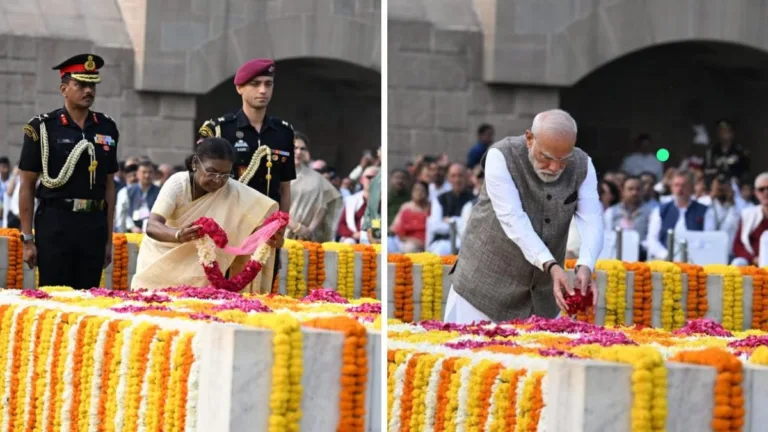
President Droupadi Murmu and Prime Minister Narendra Modi paid floral tributes to Mahatma Gandhi and former Prime Minister Lal Bahadur Shastri on their birth anniversary in New Delhi on Thursday.

PM Modi said his government will follow Gandhi’s path for building a developed India.

He said on X, “Gandhi Jayanti is about paying homage to the extraordinary life of beloved Bapu, whose ideals transformed the course of human history. He demonstrated how courage and simplicity could become instruments of great change.” PM Modi said Gandhi believed in the power of service and compassion as essential means of empowering people.

He also paid homage to India’s second Prime Minister, Lal Bahadur Shastri, whose birth anniversary, too, fell on Thursday.

He lauded him as an extraordinary statesman whose integrity, humility, and determination strengthened India.

“He personified exemplary leadership, strength and decisive action. His clarion call of ‘Jai Jawan Jai Kisan’ ignited a spirit of patriotism among our people. He continues to motivate us in the endeavour of building a strong and self-reliant India,” the Prime Minister said.

PM Modi, who has been passionately promoting swadeshi, said buying products made by Indians will be a true tribute to Gandhi and Shastri.

Swadeshi is the foundation of a self-reliant and developed India, he added.

This year marks the 156th birth anniversary of Mahatma Gandhi, remembered as the Father of the Nation for his pivotal role in India’s freedom struggle

Born in Gujarat in 1869, Gandhi is considered the most influential Indian of his era as he shaped the country’s freedom movement through truth and non-violence, winning worldwide following.

Shastri was born in Uttar Pradesh in 1904 and rose to become the country’s Prime Minister after the death of Jawaharlal Nehru. His honesty and leadership of the country in his short stint as prime minister during which India fought a war with Pakistan earned him universal praise. (Agencies)

Ex-President Kovind: Good People Avoiding Politics

0

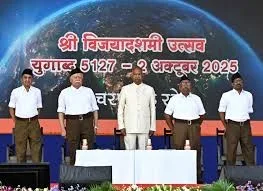
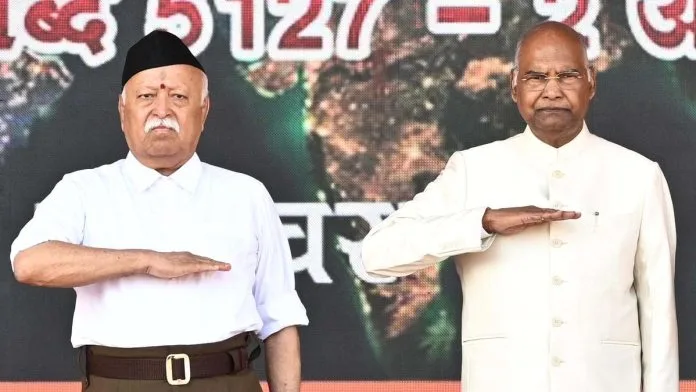
Former President Ram Nath Kovind expressed concerns on Thursday about the increasing reluctance of good people to engage in politics. Speaking as the chief guest at the annual Vijayadashmi rally of the Rashtriya Swayamsevak Sangh (RSS) in Reshimbagh ground, Kovind called upon the youth of India to actively participate in shaping the nation’s political landscape.

Kovind’s remarks came during a significant occasion that also celebrated the centenary of the RSS, an organization founded by Keshav Baliram Hedgewar on Dussehra in 1925. He noted his deep admiration for both Hedgewar and Dr. B.R. Ambedkar, stating, “I was inspired by the values of national unity and social harmony shared by Dr. Ambedkar and Dr. Hedgewar.” He emphasized the importance of these values in fostering a robust and inclusive political environment.

During his address, Kovind asserted that the RSS promotes an ethos free from casteism and discrimination. “There is no casteism and discrimination in RSS,” he said, underlining the organization’s commitment to social welfare and unity. He further elaborated that the founder’s “vichar” (thoughts) have profoundly influenced his understanding of society and the country’s well-being.

The former president lamented the absence of principled individuals in politics, stating, “Good people are not joining politics.” He reiterated the necessity for active youth engagement in governance and political reform, which he believes is crucial for a vibrant democracy.

Kovind announced that he is in the process of writing a book titled ‘Triumph of the Indian Republic,’ where he aims to discuss the country’s political evolution and the key figures who shaped it. This book, as he explained, seeks to inspire future generations to take pride in India’s democratic framework.

In conclusion, Kovind’s powerful remarks at the Vijayadashmi rally resonate with a broader societal concern — the need for integrity and earnestness in politics. His call to action serves as a reminder of the responsibility of young Indians to participate in the nation’s governance, ensuring that true representations of integrity and values continue to flourish within the political sphere.

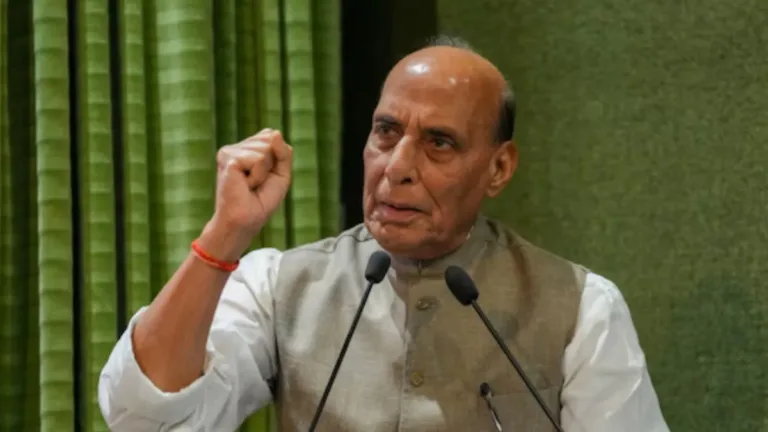
India Achieved All Objectives Of Operation Sindoor: Rajnath Singh

0

Oct 2: The Indian military successfully achieved all the objectives of Operation Sindoor but its fight against cross-border terrorism will continue, Defence Minister Rajnath Singh said on Thursday.

Singh said Pakistan made an unsuccessful attempt to penetrate India’s defence system during Operation Sindoor but the Indian military “exposed” the Pakistani air defence apparatus and sent a message to the world that it can inflict heavy losses on the adversary.

The defence minister was addressing a group of soldiers at a military base in Gujarat’s Bhuj ahead of performing a ‘shastra puja’ (worship of weapons) on the occasion of Dussehra.

“During Operation Sindoor, Pakistan made an unsuccessful attempt to penetrate India’s defence system from Leh to Sir Creek,” he said.

“However, in its retaliatory action, Indian forces completely exposed the Pakistani air defence system and sent a message to the world that Indian forces can inflict heavy losses on Pakistan whenever and wherever they wish,” he said.

Singh said India displayed restraint because its military action was against terrorism.

“Escalating it and starting a war was not the objective of Operation Sindoor. I am happy that Indian forces have successfully achieved all the military objectives of Operation Sindoor. But our fight against terrorism continues,” he said. (Agencies)

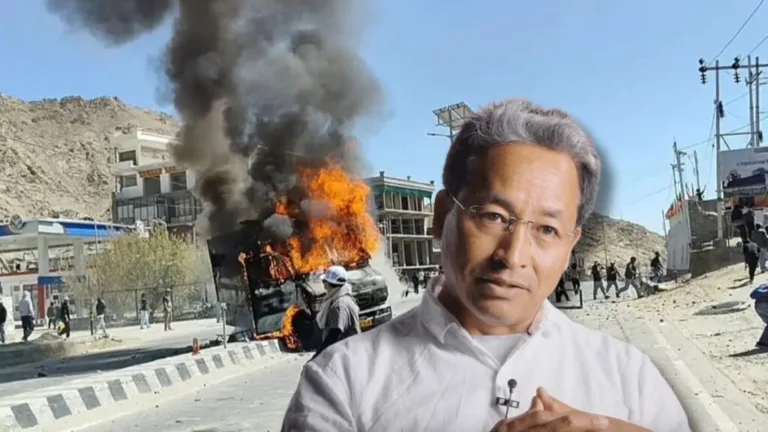
Ladakh admin says Wangchuk’s NSA detention on credible grounds denies ‘witch-hunt’

Ladakh Administration has rejected claims of a “witch-hunt” or a “smoke-screen” operation against activist Sonam Wangchuk, who was detained under the National Security Act last week. It asserted that the actions taken by law enforcement agencies were based on credible inputs and documents.

The administration appealed that the process of law should be allowed to take its own course and expressed confidence that “together we will bring back normalcy in the peace-loving Leh township and continue with our dialogue process”.

Wangchuk, the primary face of the agitation seeking statehood and Sixth Schedule safeguards for Ladakh, was detained under the stringent NSA following the violent clashes between protesters and security personnel on September 24.

Talks between the Centre and representatives from Ladakh have hit a roadblock with the Kargil Democratic Alliance (KDA) backing the Leh Apex Body’s (LAB) decision to suspend dialogue until Wangchuk and others were released.

Terming the release of Wangchuk and others as the key condition for resuming negotiations, scheduled for October 6, the two powerful organisations also demanded a judicial inquiry into the police firing in Leh that left four people dead and scores of others injured.

Gitanjali Angmo, Wangchuk’s wife and co-founder of the Himalayan Institute of Alternatives Ladakh (HIAL), has alleged that a “witch-hunt” was underway to project her husband as an “anti-national.”

She claimed there was “no need to impose the NSA on Sonam Wangchuk” and asserted that authorities have not provided her with formal documents detailing the charges.

In a statement issued on Tuesday night, the Department of Information and Public Relations said, “The administration of UT of Ladakh would like to clarify a few issues in the background of a series of press conferences and media statements given by certain sections.

“There have been reports in the media of baseless allegations of victimisation of certain individuals, including Wangchuk, by government agencies. There is no question of witch-hunting or smoke screen,” it said.

The administration said actions taken by the law enforcement agencies were based on credible inputs and documents. “The agencies should be allowed to continue with their investigation impartially without vitiating the process.”

It said the case of financial irregularities and foreign currency violations by HIAL is under investigation by agencies. “Prima facie, there is evidence available, which merits such investigation.”

Further, the statement said, despite knowing that it is not a recognised university, HIAL is issuing degrees to young men and women, jeopardising their future prospects.

“HIAL did not make full disclosure of foreign funds in their balance sheets in the relevant Financial Years. FCRA cancellation of SECMOL is based on clear evidence of multiple violations (not just one).

“After observing these irregularities, appropriate action has been taken. There are established processes and forums available to appeal to the appropriate authorities, which the organisation can resort to,” it said.

It said the government had already announced dates for talks on September 20 and had also expressed flexibility for dates, taking into consideration the convenience of the Ladakh leaders.

“Still, Wangchuk made multiple provocative statements. He gave the reference of Nepal, Sri Lanka and Bangladesh on several occasions from the Anshan venue, trying to incite the public, especially the youth,” it said.

During an interview with Ladakh Express on September 11, the statement said, Wangchuk stated, “the youth are saying that they do not want peace and Mahatma Gandhi’s path is not necessary. People are not scared of the security forces deployed, and if people come out worse may happen.

“Before starting his anshan, Wangchuk suggested (Sept 9) people to wear masks, caps and hoodies, etc., while participating in the protest, citing Covid as an excuse, though there is no sign of spread of Covid in Ladakh,” it said.

He said Wangchuk, in a video uploaded on his YouTube channel ‘Achoe Nyingstam’ (a dedicated channel for the Ladakhi audience wherein he speaks only in vernacular), stated (June 8, 2025) that he would bring an ‘Arab Spring’ type revolution in India to overthrow the government.

“Wangchuk had suggested ‘overthrow’ of government on the lines of ‘Arab Spring’, if their demands were not met, besides putting forth the idea of self-immolation for instigating agitation for this purpose, as happened in Arab countries including Tunisia,” the statement said.

On multiple occasions, the statement said he suggested self-immolation by Ladakhis on the lines of protests in Tibet.

Referring to the September 24 violent protests, it said even though other LAB leaders, including elders, rushed to pacify the aggressive crowd, Wangchuk made no attempts to ensure peace.

“When the situation was out of control, Wangchuk called off his fast and discreetly moved out from the backside of the anshan venue, thereby indicating his overall sense of irresponsibility,” it said.

It said Wangchuk did not call off his hunger strike despite the government announcing the date of the next meeting of the High Powered Committee, although he sat on the strike demanding talks with the government.

“The government also expressed flexibility for dates as per the convenience of the Ladakh leaders. This irresponsible act of continuation of the hunger strike for personal and political gain is responsible for all the further unfortunate developments,” the statement said.

RBI Upgrades FY26 GDP Growth to 6.8%, Cuts Inflation to 2.6%

The Reserve Bank of India (RBI) on Wednesday announced a significant revision in its economic forecasts, projecting the gross domestic product (GDP) growth rate for the fiscal year 2025-26 at 6.8 percent. It also lowered the inflation forecast to 2.6 percent, attributing these changes to an above-normal monsoon and the rationalisation of Goods and Services Tax (GST) rates.

In August, the RBI had estimated a 6.5 percent growth rate for the same fiscal year, along with an inflation forecast of 3.1 percent. The recent adjustments indicate a more optimistic outlook, reflecting crucial developments on both domestic and international fronts.

During the announcement of the bi-monthly monetary policy, RBI Governor Sanjay Malhotra highlighted the strength of the Indian economy, which demonstrated growth during the first quarter of FY26. Malhotra noted that the good monsoon season has positively influenced economic performance. “We observe a higher growth in Q1 2025-26, alongside a considerable moderation in headline inflation,” he stated.

Regarding the impact of GST rationalisation, Malhotra emphasized its potential to encourage consumption and spur economic growth while simultaneously having a calming effect on inflation. He acknowledged that while domestic factors are promising, global economic conditions, including recent US tariffs, could dampen export performance.

“Considering these diverse elements, we have revised the real GDP growth for 2025-26 to 6.8 percent, with projections of 7.0 percent for Q2, 6.4 percent for Q3, and 6.2 percent for Q4,” he explained. The GDP growth rate for the initial quarter of 2026-27 is expected to be around 6.4 percent.

Malhotra also noted that inflation conditions remain under control, with actual inflation outcomes significantly lower than previous predictions. “The low inflation levels can be primarily traced to a sharp decline in food prices, driven by improved supply chains and effective government interventions,” he elaborated.

The core inflation rate has stayed relatively unchanged, with August figures reporting at 4.2 percent. This stability exists despite ongoing pricing pressures on precious metals. The RBI’s revised Consumer Price Index (CPI) inflation forecast for 2025-26 now indicates 2.6 percent inflation, with quarterly estimates showing 1.8 percent for Q2, 1.8 percent for Q3, and 4.0 percent for Q4. Looking ahead, the CPI inflation rate for the first quarter of 2026-27 is projected at 4.5 percent.

This revised economic outlook signals the resilience of the Indian economy in navigating both domestic challenges and external pressures. Analysts and economists will closely monitor these developments, as they play a pivotal role in shaping monetary policy and influencing market confidence in the upcoming fiscal year.

At Least 69 People Killed In Powerful Earthquake That Hit The Philippines

At least 69 people were killed in a powerful earthquake that hit a central Philippine province where dozens of people were killed by a powerful earthquake Tuesday night.

 The magnitude-6.9 earthquake that hit at about 10 pm trapped an unspecified number of residents in collapsed houses, nightclubs and other businesses in the hard-hit city of Bogo and outlying rural towns in Cebu province, officials said.

Rescuers scrambled to find survivors Wednesday. Army troops, police and civilian volunteers backed by backhoes and sniffer dogs were deployed Wednesday to carry out house-to-house searches for survivors.

The epicentre of the earthquake, which was set off by movement in an undersea fault line at a dangerously shallow depth of 5 kilometres, was about 19 kilometres northeast of Bogo, a coastal city of about 90,000 people in Cebu province where about half of the deaths were reported, officials said.

The death toll in Bogo was expected to rise, according to officials, who said intermitted rain and damaged bridges and roads were hampering the race to save lives.

“We’re still in the golden hour of our search and rescue,” Office of Civil Defence deputy administrator Bernardo Rafaelito Alejandro IV said in a news briefing. “There are still many reports of people who were pinned or hit by debris.”

The Philippine government is considering whether to seek help from foreign governments based on an ongoing rapid damage assessment, Alejandro said.

Workers were trying to transport a backhoe to hasten search and rescue efforts in a cluster of shanties in a mountain village hit by a landslide and boulders, Bogo city disaster-mitigation officer Rex Ygot told The Associated Press early Wednesday.

“It’s hard to move in the area because there are hazards,” said Glenn Ursal, another disaster-mitigation officer, who added that some survivors were brought to a hospital from the mountain village.

Deaths also were reported from the outlying towns of Medellin and San Remigio, where three coast guard personnel, a firefighter and a child were killed separately by collapsing walls and falling debris while trying to flee to safety from a basketball game in a sports complex that was disrupted by the quake, town officials said.

The earthquake was one of the most powerful to batter the central region in more than a decade and it struck while many people slept or were at home.

The Philippine Institute of Volcanology and Seismology briefly issued a tsunami warning and advised people to stay away from the coastlines of Cebu and the nearby provinces of Leyte and Biliran due to possible waves of up to 1 metre.

No such waves were reported and the tsunami warning was lifted more than three hours later, but thousands of traumatised residents refused to return home and chose to stay in open grassy fields and parks overnight despite intermittent rains.

Cebu and other provinces were still recovering from a tropical storm that battered the central region on Friday, leaving at least 27 people dead mostly due to drownings and falling trees, knocking out power in entire cities and towns and forcing the evacuation of tens of thousands of people.

Schools and government offices were closed in the quake-hit cities and towns while the safety of buildings were checked. More than 600 aftershocks have been detected after Tuesday night’s temblor, Philippine Institute of Volcanology and Seismology director Teresito Bacolcol said.

Rain-soaked mountainsides were more susceptible to land- and mudslides in a major earthquake, he warned.

“This was really traumatic to people. They’ve been lashed by a storm then jolted by an earthquake,” Bacolcol said. “I don’t want to experience what they’ve gone through.”

The Philippines, one of the world’s most disaster-prone countries, is often hit by earthquakes and volcanic eruptions due to its location on the Pacific “Ring of Fire,” an arc of seismic faults around the ocean. The archipelago is also lashed by about 20 typhoons and storms each year. (AP)