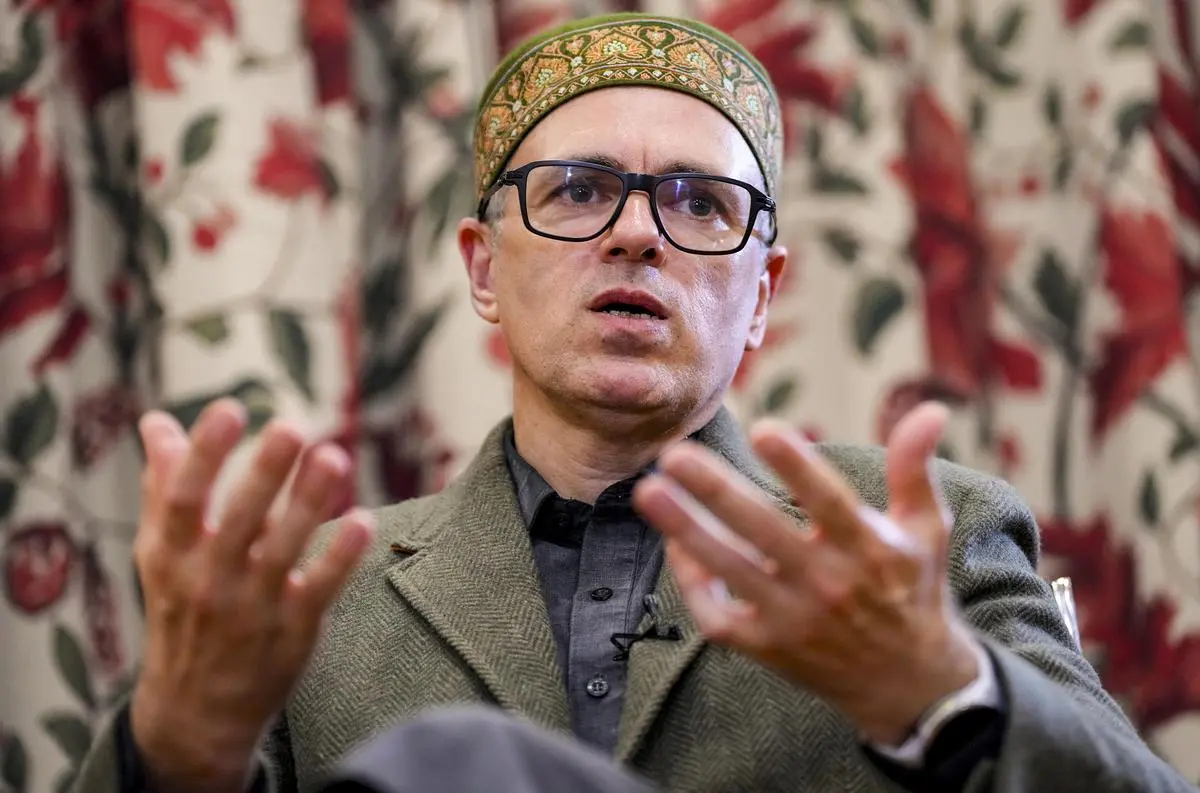
Jammu and Kashmir Chief Minister Omar Abdullah stated on Friday that Tamil Nadu’s Governor should not stop TVK leader Vijay from forming the government. Abdullah insisted that Vijay deserves a chance to demonstrate his majority in the assembly.
On Thursday, Tamil Nadu Governor Rajendra Vishwanath Arlekar dismissed TVK chief Vijay’s request to form a government, claiming the party lacks the necessary numbers to do so.
The Tamilaga Vettri Kazhagam (TVK) currently does not hold a simple majority required to govern Tamil Nadu. Despite receiving support from the Congress party, which has five MLAs, TVK still falls short of the 118 seats needed in the 234-member Tamil Nadu Assembly.
Abdullah emphasized that the imposition of President’s rule in Tamil Nadu lacks justification. He referenced numerous Supreme Court rulings underscoring the importance of inviting the single largest party to attempt forming a government and to prove its majority on the assembly floor.
“If we look at the Supreme Court’s judgement, then President’s rule should not apply. Multiple cases illustrate that after elections, the largest party should get an opportunity to form the government and prove its majority in the assembly,” Abdullah stated during a press interaction regarding the political landscape in Tamil Nadu.
He drew parallels to historical instances, recalling when former prime minister A B Vajpayee formed a government that lasted 13 days before admitting he did not have the numbers. The President of India at the time did not prevent him from assuming office.
“This precedent further backs the argument that Tamil Nadu’s Lok Bhavan lacks justification for halting the process,” Abdullah remarked.
He strongly advocated that Vijay should be granted the opportunity to lead the government and ascertain whether he can secure the necessary majority during assembly proceedings. “If he can prove his majority, he will continue; otherwise, he will resign,” he concluded.
Omar Abdullah’s comments come amidst intensified political speculation and debates surrounding governance in Tamil Nadu, as parties maneuver to align positions in the assembly. As the situation unfolds, eyes remain on the Tamil Nadu political scene.