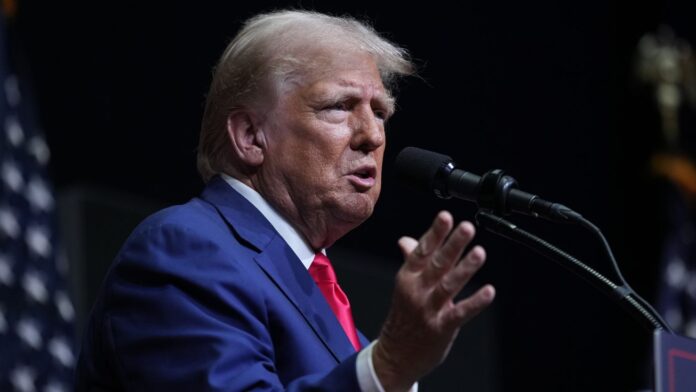
President Donald Trump announced on Tuesday that he has paused ‘Project Freedom’, aimed at escorting ships through the strategic Strait of Hormuz. This decision follows his claim of significant progress in negotiations with Iran, which seeks to formalize a peace agreement to end the ongoing conflict.
In a detailed post on Truth Social, Trump conveyed, “Great progress has been made toward a complete and final agreement with representatives of Iran.” He noted that Pakistan and other allied nations have requested this brief suspension of the project to facilitate the negotiation process.
“Given the military successes achieved during our campaign against Iran, we have mutually decided to pause Project Freedom, although the blockade will remain intact,” Trump elaborated. This project was initiated on Monday to assist ships stranded due to the closure of the Strait of Hormuz. Trump had earlier announced the operation on Sunday, and it was quickly put into action by the US Central Command.
However, the initiation of Project Freedom created tensions in the region. The Strait of Hormuz is a critical artery for global oil transportation, handling approximately one-fifth of the world’s oil supplies. The United Arab Emirates (UAE) reported that Iranian forces attacked its ships, while the US also claimed to have destroyed a number of Iranian small boats.
Trump’s announcement came shortly after US Secretary of State Marco Rubio declared the conclusion of Operation Epic Fury, which began on February 28. Rubio noted that the operation met its objectives, stating, “We’re not cheering for an additional situation to occur. We would prefer the path of peace. What @POTUS would prefer is a deal… that is, so far, not the route that Iran has chosen.”
During a press conference, Rubio clarified the humanitarian goals behind Project Freedom. “Our mission was to rescue nearly 23,000 civilians from 87 different countries left abandoned by the Iranian regime,” he explained. He emphasized that this initiative is defensive rather than offensive: “This is not an offensive operation. If no one attacks us, there will be no shooting.”
As the situation develops, diplomatic observers will be keenly watching how these negotiations will shape future relations between the United States and Iran. The potential for a formal agreement raises questions about regional stability and the safety of maritime operations in the strategically vital Gulf.
While many await the outcome of these negotiations, the intricacies of military and diplomatic strategy continue to unfold in the tense atmosphere surrounding the Strait of Hormuz. With the conflict reaching a pivotal moment, stakeholders across the globe hope for a resolution that prioritizes peace and security in the region.