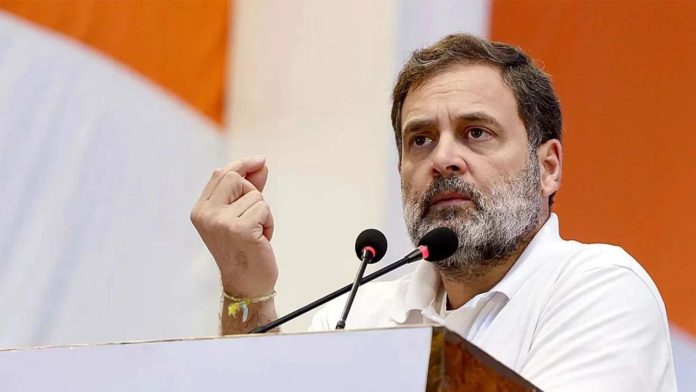
Congress leader Rahul Gandhi recently claimed that every sixth Member of Parliament (MP) from the Bharatiya Janata Party (BJP) in the Lok Sabha achieved their seat through vote chori, a term implying electoral fraud. Speaking on X, he challenged the BJP’s election integrity, suggesting that these MPs deserve to be labeled ‘ghuspethiya’, or infiltrators, according to the party’s own linguistic framework.
Gandhi’s comments, made on Wednesday, came amidst a broader critique of the BJP’s electoral practices. He expressed concerns regarding the legitimacy of the BJP’s parliamentary representation, stating, “If fair elections took place now, they would struggle to secure even 140 seats.”
The Leader of Opposition in the Lok Sabha said, “When vote chori occurs, sometimes individual seats are stolen, while at other times, entire governments fall prey. Of the 240 BJP MPs in the Lok Sabha, approximately every sixth MP secured their seat through these means.”
Continuing his criticism, Gandhi stressed the importance of accountability and transparency within electoral processes. He remarked, “They are not hard to identify. Should we, in the BJP’s own parlance, label them ‘ghuspethiya’? And what about Haryana? The entire government there is an ‘ghuspethiya’.”
His pointed remarks reflect a growing frustration with the BJP’s governance tactics and electoral practices that, according to him, manipulate various democratic institutions for political gain. Gandhi underscored his argument by accusing BJP of distorting voter lists and sacrificing electoral integrity for power.
In the wake of the BJP’s significant victories in the Bengal and Assam assembly polls, Gandhi referred to the outcomes as a “theft” of the public mandate. He alleged that these results are symptomatic of the BJP’s intent to undermine democracy in India. “The theft of Assam and Bengal’s mandate is a big step forward by the BJP in its mission to destroy Indian democracy,” he stated.
Gandhi’s comments extended beyond party lines, urging supporters and rivals alike to reassess their perspectives. He implored those who revel in the Trinamool Congress’s (TMC) setbacks to consider the broader implications. “This is not about one party or another. This is about India,” he emphasized on X.
The BJP notably ousted the TMC from power in West Bengal and maintained its stronghold in Assam in the recent assembly poll results, which could further intensify political debates and future elections.
Political analysts suggest that Gandhi’s focus on electoral integrity may resonate with a voter base increasingly attuned to issues of transparency and accountability in governance. Whispers of ‘vote chori’ echo concerns within a significant segment of the electorate as parties prepare for future encounters at the ballot box.
In conclusion, Gandhi’s allegations highlight ongoing tensions in Indian politics, where electoral integrity and democratic processes remain pivotal in influencing public sentiment and party fortunes. His challenge to the BJP to uphold democratic values serves as a reminder of the intricate dance of power in the ever-evolving political landscape of India.