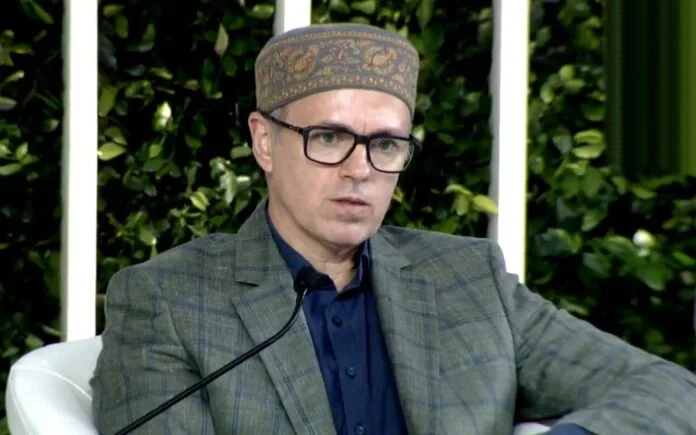
On Wednesday, Jammu and Kashmir Chief Minister Omar Abdullah described his office as a seat of “disempowerment.” He remarked that he faces the unique misfortune of overseeing a Union Territory with far fewer powers than any other Chief Minister in the country.
At an event organized by a prominent national newspaper, Abdullah delivered a forthright critique of the administrative setup in Jammu and Kashmir. He alleged that the ongoing interference from the Lieutenant Governor’s office hampers effective governance, and he reiterated his demand for a defined timeline for restoring statehood.
“I find it very difficult to reconcile the terms ‘Union Territory’ and ‘Jammu and Kashmir’ in the same breath,” Abdullah stated emphatically. He added that while officials seldom emphasized the term ‘State’ during his first tenure, the current Union Territory status has become inescapably prominent.
Abdullah highlighted the ongoing power struggle with the Lieutenant Governor, Manoj Sinha. He claimed that Sinha continues to assume roles traditionally reserved for an elected government, such as chairing the Jammu and Kashmir Power Development Corporation.
“What business does someone responsible for security have holding a tourism meeting?” Abdullah questioned, referring to Sinha’s recent convening of a tourism event in Gulmarg.
He also criticized the appointment of an IAS officer to a position meant for Jammu and Kashmir Administrative Services (JKAS), arguing it denies the elected government control over the Information Department.
Abdullah expressed frustration over the numerous pending cabinet decisions, including vital modifications to reservation policies, which remain stagnant under the Lieutenant Governor’s authority. He emphasized the disparity in power distribution between the elected officials and unelected representatives.
Turning to the topic of statehood, Abdullah reminded the Centre of its three-step roadmap: delimitation, elections, and then statehood. “Two of the steps have been completed. Why are we still waiting for the third?” he asked pointedly.
Abdullah insisted that the Centre must clarify what it means by an “appropriate time” for restoring statehood. “If it hinges on political circumstances, like when the BJP comes to power, then be honest and let people decide accordingly,” he stated.
On the topic of restoring Article 370, Abdullah expressed skepticism, suggesting that political changes at the Centre would be necessary for any reinstatement. “It is futile to expect the same people who revoked it to restore it,” he said, reaffirming his commitment to preserving Special Status while avoiding unrealistic promises to the public.
The Chief Minister raised concerns over increasing radicalization, attributing it to hyper-nationalism and punitive measures taken against communities. He mentioned the demolitions following terrorist attacks, questioning the effectiveness of collective punishment. “If the residents are radicalized, what leads us to believe it’s not our own doing?” he posed.
Abdullah also highlighted recent controversies regarding sporting events and medical college admissions where the selection of majority Muslim candidates stirred public uproar. He asked, “When an entire community feels marginalized, how can we expect no backlash?”
On the national political landscape, Abdullah characterized the INDIA bloc as being in precarious condition. He admitted that critical issues, including Article 370, have predominantly fallen off the bloc’s agenda.
Defending Congress leader Rahul Gandhi for his muted stance on these issues, he pointed out, “He should focus on winning an election before tackling such sensitive topics.” Abdullah noted that the current political environment does not favor raising these contentious matters.
Abdullah distanced himself from his father’s views regarding EVM tampering, stating, “I believe we must own our defeats and understand our shortcomings instead of attributing them to external factors like machines. The real issue lies in constituency delimitation.”
Earlier in his speech, Abdullah discussed environmental concerns such as pollution and prolonged dry spells affecting Srinagar, noting that its geography exacerbates smog-related issues. He emphasized correcting misconceptions surrounding tourism as the primary economic driver for Jammu and Kashmir, clarifying that agriculture, horticulture, and industry contribute more significantly to the Gross State Domestic Product.