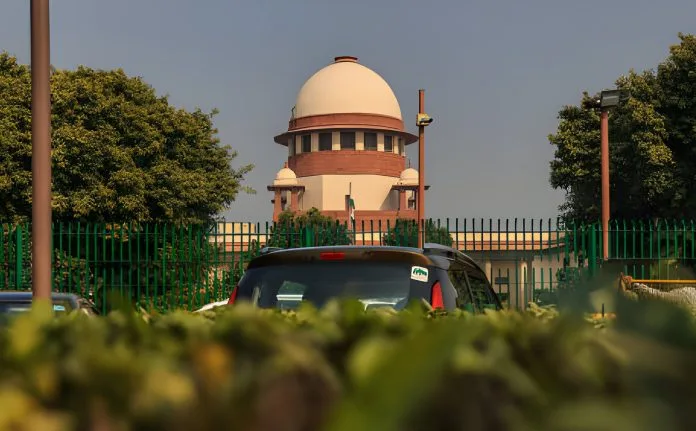
The Supreme Court of India on Wednesday referred the vital question of whether litigants can directly approach high courts for anticipatory bail to a three-judge bench. The court’s decision came amidst concerns over legal procedural norms, particularly in cases involving anticipatory bail applications.
A bench consisting of Justices Vikram Nath and Sandeep Mehta stated, “This matter requires to be heard by a three-judge bench.” They directed the case to be listed before a larger bench once it is constituted, signifying the importance of this issue.
This deliberation follows an earlier appointment of senior advocate Siddharth Luthra as amicus curiae to provide assistance on the matter, underscoring the complexity and significance of the legal questions involved.
Kerala High Court’s Practice Under Scrutiny
The Supreme Court expressed particular concern regarding the “regular practice” observed in the Kerala High Court, where litigants repeatedly file anticipatory bail applications directly without first approaching the sessions court. “One issue that is bothering us is that in the Kerala High Court, anticipatory bail applications are regularly entertained directly. Why is that so?” the bench inquired during the proceedings.
In reviewing the relevant legal framework, including provisions from the old Code of Criminal Procedure and the newly enacted Bharatiya Nagarik Suraksha Sanhita (BNSS), 2023, justices noted that a structured hierarchy exists for managing bail applications, raising questions about the legality of bypassing the sessions court.
“It doesn’t happen in any other state. Only in the Kerala High Court… applications for anticipatory bail are regularly entertained directly,” the bench pointed out, raising eyebrows regarding the procedural consistency followed across the country.
Background of the Triggering Case
The Supreme Court’s observations emerged while considering a plea filed by two individuals challenging a decision from the Kerala High Court that denied them anticipatory bail. The petitioners, having approached the High Court directly, skipped the essential step of seeking relief from the sessions court, prompting the Supreme Court to critically examine this trend.
The justices emphasized that such a practice could deprive courts of comprehensive factual records that typical sessions court proceedings would usually compile. They suggested the need for a clear and uniform approach to anticipate bail pleas, which might aid in preserving the integrity of the judicial process.
“We are inclined to consider whether the option to approach the high court is a matter of choice for the accused or whether it should be mandatory to first go to the sessions court,” remarked the bench, shedding light on the critical balance between legal rights and procedural adherence. The Supreme Court has also issued a notice to the Kerala High Court, through its Registrar General, seeking their official response on the matter.
This case reflects growing concerns regarding legal practices within the judicial framework of India. With increasing discussions about judicial reforms, the outcome of this referral could significantly impact the future of anticipatory bail proceedings across high courts in India.
As the legal community awaits further developments, the Supreme Court’s proactive stance emphasizes the judiciary’s commitment to uphold legal norms and procedural clarity, ensuring that justice remains accessible and fair.