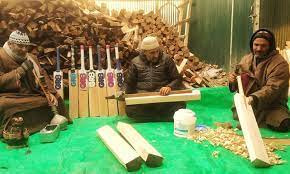
Sangam, September 28: As the Cricket World Cup excitement builds in India, Sunil Kumar, a skilled batmaker from Uttar Pradesh’s Meerut, is one of several master craftsmen drawn to Sangam, a town in south Kashmir. Local manufacturers have experienced a surge in orders in anticipation of the Cricket World Cup, which commences next week.
While sales of cricket bats made from Kashmir willow typically see an upswing before every ICC-organized multilateral event, this year’s orders have been particularly high, owing to India hosting the tournament after a 12-year gap. Sunil Kumar shared his perspective, stating, “With the Cricket World Cup approaching, the demand for bats has risen so much that we are not able to complete all the orders.”
For Kumar, the increase in work not only means higher earnings but also the satisfaction of knowing that the bats he crafts will be used in international cricket. He proudly mentioned, “I am a batmaker with 20 years of experience. I have made bats for ace cricketers such as Rohit Sharma, Virat Kohli, KL Rahul, Andre Russell, and Dwayne Bravo.”
Fawzul Kabir, the spokesperson for the Cricket Bat Manufacturers’ Association of Kashmir, noted that the demand for Kashmir willow bats has steadily risen over the past two years, especially after the ICC granted approval for their use in international tournaments. Kabir, who manufactures bats under the GR8 Sports brand, stated, “We have been manufacturing cricket bats for 102 years but didn’t have any national or international recognition until 2021. After getting the ICC’s approval, our bats appeared in different international tournaments, and the demand has risen manifold.”
Kabir asserted that Kashmir caters to 80 percent of the global demand for cricket bats. He added, “With the World Cup around the corner and being hosted by India, the demand has risen manifold. We manufacture around three million bats annually, but the demand for this month and the previous one was 15 times higher. We manufactured around three to four million bats in two months that we delivered.”
He also pointed out that while there were “zero exports” until 2021, more than 1.85 lakh bats from Kashmir have been exported to various countries. He emphasized the appeal of Kashmir willow bats as a cost-effective and quality alternative, noting that at least 17 players will be using his company’s bats during this edition of the World Cup.
Mushtaq Ahmad Sheikh, a worker at a bat manufacturing unit, explained how the workforce eagerly anticipates the World Cup because it results in increased wages. He stated, “We always wait for the World Cup because our work increases manifold, and we get double the wages. We work day and night during these days as this is the source of our livelihood.” Sheikh also noted that buyers increase their orders three to four times during the World Cup season.
Omer Alam, a former cricketer from Jammu and Kashmir who played in the Ranji Trophy, commended the investment made in improving the quality of Kashmir willow bats, which is now yielding dividends. He highlighted the durability of Kashmir willow bats, stating, “The Kashmir (willow) bats are much cheaper and they have a longer life. English willow bats are used for one season, but Kashmir willow bats last for two to three seasons… We have seen international players playing with these bats, and it has good potential.”