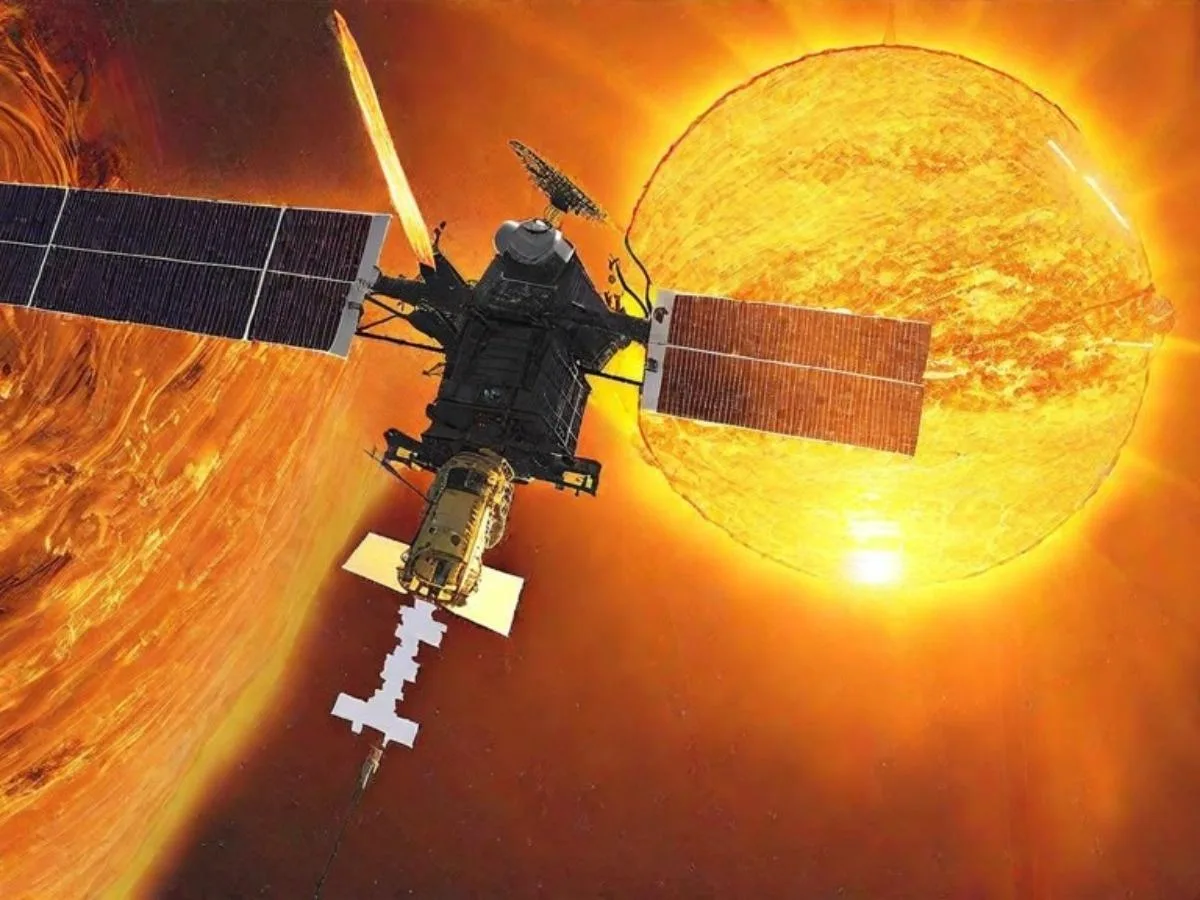
Bengaluru, Sep 15: India’s maiden solar observation mission, Aditya L1, celebrated another milestone as it accomplished its fourth Earth-bound maneuver, announced ISRO during the early hours of Friday. The space agency stated, “The fourth Earth-bound maneuver (EBN#4) was executed successfully. ISRO’s ground stations at Mauritius, Bengaluru, SDSC-SHAR, and Port Blair meticulously tracked the satellite during this operation. Meanwhile, a transportable terminal, presently stationed in the Fiji islands for Aditya-L1, will facilitate post-burn operations.”
The mission achieved a new orbit with parameters of 256 km x 121973 km, as per ISRO. The next crucial phase, the Trans-Lagrangean Point 1 Insertion (TL1I), is slated for September 19, scheduled around 02:00 Hrs. IST.
Aditya-L1 distinguishes itself as India’s pioneer space-based observatory assigned to study the Sun from a halo orbit encircling the first Sun-Earth Lagrangian point (L1), positioned approximately 1.5 million km from Earth.
The first three Earth-bound maneuvers were executed successfully on September 3, 5, and 10, consecutively. These maneuvers are integral to the spacecraft’s 16-day orbital journey around Earth, which enables it to acquire the necessary velocity for the onward journey to L1.
With four Earth-bound orbital maneuvers now accomplished, Aditya-L1 is primed for a Trans-Lagrangian1 insertion maneuver, commencing its nearly 110-day journey to the destination around the L1 Lagrange point.
Upon arrival at L1, another maneuver will secure Aditya L1 in an orbit around L1, a finely balanced gravitational position nestled between Earth and the Sun. The satellite will spend its entire mission orbiting L1 in an irregularly shaped trajectory, oriented approximately perpendicular to the line connecting Earth and the Sun.
Aditya-L1 was launched successfully on September 2 by ISRO’s Polar Satellite Launch Vehicle (PSLV-C57) from the Second Launch Pad of Satish Dhawan Space Centre (SDSC), Sriharikota. The spacecraft was successfully inserted into an elliptical orbit of 235×19500 km around Earth after a 63-minute and 20-second flight.
ISRO highlights the advantage of placing a spacecraft in a halo orbit around the L1 point, as it allows continuous observation of the Sun without any interruptions or eclipses. This unique vantage point offers valuable insights into real-time solar activities and their impact on space weather.
Aditya-L1 carries seven scientific payloads, all developed indigenously by ISRO and national research laboratories, including the Indian Institute of Astrophysics (IIA) in Bengaluru and the Inter-University Centre for Astronomy and Astrophysics (IUCAA) in Pune. These payloads are designed to observe the photosphere, chromosphere, and the Sun’s outermost layers (corona) using electromagnetic particle and magnetic field detectors. Additionally, three of the payloads conduct in-situ studies of particles and fields at Lagrange point L1, contributing vital scientific data on solar dynamics in the interplanetary medium.
Scientists believe there are five Lagrangian points, or “parking areas,” between Earth and the Sun, where spacecraft can efficiently remain with reduced fuel consumption. These points, named after Italian-French mathematician Joseph-Louis Lagrange, result from a delicate equilibrium between the gravitational forces of the Sun and Earth, enabling small objects to remain synchronized with them.