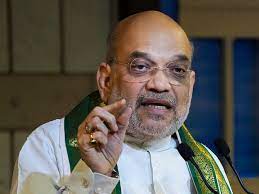
New Delhi, September 14 : Union Home Minister Amit Shah emphasized on Thursday that Hindi serves as a unifying force amidst India’s linguistic diversity, honoring both Indian and global languages and dialects.
In his message marking “Hindi Diwas,” Shah underscored that Hindi does not compete with any other Indian language, and he stressed that a strong nation can only emerge by strengthening all of its languages. He expressed confidence that Hindi would play a pivotal role in empowering local languages.
“India has been a country of diverse languages. Hindi unites the diversity of languages in the world’s largest democracy,” Shah said. “Hindi has been a democratic language. It has honored different Indian languages and dialects as well as many global languages and adopted their vocabularies, sentences, and grammar rules.”
Shah highlighted the significant role played by the Hindi language in uniting the nation during the challenging days of the freedom struggle, fostering a sense of unity in a country with numerous languages and dialects. He noted that Hindi, as a means of communication, had a crucial role in advancing the freedom movement across the nation.
According to Shah, the movements for achieving “Swaraj” (self-rule) and “Swabhasha” (one’s own language) were concurrent endeavors in the country.
Acknowledging the important role of Hindi in the freedom movement and post-independence, Shah noted that it was accepted as the official language on September 14, 1949, by the framers of the Constitution. He emphasized that a country’s original and creative expression is possible only through its own language.
Shah underscored that all Indian languages and dialects constitute the cultural heritage of the nation and must be nurtured and preserved. He also highlighted that Indian languages have received recognition and respect at both national and global forums under the leadership of Prime Minister Narendra Modi.
The Home Minister further mentioned that the Department of Official Language within the Ministry of Home Affairs is diligently working to enrich Indian languages through modern technology, aiming to establish them as languages of public administration, education, and scientific use.
Shah explained that, guided by the Prime Minister’s leadership, public welfare schemes are effectively implemented by facilitating communication between the government and the public in Indian languages.
He pointed out that the principle of language evolution suggests a shift from complexity to simplicity and expressed his preference for the use of simple and clear Hindi words in official work.
Shah mentioned the formation of the Parliamentary Committee on Official Language, which periodically reviews the progress made in the use of Hindi in government functions across the country and presents its reports to the President.
Highlighting efforts to increase the use of the official language, Shah revealed that 528 town official language implementation committees (TOLICs) have been established to date, including overseas committees in London, Singapore, Fiji, Dubai, and Port-Louis.
India has also initiated efforts to promote the use of Hindi in the United Nations (UN).
Moreover, the Department of Official Language has introduced new traditions such as organizing the “All India Official Language Conference.” Shah also noted the development of a memory-based translation system called “Kanthastha” and the creation of the “Hindi Shabd Sindhu” dictionary as innovative initiatives to advance the official language in alignment with technology.