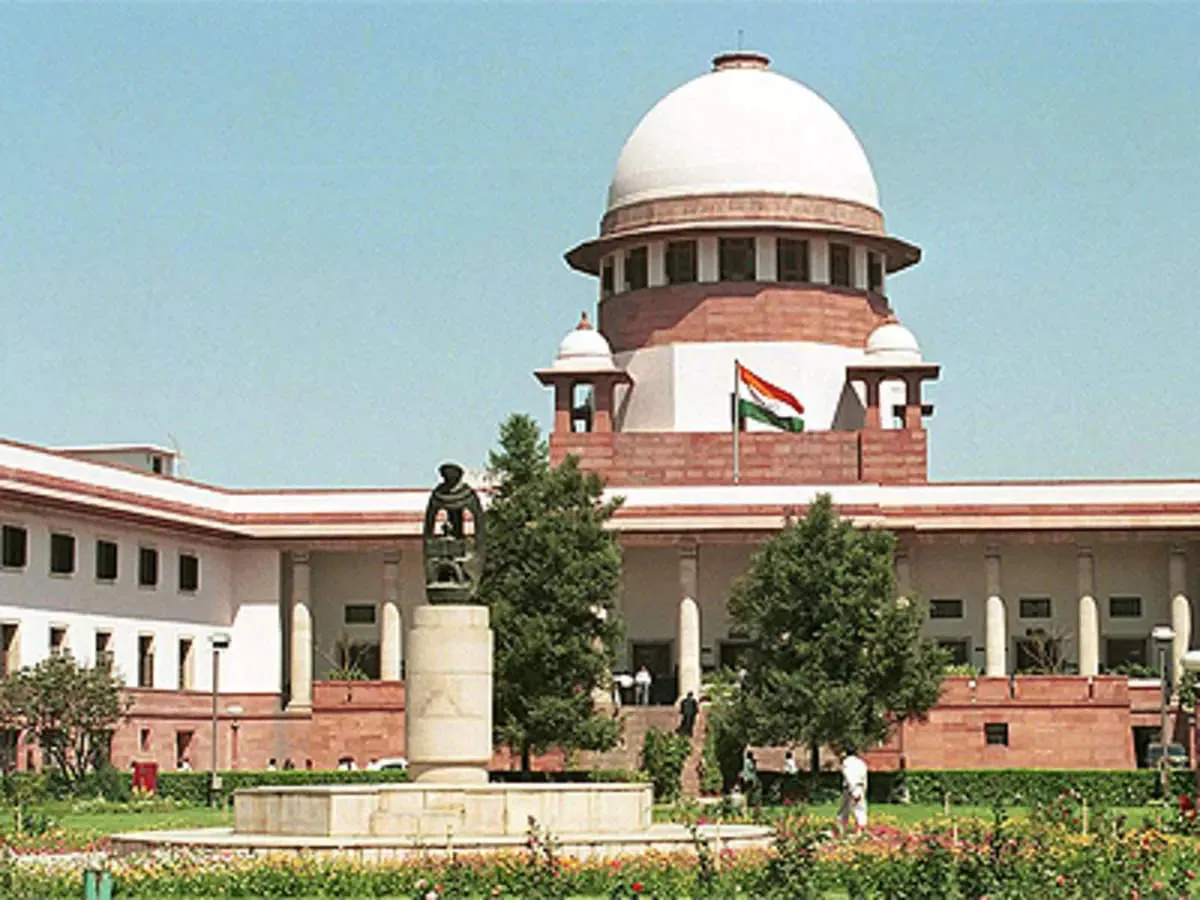
New Delhi, August 18: The Supreme Court raised substantial doubts regarding the validity of multiple constitutional orders that facilitated the application of provisions from the Indian Constitution to Jammu and Kashmir after the year 1957.
The court specifically referred to the Constitution (Application to Jammu and Kashmir) Amendment Orders that were enacted between 1957 and August 6, 2019. A five-judge panel, led by Chief Justice D Y Chandrachud, expressed surprise at the argument presented by senior advocate Dushyant Dave, who was representing a petitioner. Dave contended that Article 370, which conferred special status upon the former state of Jammu and Kashmir, had fulfilled its purpose and no longer held significance.
Differing from other prominent lawyers like Kapil Sibal and Gopal Subramanium, Dave asserted that Article 370 had not entirely become a permanent fixture and had effectively served its purpose with the culmination of the Constituent Assembly of Jammu and Kashmir in 1957.
Dave stated, “I respectfully submit that Article 370 has lived its life. It has achieved its purpose. Now, Article 370 (1) survives because tomorrow, if the Constitution is amended and a new article is inserted, which we would like to apply to Jammu and Kashmir also… To this limited extent, this Article 370 (1) may be necessary.”
Chief Justice Chandrachud then inquired of Dave, “If Article 370 has fulfilled its purpose after the constituent assembly for the state of Jammu and Kashmir completed its tasks, then why were there subsequent occasions to issue constitutional orders after 1957?”
Dave argued that once the constituent assembly of Jammu and Kashmir had resolved to remain with India, that decision had become inviolable and beyond revision. “It cannot be revisited. The President becomes functus officio in 1954 (after the issuance of the constitution order that applied most provisions of the Indian constitution), as far as Article 370(3) is concerned. Your lordship has expressly accepted this position,” he elaborated.
During the seventh day of hearings on a series of pleas contesting the Central Government’s decision of August 5, 2019, Dave maintained that only Article 370(1) remained applicable, allowing for the periodic extension of amendments made to the Indian Constitution.
Addressing the exceptions within Article 370, Chief Justice Chandrachud pointed out, “So, your entire argument hinges on the idea that Article 370 has concluded its function after the constituent assembly finished its tasks. However, this contradicts the constitutional practice, as after 1957, there were orders progressively modifying the Constitution’s provisions related to J-K. This indicates that Article 370 continued to have relevance beyond that point.”
He further argued that it wouldn’t be accurate to claim that Article 370 had reached the end of its life and that the temporary provision had taken on a permanent role in the Indian constitutional framework. “If that were true, then there wouldn’t have been a need for progressive constitutional orders issued from 1958 onwards,” the Chief Justice emphasized.
Supplementing his query, Chief Justice Chandrachud challenged Dave, stating, “Then how can the Constitution be altered at all? If your argument stands, once the constituent assembly made its decision in 1957, there would be no authority to modify any provision of the Constitution concerning J-K. This contradicts what everyone has presented.”
Dave countered that Article 370’s clause 3 solely pertained to the continuation of the entire Article 370, and since the constituent assembly of Jammu and Kashmir had opted to become part of India, that decision had become permanent.
The bench acknowledged Dave’s arguments as worthy of consideration, with Chief Justice Chandrachud stating, “We need to address this submission. I’m examining this. Yet, there is an internal inconsistency in accepting this, because if this submission is correct regarding the proviso to clause 3, then the implication would be that once the constituent assembly concluded its tasks in 1957, there wouldn’t be any amendment to the constitution under clause 2 of Article 370. This contradicts not just constitutional practice, but also the acceptance by both J-K and the Indian Government, as amendments were made to the constitution even after 1957 and up until the contentious amendment of 2019.”
The hearings are set to resume on August 22, with the bench urging petitioners’ counsel to conclude their arguments on that day, following which the Center’s submissions will be heard.
In a hearing on August 10, the Supreme Court had asserted that the cession of Jammu and Kashmir’s sovereignty to India was fully realized upon the state’s accession to the Indian Union in October 1947. The court also stated that it was challenging to maintain the permanence of Article 370, which granted special status to the former state.
Numerous petitions challenging the abrogation of Article 370’s provisions and the Jammu and Kashmir Reorganisation Act of 2019, leading to the division of the erstwhile state into two union territories, were referred to a Constitution bench in 2019.