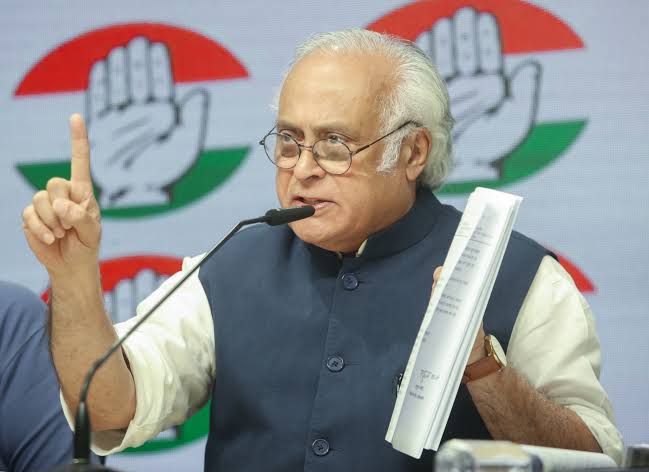
Congress general secretary in-charge communications Jairam Ramesh on Friday launched a fresh attack on the Narendra Modi government over its China policy, accusing it of maintaining a conspicuous silence over recent military face-offs in Arunachal Pradesh and alleging that its approach towards Beijing was compromising India’s border security, economic interests and strategic autonomy.
In a post on social media platform X, Ramesh said the Director General of the Indo-Tibetan Border Police (ITBP) had rightly praised the force’s performance during recent confrontations with the People’s Liberation Army (PLA) in Arunachal Pradesh, but questioned why Prime Minister Narendra Modi and his government had not publicly addressed the reported incidents and their implications for national security.
“While the self-styled Vishwaguru’s calibrated concessions to China continue,” Ramesh wrote, using a sarcastic reference to Modi to challenge the government’s handling of relations with Beijing.
Referring to corps commander-level talks held at Wacha and Damai in Arunachal Pradesh last month following a face-off at Taksing, Ramesh said local residents had reported that patrolling points had once again been lost, drawing a parallel with the developments in eastern Ladakh. He also accused China of continuing to rename places in Arunachal Pradesh and constructing a 60,000-megawatt dam, which he alleged could threaten India’s ecological and water security.
The Congress leader argued that the concerns along the border could not be separated from India’s growing economic dependence on China. Citing trade figures, he claimed that the bilateral trade deficit had reached a record $112 billion in 2025-26, up from $99 billion in the preceding financial year.
He said the widening imbalance was hurting micro, small and medium enterprises across several sectors and questioned the effectiveness of the government’s flagship manufacturing initiative.
“Make in India has become Import from China,” Ramesh charged, portraying the trade deficit as evidence of the gap between the government’s manufacturing ambitions and the country’s continuing reliance on Chinese goods.
He maintained that the economic imbalance posed a serious challenge to India’s economic security and argued that the government’s China policy should be judged not merely by diplomatic engagements but also by its consequences for domestic industry, strategic autonomy and national defence.
Ramesh traced the political controversy over the government’s handling of China to Modi’s remarks on June 19, 2020, days after the deadly Galwan Valley clash in eastern Ladakh in which 20 Indian Army personnel were killed. The Prime Minister had said: “Na koi wahan hamari seema mein ghus aaya hai aur na hi koi ghusa hua hai, na hi hamari koi post kisi doosre ke kabze mein hai.”
The Congress has repeatedly criticised the statement, with Ramesh describing it as an “infamous clean chit” to China. The remarks have remained at the centre of the political dispute over the government’s account of the border crisis and the circumstances surrounding the Galwan confrontation.
The Congress leader also invoked remarks attributed to former Army chief General M.M. Naravane, claiming that the retired officer had disclosed that the only instructions he received during the Ladakh crisis were: “Jo uchit samjho woh karo.” Ramesh cited the statement to question the clarity of the political leadership’s direction to the military at a critical moment in the confrontation with China.
He further referred to a public statement made on July 4, 2025, by then Deputy Chief of Army Staff Lieutenant General Rahul Singh regarding China’s extensive involvement in Pakistan’s military campaign during Operation Sindoor. Ramesh said the account was subsequently publicly contradicted by former Chief of Defence Staff General Anil Chauhan on August 25, 2026.
He also drew attention to Chauhan’s subsequent appointment to lead a think tank that Ramesh described as part of the Rashtriya Swayamsevak Sangh-Bharatiya Janata Party ecosystem.
The latest intervention brings together several strands of the Congress’s criticism of the government: the military situation along the India-China border, the political fallout from the Galwan clash, China’s activities in Arunachal Pradesh and the widening trade deficit between the two countries. The Opposition has consistently demanded greater transparency from the government on the border situation, while the government has maintained its diplomatic and security engagement with Beijing amid efforts to strengthen domestic manufacturing and reduce strategic vulnerabilities.
By linking reported military confrontations in Arunachal Pradesh with developments in Ladakh, Chinese infrastructure projects and India’s trade dependence, Ramesh sought to present the China question as a broader test of the Modi government’s national security and economic policies. His central charge was that India continued to bear the consequences of its approach to Beijing, while the government had failed to provide adequate public answers on the military and economic challenges confronting the country. (Agencies)