

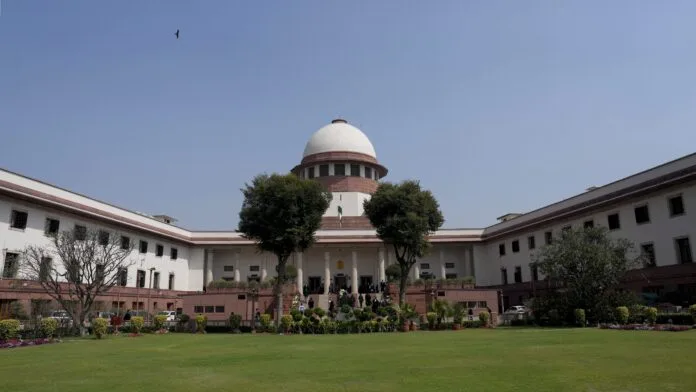
The Supreme Court of India has raised significant concerns regarding a disturbing trend where judges issue multiple judicial orders immediately before their retirement. This phenomenon, characterized by judges passing orders akin to a batter ‘hitting sixes in the final overs,’ has garnered increasing attention from legal authorities and practitioners.
The remarks came from a Bench led by Chief Justice of India (CJI) Surya Kant, during the hearing of a petition filed by a Principal District and Sessions Judge from Madhya Pradesh. The judge challenged his suspension, which occurred just ten days ahead of his scheduled retirement.
“It is an unfortunate trend. There is a growing tendency of judges passing so many orders just before retirement,” CJI Surya Kant stated solemnly during proceedings.
The Bench, consisting of Justices Joymalya Bagchi and Vipul M. Pancholi, expressed their discontent over this issue. They compared such actions to a cricket player trying to score last-minute runs, suggesting a sense of urgency behind these decisions.
The suspended officer was due to retire on November 30, 2023, but faced suspension following a Full Court decision from the Madhya Pradesh High Court on November 19. Allegedly, this suspension arose from two specific judicial orders he issued shortly prior to his retirement.
Appearing on behalf of the petitioner, senior advocate Vipin Sanghi defended the judicial officer, emphasizing his exemplary service record and highlighting commendable ratings in his Annual Confidential Reports (ACRs). Sanghi argued that disciplinary action based purely on judicial orders is unwarranted, stating, “How can an officer be suspended for judicial orders which are appealable and can be corrected by higher courts?”
The Supreme Court judges concurred with Sanghi’s argument, asserting that ordinarily, disciplinary proceedings do not arise from judicial errors. However, CJI Surya Kant probed deeper, asking, “What if the orders are palpably dishonest?” This distinction underscores the fine line between an honest judicial error and actual misconduct.
Moreover, on November 20, the Supreme Court decided to enhance the retirement age for judicial officers from 60 to 61 years. Consequently, this decision altered the petitioner’s retirement date to November 30, 2026. The CJI noted that the judicial officer was not privy to this crucial extension when he issued the contested orders, which influences the context of the suspension.
The Bench questioned why the officer had not sought legal recourse through the High Court to contest his suspension. Sanghi clarified that since the suspension resulted from a Full Court decision, the petitioner opted to approach the Supreme Court directly. However, the justices acknowledged past instances when Full Court decisions were overturned by High Courts in judicial proceedings.
The Court also criticized the officer’s method of seeking information regarding his suspension via applications under the Right to Information (RTI) Act. They expressed that it is not befitting of a senior judicial officer to pursue information through such channels when a formal representation could have sufficed.
The Supreme Court ultimately declined to entertain the petition but granted the judicial officer the liberty to submit a representation to the Madhya Pradesh High Court, requesting a reconsideration of the suspension order. The Bench instructed the High Court to review and make a decision on this representation within four weeks.

