

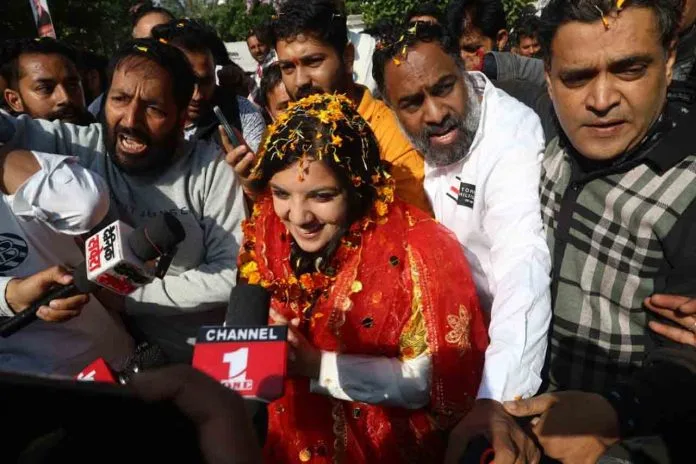
Devyani Rana of the Bharatiya Janata Party (BJP) has achieved a decisive victory in the Nagrota Assembly seat during the recent elections held in Jammu and Kashmir. Official results released by the Election Commission of India confirmed her win with a commanding lead.
Rana secured a total of 42,183 votes, more than double that of her nearest opponent, Harsh Dev Singh from the Jammu & Kashmir National Panthers Party, who received 17,661 votes. Following them on the ballot were Shamim Begum from the Jammu & Kashmir National Conference with 10,834 votes, and independent candidate Anil Sharma, who managed to garner only 837 votes.
This victory signifies a significant moment for the BJP in the Nagrota constituency, showcasing Rana’s appeal among the electorate. The Election Commission completed all 11 rounds of counting before announcing the results, which revealed a victory margin of 24,522 votes.
Rana’s win resonates with the BJP’s ongoing strategy to strengthen its foothold in Jammu & Kashmir, a region with complex political dynamics. Her victory reflects not only local sentiments but also signifies broader support for the BJP in this politically crucial area.
Political analysts view Rana’s success as a reaffirmation of the BJP’s policies and outreach in the region. The party has focused extensively on development and good governance since its rise in prominence in Jammu & Kashmir.
In her victory speech, Rana expressed gratitude to the voters of Nagrota and pledged to work tirelessly for their development. She emphasized collaboration, stating, “Together, we will transform Nagrota into a model for progress and governance.” Her commitment to addressing local issues resonated with her supporters.
The BJP has witnessed a surge in its influence across the Indian political landscape, leveraging welfare schemes and development projects to win over constituents. Rana’s victory in Nagrota exemplifies how effectively these strategies have translated into electoral success.
Political observers will closely watch Rana’s performance in the assembly, as her policies and legislative initiatives may influence future elections in the region. With expectations running high, Rana’s leadership will be pivotal in reshaping Nagrota’s political narrative.

