

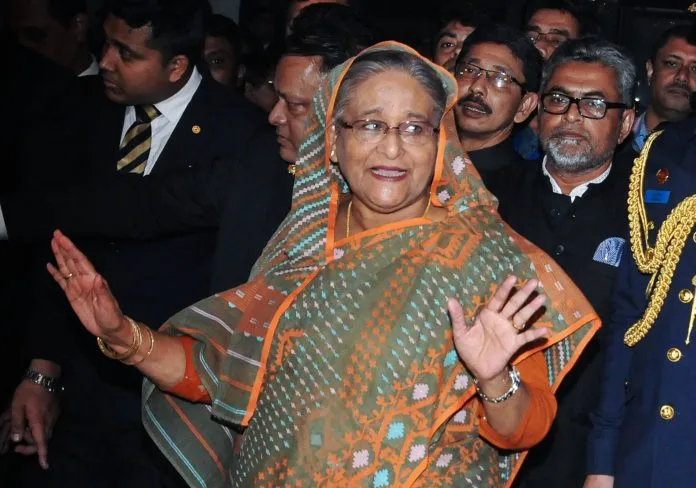
Former Bangladesh Prime Minister Sheikh Hasina declared her return to the nation depends on restoring participatory democracy, lifting the ban on her party, the Awami League, and ensuring free, fair elections. In a recent exclusive email interview with PTI from an undisclosed location in India, Hasina expressed concern over the unelected Yunus-led interim administration and its impact on India-Bangladesh relations.
“I am immensely grateful to the Indian government and its people for their kind hospitality,” she stated, acknowledging India’s support during her time of distress. Hasina has stayed in India since fleeing her country on August 5, 2024, in the wake of violent protests that led to her resignation.
Hasina emphasized that her return is contingent on the restoration of democracy, highlighting the necessity for the interim government to rescind the ban on the Awami League. She noted, “The most important condition for my return to Bangladesh is the same condition that the Bangladeshi people require: a return to participatory democracy.” Her insistence stems from the belief that any election excluding her party would lack legitimacy and fail to represent the will of the citizens.
During the chaotic months leading to her departure, she acknowledged government missteps in managing protests, stating, “Obviously, we lost control of the situation and that was regrettable.” She attributed the unrest to what she called “seasoned political firebrands masquerading as student leaders,” who exacerbated tensions during that period.
Addressing the upcoming elections scheduled for February 2025, Hasina rejected allegations of calling for a boycott and asserted the need for her party’s participation to establish a legitimate government. “Tens of millions of people support us… It would be a huge missed opportunity for a country that badly needs a government with genuine consent of the people,” she insisted.
Hasina’s critique of Dr. Muhammad Yunus, the interim leader, was sharp and unequivocal. She accused Yunus of weakening Bangladesh’s strategic partnership with India through his alleged hostility. “Yunus’ hostility to India is foolish and self-defeating… He is unelected, chaotic, and dependent on extremist forces,” she stated, cautioning that his diplomatic blunders could jeopardize bilateral ties further.
Through her remarks, Hasina sought to reassure Indian citizens that the interim government does not reflect the sentiments of the Bangladeshi populace. She affirmed, “India is and will remain our nation’s most important friend,” emphasizing the need for solidarity amid political challenges.
In a dramatic turn, Hasina offered to stand trial under international supervision, including at the International Criminal Court if necessary, positioning herself as a leader willing to face scrutiny. She criticized Yunus for evading accountability, asserting that an impartial tribunal would likely result in her exoneration.
Moreover, she dismissed the Bangladesh International Crimes Tribunal, which has sought severe penalties against her, labeling it a “kangaroo tribunal” aimed at politically extinguishing her party and influence. She expressed, “They want to eliminate us as political forces. The fact that they would use the death penalty to silence opponents shows how little respect they have for democracy or due process.”
Finally, Hasina noted that while Yunus may have initially garnered support from some Western liberals, that backing was waning as they observed his government placing radicals in prominent positions, discriminating against minorities, and undermining constitutional frameworks.

