

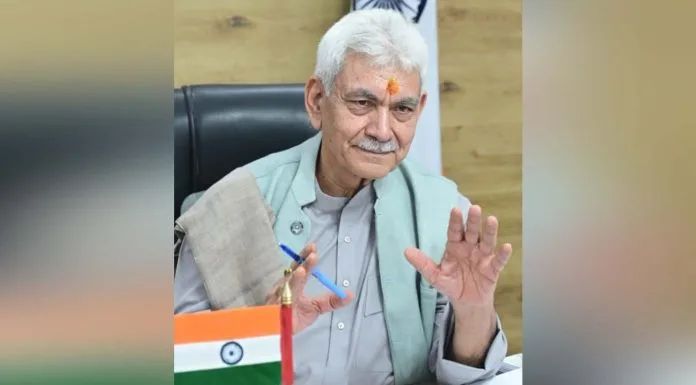
Lieutenant Governor Manoj Sinha emphasized the openness of the administration to dialogue with all stakeholders regarding the Katra Ropeway Project. Speaking in an exclusive interview, Sinha assured that the project would boost pilgrimage numbers while addressing concerns of local traders and service providers.
Ropeway Project: Stakeholder Engagement and Benefits
- A High-Level Committee, chaired by the Lieutenant Governor, is actively engaging with stakeholders to address grievances and ensure consensus on the Shri Mata Vaishno Devi Ropeway Project.
- The committee includes Dr. Ashok Bhan, Suresh Kumar Sharma, Divisional Commissioner Jammu Ramesh Kumar, and CEO SMVDSB Anshul Garg.
- The committee is open for dialogue and has already held consultations with stakeholders, including those agitating against the project.
Background of the Ropeway Project
- Initiated following the National Green Tribunal’s (NGT) 2017 directive to phase out mules on the Shri Mata Vaishno Devi track due to environmental concerns.
- A Rehabilitation Scheme was introduced for service providers, including 3,844 ponywallahs, 4,233 pithus, and 3,300 palkiwallahs.
- The Supreme Court recommended a ropeway facility in 2018, and global tenders were invited to complete the project in four years.
- The finalized alignment is from Tarakote to Sanjichhat, as alternative routes faced technical and logistical challenges.
Proposed Benefits
- Enhanced Pilgrimage: The project is expected to increase pilgrimage numbers and provide emergency evacuation capabilities.
- Support for Service Providers: The Lieutenant Governor guaranteed compensation, including financial aid of Rs. 50,000 and alternative livelihood opportunities for affected stakeholders.
- Boost for Katra Town: A ticketing counter at Niharika Bhawan and other infrastructural developments, including two helipads, will further enhance Katra’s economy.
Industrial Package: Seeking Expansion
- The Lieutenant Governor has proposed an increase in the Rs. 28,400 crore Industrial Package, which has been exhausted due to high demand.
- Industrial investment proposals worth Rs. 1.60 lakh crore have been received, with projects worth Rs. 19,000 crore already underway and Rs. 8,000 crore in production.
- New Industrial Estates are being developed to overcome land constraints.
Anti-Terror Achievements and Future Plans
- Sinha highlighted significant progress in counter-terror operations, with 75 terrorists eliminated in 2024, including 55 foreign operatives.
- The administration is targeting a terror-free Jammu and Kashmir by 2025, leveraging a comprehensive approach to dismantle terrorist ecosystems.
- Peaceful conduct of elections and revival of normalcy, including cinema halls and nightlife, reflect the changing landscape of the Union Territory.
Governance and Business Rules
- On relations with the newly elected government, Sinha stated that all institutions are functioning as per the Constitution.
- A Cabinet Sub-Committee is drafting Business Rules for the Union Territory, which will be finalized soon.
Focus on Development and Infrastructure
- The administration is committed to infrastructure development, promoting tourism, and addressing concerns of all stakeholders through dialogue and constructive action.
- Efforts to align with modern needs while preserving local interests remain a cornerstone of the government’s approach.

