

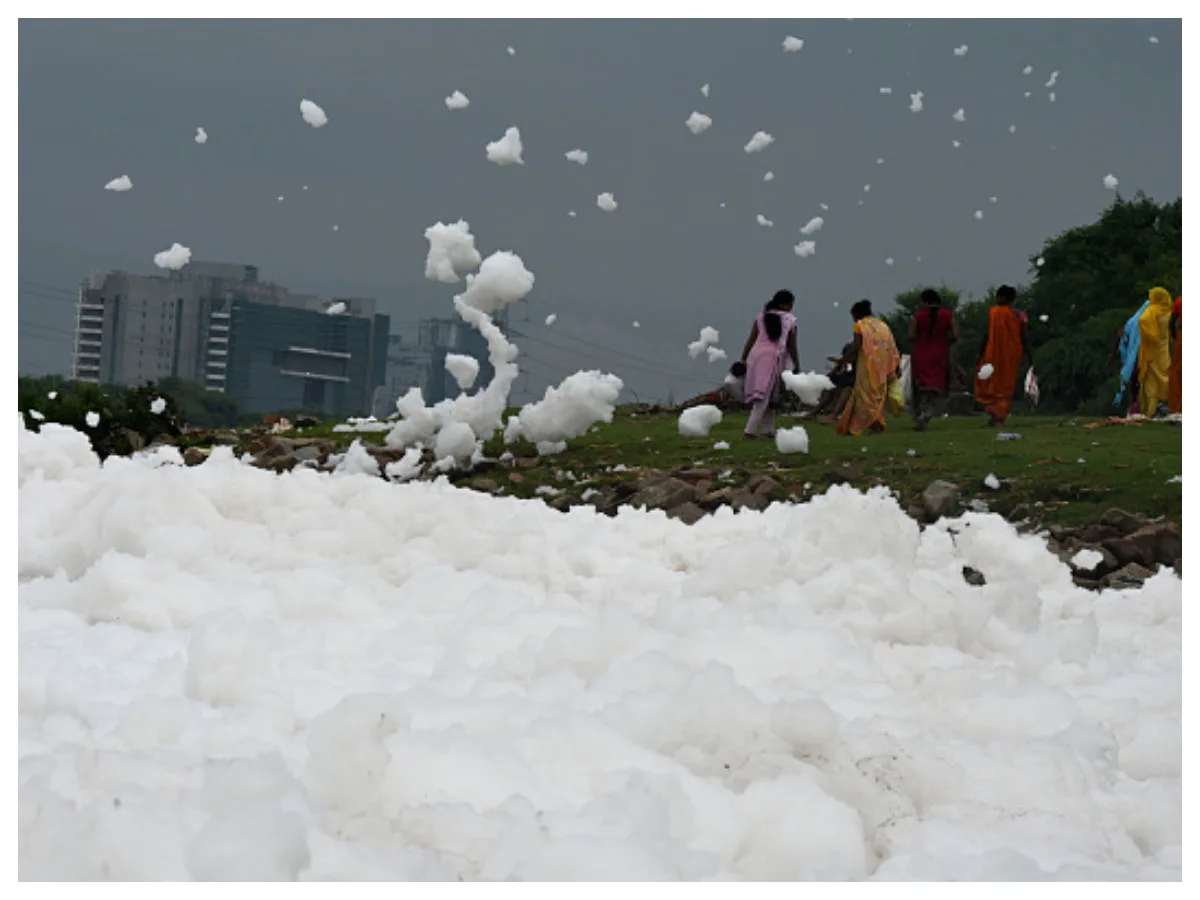
New Delhi, Oct 18 : A thick layer of toxic froth covered parts of the Yamuna River in Delhi on Friday, raising concerns about health hazards, particularly with the festive season approaching. Videos circulating on social media showed large sections of the river blanketed in white foam, resembling clouds over the water, which gradually dissipated later in the day.
The Aam Aadmi Party (AAP)-led Delhi government responded, stating that officials are actively addressing the situation. “Defoamers are being sprinkled to tackle the issue, and steps are being taken to manage and resolve it,” the party said in a statement.
Experts are attributing the frothing to high pollution levels in the river, warning that this poses a serious health risk to residents. Bhim Singh Rawat, associate coordinator of the South Asia Network on Dams, Rivers and People (SANDRP), noted that the upper segment of the Yamuna usually experiences flood spells during the southwest monsoon, but this year, such events were notably absent. “The absence of these flood spells, which usually help in cleansing the river, has resulted in visible pollution and froth,” he said.
Rawat added that the pollution levels in the Yamuna are alarming, not only affecting human health but also wildlife. The froth seen this year is composed of high levels of ammonia and phosphates, known to cause respiratory and skin problems. Environmental experts pointed out that while frothing is common when fats from decaying plants and pollutants mix with the water, its appearance during the monsoon season is unusual, likely due to the lack of typical flood events that usually flush away pollutants.
With major festivals like Chhath Puja around the corner, experts have called on the government to address the pollution in the Yamuna more urgently. The AAP government said engineers have been deployed to oversee operations at the Okhla and Agra Canal barrages, ensuring that the barrage gates’ timings are properly monitored. Photos of the Yamuna downstream at Kalindi Kunj are being uploaded every two hours to ensure continuous observation.
As the river remains a critical part of religious rituals during festivals, the health risks posed by the frothing and the pollution in the water require immediate and sustained attention.

