

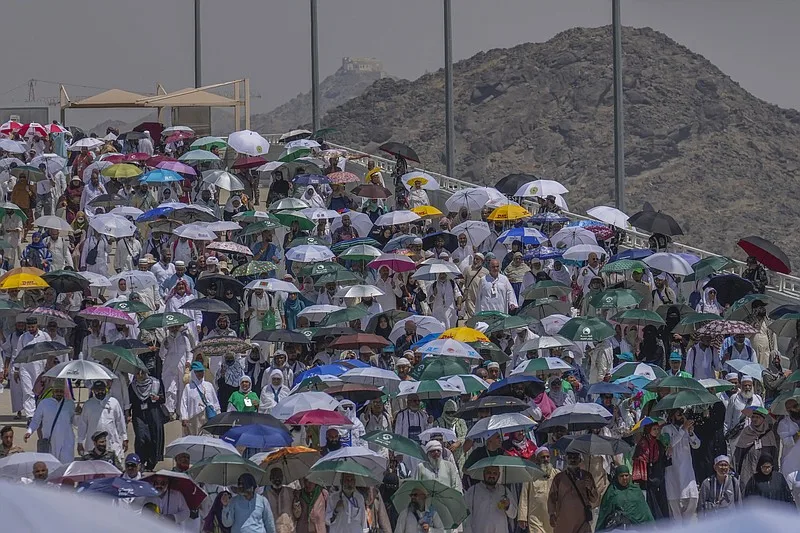
Mina (Saudi Arabia), June 19 – Muslim pilgrims concluded the Hajj amidst scorching summer temperatures on Tuesday, completing the third day of the symbolic stoning of the devil and the final circumambulation around the Kaaba, Islam’s most sacred site in Mecca.
The three-day stoning ritual in Mina, located in the desert outside Mecca, marks the culmination of the pilgrimage, symbolizing the casting away of evil and sin. It commenced a day after pilgrims gathered on Saturday at Mount Arafat, a sacred hill.
The concluding days of the annual Hajj coincide with Muslims worldwide celebrating Eid al-Adha, where the faithful commemorate Prophet Ibrahim’s test of faith by sacrificing animals and distributing the meat to the needy, affirming their financial capacity.
The Hajj, one of Islam’s five pillars, primarily honors the narratives of Prophet Ibrahim, his son Prophet Ismail, Ismail’s mother Hajar, and Prophet Muhammad, as recounted in the Quran, Islam’s holy scripture. According to Islamic tradition, God spared Ismail and stayed Ibrahim’s hand.
“I am reassured. I feel comfortable,” remarked Mejahed al-Mehrabi, a Yemeni pilgrim, to The Associated Press after completing the third day of the stoning ritual. “Anyone who can visit the Grand Mosque (in Mecca) should do so.”
Nigerian pilgrim Amir Omar expressed immense satisfaction after finishing the symbolic stoning, stating, “I am feeling very great that I perform one pillar of my religion. I am feeling very grateful.”
Temperatures soared on Tuesday, reaching up to 47 degrees Celsius (117 degrees Fahrenheit) in Mecca and surrounding sacred sites, according to the Saudi National Center for Metrology. The extreme heat led to numerous pilgrims, especially elderly ones, collapsing and requiring medical attention. Reports indicated deaths due to sunstroke, including at least 41 Jordanians and 35 Tunisians, with additional fatalities among Egyptian pilgrims reported in local media.
Following the third symbolic stoning, pilgrims proceeded to Mecca for “tawaf,” circumambulating the Kaaba in the Grand Mosque counterclockwise seven times. Known as the Farewell Tawaf, this marks the conclusion of Hajj as pilgrims prepare to depart the holy city.
Upon completion of Hajj, men traditionally shave their heads while women snip a lock of hair as a sign of renewal. Many pilgrims then journey to Medina, approximately 340 kilometers (210 miles) away, to visit the Sacred Chamber housing the tomb of Prophet Muhammad, one of Islam’s three holiest sites alongside the Grand Mosque in Mecca and Al Aqsa Mosque in Jerusalem.
All Muslims who are physically and financially capable are required to perform Hajj at least once in their lives. In 2024, more than 1.83 million Muslims, including 1.6 million pilgrims from 22 countries and 222,000 Saudi citizens and residents, participated in the Hajj, according to Saudi Hajj authorities.
The 2024 pilgrimage unfolded against the backdrop of the Israel-Hamas conflict, prompting pilgrims like al-Mehrabi to pray fervently, first for Gaza and then for Yemen, beset by its own prolonged conflict.

