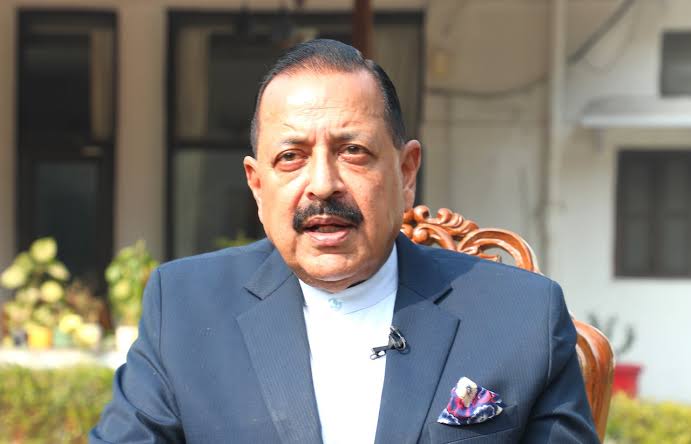
Union Minister of State Dr. Jitendra Singh announced that Jammu and Kashmir (J&K) will be a key player in India’s journey toward ‘Destination 2047.’ Speaking at the launch of the ATL Sarthi and Frontier Region Programme of Atal Innovation Mission (AIM) at the University of Kashmir on October 18, 2023, he emphasized the region’s vast potential and emerging resources.
This event marks a significant step as India aims to elevate its economy from the current fourth to the third position globally. Dr. Singh stated that J&K’s contribution will be instrumental due to its unexplored resources and geographic advantages. He mentioned that since Prime Minister Narendra Modi’s government took charge in 2014, regions like J&K have started to receive greater attention, especially in sectors like tourism, floriculture, and innovation.
Dr. Jitendra Singh expressed optimism about J&K becoming a vital contributor to India’s growth story, particularly in innovation over the next two decades. During the event, he highlighted the importance of the launch of ATL Sarthi, which signifies a commitment to integrating J&K into India’s broader economic framework.
The Minister elaborated on the plans for J&K, announcing the establishment of 500 new Atal Tinkering Labs (ATLs) across the Union Territory, making up the largest share of 2,500 labs sanctioned for frontier regions with a total investment of ₹100 crores. These labs will provide school students with exposure to advanced tools in areas such as robotics, 3D printing, and artificial intelligence, aiming to foster early innovation.
Dr. Singh emphasized that India’s economic momentum has been driven by technology-based sectors, including space and biotechnology, which will continue to contribute significantly to value addition in the coming years. For instance, he noted that India’s space economy has skyrocketed from negligible figures to an impressive $8 billion, and predictions suggest it could reach between $40-45 billion over the next decade. Currently, over 400 startups are thriving in this sector.
Highlighting the role of public-private partnerships, the Minister said, “Sustaining growth requires the involvement of private players. Initiatives like InSpace in space research and BIRAC in biotechnology demonstrate how structured collaboration can yield positive results.”
Dr. Singh also pointed out J&K’s burgeoning involvement in initiatives like the Aroma Mission, which has spawned around 3,500 lavender startups, offering significant employment opportunities and attracting young entrepreneurs back from corporate careers. This shift is reshaping local economies and providing alternatives to traditional government jobs.
In discussing the innovation landscape, Dr. Singh noted that 50 students from J&K ranked among the top 1,000 participants in the School Innovation Marathon, reflecting a growing pool of talent in the region. He encouraged parents and students to embrace entrepreneurship, dispelling the myth that successful startups can only emerge from metropolitan areas; he stated that nearly half of India’s startups originate from Tier 2 and Tier 3 cities.
He concluded with a vision for the future, stating, “As we look towards India@2047, the students in these tinkering labs will be in their prime working years. They will be the torchbearers of a developed India, positioning J&K at the forefront of the national journey.”
The event also saw participation from key figures including Lieutenant Governor Manoj Sinha, Chief Minister Omar Abdullah, and other prominent education officials, emphasizing the collaborative effort to foster innovation in J&K.